Categories
Business Journalism Personal Publishing

On Wonkette and the rest of Gawker media…

So Nick Denton’s Gawker media has released its latest offspring into the world, and so far (particularly after the enormous success of fleshbot) it doesn’t look like much of a contender. Wonkette has been described as Gawker for DC (by Glenn Reynolds, no less), but so far she’s evidenced little of the ready wit and weblog-savvy of that rather superior organ’s array of editorial talent. Wonkette’s Ana Marie Cox writes like a weblog-naif – she’s overly fascinated by the speed of the publishing and the novelty of not having an editor (and too involved in the immediacy of her voice over the quality of the material she’s referencing) to make the site a really compelling read. I’ve no doubt all this will change of course – the novelty of writing for a weblog can fade over time. But in the meantime: For God’s sake, calm down before you do yourself a mischief!

Gawker media is in my mind a lot at the moment, for a whole range of reasons. First and foremost, I’ve got a paper that I should be writing for an upcoming conference on e-publishing at the London Book Fair. Specifically, I’ve been thinking about writing about Nick’s model of nanopublishing and the way in which these small ventures can create grass-roots, highly-targetted brands – brands which could be floated off into larger ventures, used as branded chunks (syndicated columns perhaps) within larger publications or simply used to colonise the brain-space of people who feel disenfranchised by the large and inhuman face of large-scale media. In particular I want to talk about that alternative model of online publishing – in which large teams of individuals are brought in to run online presences / support sites for commercial magazines or other large media presences at tremendous expense – expense which evidently might simply not be necessary.

But of course the problem with Nick’s nano-publishing model (and he problem with my proposed paean to it) is that it doesn’t really seem to make anyone that much money and that perhaps as a direct consequence, no one else seems to want to do it. I mean, short of business ignorance (which we shouldn’t dismiss as a likely proposition) what other reasons could there be for the lack of competition to Gawker Media? I mean, it’s established a model that’s far from hard to replicate if you have a little money lying around and a certain amount of savvy. And it’s even generated a core concept (local savvy correspondents filtering and condensing the regional media down to thick paste that is as much about myth-making the place as it is purporting to give back-stage access into what’s really going on) that’s eminently replicable to every decent-sized on the planet. I mean, we can all imagine a London equivalent, a Tokyo equivalent or a Sydney equivalent – we can all see the possibilities in a version of this model for Rome, Paris, Edinburgh and Barcelona. Which leads me to wonder – where are they?

I have my theories, of course. Do you have any?

Categories
Random

On parody search engines…

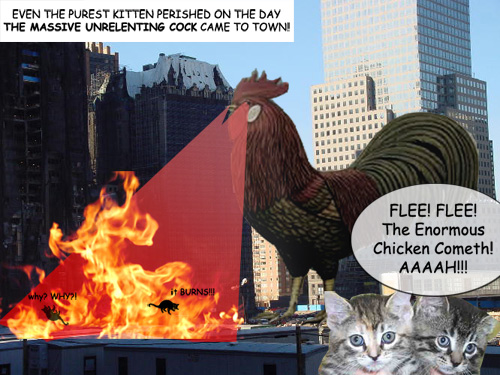
Compare and contrast: (1) Me making a funny at Google’s expense a couple of years ago: Google Pornfinder and (2) The site recently launched to help the world find porn (as reported in this Boing Boing entry): Booble. What next? Should I expect someone to genetically engineer Fifty-foot cat-killing laser-eyed chickens?

Categories
Random

Where all the best people work…

From an entertaining post on an interesting Metafilter thread:

The BBC is best when it’s at its least domestic and condescending: its radio and web output is better than its TV news (BBC World excepted) and the World Service is best of all. There’s a reason why people who work at Bush House feel superior: they are superior.

For the record, I work at Broadcasting House, which is kind of like the BBC’s version of the Lost City of Atlantis.

Categories
Random

A short video of snow in Norfolk…

I’ve been meaning to get this up online for the last couple of weeks but keep getting distracted. While I was up in Norfolk for Christmas it started snowing insanely hard and I almost accidentally got about fifteen seconds of it on video. So for your total lack of interest, here’s the view from my bedroom window as the snow comes down (.avi 3.9Mb). I find it strangely soothing.

Categories
Random

On the Bloggies…

So the nominations for the the Bloggies are now up and I would encourage everyone to go and explore some of the weblogs that have been short-listed. For good or ill, quite a lot of the old crew have ended up on the nominations again this year, with plasticbag.org surprising me a bit by being up for four categories. Evidently there’s still a bit of life in the old blog yet. If you want to vote for it, then it’s represented in the Best British or Irish and Best GLBT weblog categories and to my delight Weblogs and the Mass Amateurisation of Nearly Everything has a shot in the Best Article or Essay about Weblogs category (weirdly opposite Rebecca Blood’s classic Weblogs, A History and Perspective which actually already won the award a couple of years ago).

Now despite my reputation for being a complete kill-joy when it comes to weblog competitions, I actually have a bit of a soft-spot for the Bloggies. I’m not going to go into too much detail about why I like them (big argument here) but – in a nutshell – it’s because they’re part of the weblogging ecosystem and treat it with respect, they don’t take themselves too seriously and most importantly, because they are open to everyone to participate in, vote in and nominate for. There’s something nice – honourable, even – about nominating someone else for an award that they’d never put themselves in for but eminently deserve. And it’s fun being able (at this stage) point to some of the new sites that I’ve discovered as a result of the nominations process and which I plan to read more often. So – from the nominations list – here are some sites (old and new) that have given me particular pleasure today:

PS. When does the gay mudslinging start? Because that’s the best bit.

Categories
Gay Politics Science

On adaptive success and theories of homosexuality…

The latest issue of New Scientist contains an article – “The In Crowd” – that is both profoundly interesting and yet totally unavailable online. Gradually, I’m delighted to say, this situation is becoming more rare and more of a surprise each time it occurs.

Anyway, the article – written by Joan Roughgarden – contends that: “Same-sex relationships are not a biological dead end. They are a glue that helps hold many animal societies together, and a fatal flaw in one of Darwin’s central ideas.” Here are a few choice chunks of the article that I think encompass most of the article:

Author Bruce Bahemihl, in his book Biological Exuberance: Animal Homosexuality and natural diversity, has catalogued over 200 vertebrate species in which same-sex genital contact regularly occurs. In some species, homosexuality is not very common – around 1 to 10 per cent of all mating. In others, such a bonobos, homosexual mating occurs as often as heterosexual mating. In some species only males participate, in others only females, in still others both sexes. Sometimes homosexuality is associated with pair bonds that last for years, and in others with short-term courtships. This broad occurrence of homosexuality among vertebrates raises the possibility that if it has a genetic basis at all, it has some broad adaptive significance, and is not an aberrant condition just a few species happen to be stuck with.

In humans, moreover, homosexuality is much too common for it to be considered a genetic aberration. Real genetic diseases are really rare, and their frequency inevitably depends on their severity. A disease that is uniformly lethal must arise anew each generation, so its frequency is equal to the mutation rate, say one in 1 million. A disease that causes only a 10 per cent drop in offspring production (fitness) is 10 times more common than a lethal disease – about one in 100,000. Similarly, a mere 1 per cent drop in fitness leads to a frequency of one in 10,000. If homosexuality has a frequency of 1 in 10, the fitness loss could be no more than 0.001 per cent, which is completely undetectable. A “common genetic disease” is a contradiction in terms, and homosexuality is three to four orders of magnitude more common than true genetic diseases such as Huntington’s disease.

All this seems eminently reasonable to me so far. I mean, clearly I’m no expert in evolutionary biology, so my opinion really counts for less than nothing. But on the other hand, as an engaged reader and a gay man I’ve at least got a legitimate interest in the subject and have found myself relatively compelled by the idea that if homosexual behaviour has a genetic component, that at least some of the genes that result in it must have some adaptive utility. The most commonly cited example is that perhaps a gene might exist that in an heterosexual adult provided a significant reproductive advantage of some kind – but which had the side effect of producing a certain proportion of children who were gay. As long as the cumulative effect was to mean that – on average – the familial line would produce more sexually productive offspring than a line which did not have the gene, then it would be clear that the genes that result in gay people had a reproductive advantage.

Of course while that theory has a certain compelling logic to it, it doesn’t (perhaps shouldn’t) have anything to say about what it means to be gay in this context. In other words – it makes no statement that homosexual behaviour is itself somehow useful or positive with regard to human behaviour, survival or evolution. Homosexual behaviour then, is not considered adaptively useful.

Now back to Joan Roughgarden’s piece (carrying on directly from what was written above):

Indeed, I challenge the presumption that homosexuality leads to any reduction in fitness whatever. Throughout history and across cultures, homoerotic attraction has not precluded heteroerotic attraction. And there is little evidence that people who feel homoerotic attraction have, as a group, any less Darwinian fitness than those who don’t. After all, many exclusively heterosexual people do not have offspring either. Even if those with homoerotic attraction did have marginally fewed children, they might make up for it by a better chance of survival – during wars, for example, when homoerotic bonds might lead soldiers to protect one another more vigorously.

So what then, is the adaptive significance of homosexuality? Homosexuality has many uses, much as the ability to speak does. Homosexual contact is a way to communicate pleasure. And I suggest that homosexuality is a social inclusionary trait – that is, it provides animals, including perhaps humans at times, with admission to social groups. It evolves, I suggest, whenever same-sex cooperation helps achieve an evolutionary successful life: to survive, find mates and protect one’s young from harm. This plays out in different ways in different sexes and species. Sometimes, as with bonobos, same-sex cooperation provides group security and access to food that females need to successfully rear their young. For others, such as male Savanna baboons and probably some whales, it provides the allies they need to survive conflicts so that they may later mate. But the unifying principle is the same – homosexuality cements relationships that are crucial for a successful life.

At which point, I’m afraid, I think my scepticism comes to the fore. It seems to me that any theory of homosexuality that operates in direct opposition to people’s experience of contemporary human sexuality seems to be at least flawed. While bonobo homosexuality might be seen to be useful in the creation of social inclusion, often exactly the opposite occurs in human society. Eve Kosofsky Sedgwick’s classic book Between Men specifically talks about the continual need to disavow sexual components to male homosocial relationships (ie. male-on-male friendship / bonding relationships). We’re all familiar with this kind of experience – that the most common and most potent sources of anti-gay tirades are tightly-bound social groups of men. At the very least more is going on in those situations than simple homoeroticism bringing those men together to express solidarity and closeness. Even at our most open-minded, surely we have to state that in those circumstances, the fact that any vestigial or situational erotics have to be so vigorously denied makes it clear that there’s a distinction to be drawn between homoerotic behaviour, homosexual behaviour and homosexual identities that is much more complex than anything that Roughgarden supplies us with.

I will of course give her the benefit of the doubt in this case – the article is evidently a truncation of a body of work that no doubt includes a massive set of sample data from which to draw conclusions as well as the applied expertise of a lifetime of training. If I get the chance to read any more of her work, I will make sure that I do so vigorously. But in the meantime, I’m afraid I must remain interested but unconvinced.

Categories
Random

If God is a dancefloor…

According to Pink in her song God is a DJ: “If God is a DJ, life is a dance floor, love is the rhythm, you are the music”. Which is troubling for me, really, because if life is the dance floor and love is the rhythm and we are the music, then who the hell is dancing? Is no one dancing at all? Is that the point? Is the point that life is empty and pointless – a farce of creation without function or utility? Or is it still worse than that? Perhaps it’s demons and monsters that dance to us, stomping all over life, letting their evil hearts race to the rhythms of our loves and getting sweaty and emotional and copping off and falling over to the music that is us. We’re nothing but the noise that supernatural clubbers take drugs to! That’s your message, Pink!? Well, thanks for nothing…

Categories
Humour Illustration

An illustration of spam…

Yesterday I received a piece of spam with a title so interesting and dramatic that I felt I had to illustrate it with Photoshop. Presenting: “Unrelenting Massive C*cks Destroy Innocent Pussies!”

Addendum: Of course now my site will be blocked by my brother’s school for another six months. Sigh.

Categories
Conference Notes

Are there gay people at ETCON?

So first things first, after considerable soul-searching and fiddling around with finances I’ve found a way to go to Emerging Tech this year to cheer on my BBC other half’s paper: Glancing: I’m OK, You’re OK. Last year the conference completely blew me away and acted as fuel for one of the most creative periods in my working life to date (although unfortunately not all of that creativity ended up being expressed coherently or in the public domain). Hopefully this year’s conference will be just as good…

One thing that I found last year that I wasn’t expecting was how many like-minded people I met – or if not like-minded, how many people there I felt comfortable around. I felt that I understood their world-view even if I didn’t understand anything else that came out of their mouths. That got me thinking about what particular elements or lifestyle attributes we had in common – and that in turn made me thing about all the things things that we might not have in common – and that in turn led me to think about whether or not these events are bastions of heterosexual maleness and whether many of the people present might be gay. So as a result of that, I’m putting a kind-of poll into the field to see if there are going to be any gay people at ETCon this year that would like to get together at some point for a drink and a chat.

Categories
Design

A New Font for a New Year…

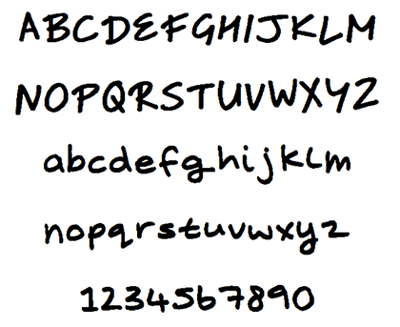
After a highly entertaining half an hour with my work colleagues and fontifier, I now have a full operational font of my handwriting. It looks a little childish and insane, like the kind of thing you’d write threatening letters with, but it looks great as the default font on OSX’s Post-It equivalents. Should you be foolish enough to want my scribblings on your computer, feel free to download it from here: Coates.ttf.