Categories
Random

A statistical head-rush…

Wow. That was a bit of a head-rush. The busiest day of traffic ever on both plasticbag.org and Barbelith. Between the two of them a meaty 25,000 page impressions logged up in 24 hours. If I include Everything in Moderation as well, it goes up to 25,027. Cor. In unrelated news I shaved my beard off this morning, and I’m just about to go in and have all my hair hacked off. I look really different without a beard. I don’t look as tired, I don’t look as ‘manly’ and I think I look a hell of a lot bitchier. And a bit fat.

Categories
Random

I'd like to thank the Academy…

I’d like to thank everyone who voted for plasticbag.org at the Bloggies, where I’ve accidentally picked up Best British or Irish weblog. I’m particularly surprised given given the quality of the other candidates: Going Underground’s Blog, A Teenager Blogs, Greenfairy.com and The Big Smoker.

More importantly, I’m genuinely delighted to report that I somehow won the Best Essay Bloggie as well for (Weblogs and) The Mass Amateurisation of (Nearly) Everything. If anything I think that one is the more important to me because I spent a long-time writing that piece and thinking around it and I think it’s one of the best things I’ve written. I’d love it if more people read it and responded. So thanks again to everyone involved!

The big winner of the night was Boing Boing, who took home the Best American Weblog, Best Group Weblog and Weblog of the Year. I’m kind of surprised – given Cory’s alleged nationality – that they didn’t win Best Canadian Weblog too! Lifetime achievement rightly went to Heather Champ, whose creative output online has been astonishing for as long as I can remember. Well done!

Categories
Humour Net Culture

From pirate dwarves to ninja elves…

I have always considered the profound distinction between ninjas and pirates to be an absolute one. One was either ninja or pirate – there were no inbetweens. One personality type was skilled and proficient, elegant and silent, contained and constrained, honourable and spiritual. The other type loud and flamboyant, gregarious and unrestrained, life-loving and vigorous, passionate and strong. I thought all people must pledge their allegiance, or be categorised accordingly.

The other day at work, another binary pair was presented to me – a co-worker who doesn’t declare people pirate or ninja, but instead elf or dwarf. For him, humanity falls into doers and thinkers – elves being elegant and timeless, conceptual and refined, abstract and beautiful while dwarves are practical and structural, hard-working and no-nonsense, down-to-earth smiths and makers. It’s a view of the world that’s expounded a bit in Cryptonomicon.

The wonderful thing about both of these classifications systems is how unladen they are with value-judgements. It is possible to consider an elven person to be intellectual and high-concept, or pretentious and useless. It’s possible to view a pirate as boorish and crass or as vivacious and life-loving. It is not better to be ninja or pirate – the world needs both. And the creativity generated by the collision of elf and dwarf is far greater than could be achieved by elf or dwarven kind alone. Not only are there no categories that come prejudged inferior or superior, but also people have no problem self-categorising themselves – there’s no shame to be felt in any of their self-classifications.

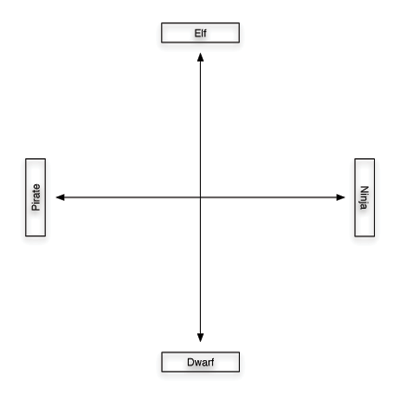
Both systems have these qualities – but still we’re left with a conundrum. Although so similar – the systems are different. So how to make them work together? Confronted with a collision between two such radically different ways of conceptualising the world, obviously our minds started working overtime. Could we find a way to map the two categorisation schemes onto one another? Could we declare all ninja’s inherently elven? Or all dwarves intrinsically piratic? The more we considered the issue, the harder it seemed to achieve some kind of detente. And then it came to us – a new view of the world, transcendent and illuminatory – a way not only to make the two systems work together but to make each infinitely more illustrative in the process! At that moment the Ninja/Pirate/Elf/Dwarf theory of human classification came into being – and with it the crowning achievement of all managerial arts, the following graph:

As you can see – the ninja/pirate polarity has become a spectrum. The elf/dwarf polarity has followed suit – it is now possible to exist directly between the extremes. But this spectrum is at right angles to the first, generating a person-space with an infinity of different potential placements. People now can be hardcore ninja dwarves, or err towards the piratic side of elfdom. Within this graph all humanity exists in all its polyphonic splendour.

Think of some of the humble bloggers on my blogroll. Where would they live? Ben Hammersley has something of the pirate about him. This is not a restrained man of quiet honour, but a proud warrior of the sea – hair flowing in the breeze. But his skills are more evenly tempered between the conceptual and the practical – as best evidenced by his work on the schema for various syndication formats. His position is clear. Matt Jones is far closer to elf than dwarf, but as swashbuckling as a man can come. Not so Dan Hill, elven once more but evidencing the self-mastery and discipline of a true ninja.

It takes little effort to spot the ultimate ninja’s quiet responsibility and attention to detail in the work of Jason Kottke and Matt Webb and both straddle the technical divide between thinkers and doers. Mark Pilgrim on the other hand has achieved a balance between ninja and pirate, while plunging into the vigorous constructive heart of dwarvish ways. And so it continues – until I can map almost my entire blogroll accordingly:

And it doesn’t end there! You could plot people’s operating systems against it – Dwarves being more Linux-focused, elves more Apple-oriented. Pure graphic designers have a tendency towards the top right, interaction designers are spread across the top. You can also deduce a lot about the people I tend to associate with online – there’s an enormous clump of people on the pirate / ninja axis who aren’t heavily elf or dwarf. In this context, this suggests a group of old-school web people who have tended toward balanced expertises across a range of disciplines. It’s interesting how those people with more clearly defined job roles tend to move towards the corners too.

Now it’s over to you – take this epic revelation and place yourself within it. If you are a life-loving pirate with dwarvish leanings, perhaps you’d like to assemble a quiz to locate people against the axes like on that rather less important and trivial Political Compass site. I would love to help, but I’m simply not capable. What can I say, I’m an elvish pirate – I have better things to do with my time…

Categories
Random

On faltering footsteps with PHP…

Wow. What a frustrating few days. I’ve been working on a project in the background (not too exciting – don’t get your hopes up) that vaguely involves PHP and I know nothing about PHP. I’m a programming weenie. You know – I do words and layouts and stuff. And occasionally ideas. So I’ve been throwing myself at it with profound diligence, concentrating like some kind of concentrating ninja on the task in hand. And after two days of as-much-concentration-as-I-can-manage-nowadays I find myself with something about a third done. And kind of done a little bit wrong as well. Thanks to Matt Biddulph for the PHP parsing guidance…

Categories
Random

Why does my Apple laptop beep at me?

Ok. It’s driving me so mad that I’m forced in the end to appeal to the general public. My laptop appears to be beeping at me. Every so often – no more than once a day, for some reason which appears to be hardware-related (I’m not even sure it’s coming through the Powerbook’s speakers) it beeps at me. Two sets of two beeps in the form: beep-beep beep-beep, always the same tones. There doesn’t appear to be any particular rationale for when it beeps, except that it could be related to whether it’s on my lap or not (I’ve never heard it happen at work) and/or whether it’s being charged (I don’t think I’ve ever heard it beep when it wasn’t being charged). It’s really worrying me as I don’t know what’s causing it to protest. It could even be a bloody alarm clock for all I know (except that it doesn’t seem to beep at any particular time of day). It’s driving me insane – does anyone know what the hell is going on?

Categories
Personal Publishing

Why do bloggers kill kittens?

A couple of days ago I posted a rather aggressive link through to 2lmc the other day complaining about their post Most read blogs least original which cited an article from Wired News called Warning: Blogs Can Be Infectious (itself quoting HP’s Blog Epidemic Analyzer – I could go on). My link read: “I’ve noticed that people are much less intellectually rigorous when they read articles that they agree with. Case in point: Most read blogs least original, says blech 2lmc”.

Since posting that, Paul and I have been having an extremely civilised discussion behind the scenes about some of the issues surrounding that article and our individual responses to it. I won’t post his e-mail to me for obvious reasons, but I wrote such a lot in response (and I think there’s enough stuff in it worthy or argument if not agreement) that I thought I’d post it up here to see how far out on a limb I was. I’ve added in some hyperlinks, edited a little for clarity and extended a couple of sentences here and there to make it readable in a larger context. Comments welcome as ever.

Dear Paul,

Firstly I should apologise for the link-text – I was halfway through writing a longer post addressing your post when I got distracted by work. When I came back to it, with the initial enthusiasm gone, I couldn’t motivate myself to finish it. I had another seventy tabs open in Safari that were squealing for attention, so I thought I’d linklog my response instead. It came out a little more snipey than I’d intended, and for that I apologise.

You say in your response that with regards to my site, you enjoy some of my larger posts but find my linklog slow on the uptake. I can’t say that I’m surprised at the latter – my linklog is exceptionally slow on the uptake. It’s that slow because I stockpile things that I’d like to write about in greater detail and then – when I realise that I’m not going to have time – I end up posting them on the linklog. I have some links stashed away in a bookmarks folder called “Backlog” that are at least four or five months old that will probably end up on the linklog at some point once I’ve finally accepted they’re not going to have the fuller treatment they deserve.

First things first, let me admit that I’d like to be the first one to post all of those links (or at least up in the first few). Certainly as an aspiration, to be first in the flow of sexy fat links would be glorious. But I want to make it clear that even if I can’t get them out that quickly, I still see considerable value in getting them out way after the fact.

My reasons are manifold. Firstly, we get straightaway down to the distinction between weblog as written for an audience versus weblog as written for me. Now clearly it’s not just for me – I’ve have to change what I write on occasion because there are people out there reading (my mother, my brother, some potential employers) who I have to be aware of. I don’t write in the same way as I did when I started. Then I could bitch about people I didn’t like and talk about my life without feeling particularly exposed. I was talking to strangers with no impact on my life. Now I’m not. But while my weblog isn’t any longer ‘just’ for me, it’s definitely not just for an audience either. I use my weblog as a searchable archive – a repository of things that I’ve seen and read and that I thought were interesting, I use it to record thoughts that I think might be useful and that otherwise I’ll forget. I use it as a notepad, as a chronicle, as a place to store my photographs. There’s an interplay between trying to be fresh for other people and not really giving a damn about other people. I think this comes back to my understanding of a weblog as a representation of a person online – an avatar with a voice. A self-representation is about being both true to yourself and knowing how to self-edit in different circumstances. That’s what a weblog is to me.

Secondly I operate with an understanding of my links as a kind of microcontent vote (also here and here). It’s the idea that by linking to something I say, “Yes – this deserves some of your attention – this is a good thing”, and that the more sites that do that the more attention something will get. So by voting for something I like (alongside dozens of other people) that thing becomes incrementally more visible in Google, Blogdex, Technorati, daypop. Also, in turn, those people who don’t read a lot of other weblogs but read mine also get exposed to it. And those other people who have weblogs may choose to pick up that link and post it to, thus exposing more people to it in turn – putting their votes behind it too. Massive link propogation (as far as I’m concerned) is not a bad thing at all – it’s how the web determines what’s worth reading.

Now the other question posed in your piece is why people would come to a site like plasticbag.org or kottke.org or BoingBoing when most of the links on those sites come from other places. Well firstly, I’d like to state up front that I can’t comment on where Jason or the BoingBoing crew get their links from. In my case, yes, it’s certainly true that the links I publish have often been posted somewhere else first (either because I’m slow to publish or because I found those links elsewhere), but I want to make it clear that even in these circumstances there’s you can characterise that behaviour in very different ways: is it mining for links as content on the one hand or is it collating the good things you’ve read on the other? I’d say it was more of the latter.

With regards to why people read our sites, I imagine to an extent it’s just because of the time we’ve been around and carrying readers with us since we started. (At this stage I should probably state out loud that I’m nowhere near in the same league as Jason and BoingBoing by the way – they’re a full order of magnitude ‘larger’ than plasticbag.org). I would also imagine that they read us because on occasion our commentary or original work is valuable enough that people are prepared to read all the other guff we write or link to as well.

But to be honest, I think the question is a bit of a red herring. First and foremost weblogs started off as carefully-selected links (maybe with commentary) to a whole range of other sites. There is an element to weblogs which is nothing but aggregatory and filtery in nature. Pretty much all weblogs (including 2lmc) find their links either from mainstream news sources, or their daily searches, or from some mailing list somewhere or from another weblog that they read regularly. That’s absolutely normal behaviour. I suspect, then, that the main reason that people read our sites is because we’re relatively consistent in the selection of links that the people who read our sites find interesting, wherever those links originally emerged from (and – in fact – however old they might be). To an extent (and this may seem tautologous), popularity has got to be to some degree correlating with how interested people are in what you produce.

Which brings me to the question of originality. My weblog grew up online with ‘via’ links on weblogs. That was the way we did things. In fact I vaguely remember us starting to use them because at the time the commodity of a good link seemed the most valuable that any weblog had. As time has passed, I think the culture has changed a bit – and there are all kinds of reasons for that. Personally, I no longer often know where I found a link. I’ll open up dozens of tabs from a cursory reading of my NetNewsWire subscriptions and then close down the windows that aren’t particularly interesting to me. Then I’ll store the pages that are interesting until such a point that I’m able to give them the attention I think they deserve. In that process I often simply lose track of where I found them. Moreover, the most practical structure of a linklog in my opinion is – well – a link. Nothing more. That seems to be the simplest and clearest way of referencing something, and as a result there’s not even always a space for adding in a via link or a reference to the originating source.

In fact as time has gone by, I’ve increasingly come to the opinion that links are everywhere and that referencing where you found the link alone is no longer quite as necessary or as useful as it once was. When I know the source and when I have the ability to link to it, I’ll still make that reference, but nowadays I’m more interested in useful links to useful material rather than just a reference to the person who told me about it. I look for commentary – something I can actually cite that had a useful contribution to make on those links concerned (however short a line that might be). A lot of other people may disagree with this as a strategy – and god knows it’s not something that I’m entirely unconflicted about myself. But I think if you consider that (as is most often the case) the originating sites are linked to anyway – “blog-rolled” in my sidebar – then I’m not sure it’s as big as anxiety-producer as it might be.

[Quick sideline: Andrew Orlowski gives webloggers hell for what he considers ‘circle-jerk’ or ‘meaningless self-promoting cliquey’ inter-linking or whatever, while other people who are not fans of weblogs and weblog-culture take us to task for not doing those things because then it’s an elitist culture within webloggery.]

With regard to the article at Wired and my slightly barbed comment that “I’ve noticed that people are much less intellectually rigorous when they read articles that they agree with”, what I think is interesting about the Wired article (and quite a lot of the stuff that’s written on the HP site) is that it’s far from immediately obvious how many ‘stolen’ links exist, how accurate their linguistic analysis is (versus what the proportion of links use headlines or site-names and reference material that comes into the public arena at specific times, like – for example – a news story), or whether this kind of behaviour is limited to specific groups or cultures online or is rife without weblogs as a whole. Nor is it clear whether or not the originating sites are linked elsewhere on the weblogger’s page. This is not to say that I dispute the results, but that I wait to be convinced that these questions have answers that could support the kind of headline, “Most read blogs least original”, which really does appear to be almost Daily Mail-like in its bluntness and lack of any qualification. I have a feeling that the originating study will eventually demonstrate a rather more nuanced and qualified version of the picture – one with fewer value judgments imposed up on it. Because at the moment (Why do bloggers kill kittens), I suspect that they’ve been taken rather out of context…

Yours, Tom Coates
Addendum: Danah Boyd on Blog Attribution

Categories
Random

Some pictures from the periphery of ETCon…

Very late – here are a selection of pictures from the periphery of ETCon, pictures about arriving, seeing things unfold, being repacked and then finally departing. There are no pictures of the events themselves. They are in roughly chronological order:

Categories
Business

A critical mass of photograph swappers…

Everyone at ETCon had a Mac. Or at least pretty much everyone at ETCon had a Mac. And pretty much everyone was using the wifi network in the conference rooms. And – much like last time – loads of people were using Rendezvous to instant message each other in iChat as well as to collaborate on documents using SubEthaEdit. Also this year, everyone was taking photos with their digital cameras. But one thing surprised me – no one was sharing their albums via iPhoto. When I was in Los Angeles I’d bought iLife because I wanted to play with Garageband, but when I started playing with the various applications I quickly realised that iPhoto’s rendezvous sharing could be really really interesting and cool in an environment like ETCon. I kept thinking that there would be a whole culture in photo swapping and distributing snaps of speakers, nicking pictures of yourself from other people’s computers, finding ways to annotate your own personal experience of the conference with the distributed materials of a few hundred attendees. But there was no such culture there.

There may be any number of reasons why it didn’t take off in that environment, of course. One possibility is that people feel different about photos than they do with playlists and music – more proprietorial, more nervous of sharing. Or there might have just been problems with the network. But I can’t help feeling that it’s a direct consequence of Apple charging for this particular update – and that the critical mass of people that you’d need to make an active subculture around that stuff will now not be reached…

Categories
Random

A few customised toolbars…

So it occurs to me that UI design for applications isn’t easy at the best of times, and that one key area of UI design is the toolbar filled with icons that sits at the top of most applications. It also occurs to me that this space is one that can be edited and changed very easily by users – should they wish to do so. So then it occurs to me that perhaps there are usability lessons that can be learned from looking at the various custum configurations that people use on these applications and that applications should prompt users a couple of days after they have made significant UI changes to ask them if information about their new configuration could be sent back to the developers. It should then be relatively simple for the developers to keep a live track of which parts of the UI are most commonly adapted and to pull out statistically which configurations people find most useful (with the aspiration of being able to improve that structure over all subsequent versions of those applications). Until that day, here are a few of my customised toolbars:

Categories
Net Culture

On e-mail as a means of exchange…

I’ve had lots of conversations over the last few years about ways in which rising marginal cost could deal with grotesque abuses of online services. There are probably a dozen posts in this blog about that subject alone. Now the obvious example of a place where this kind of thing has been proposed has been e-mail – people have been talking about ways to get people to pay for e-mail “stamps” for years as a possible means of avoiding spam. Bill Gates has proposed another version of this scheme recently. His idea – ten-second pieces of computing time on the machine that sends the mail being given to some worthy cause (or to just solve some abstract puzzle). This would – apparently – be a gesture of good faith on the part of the sender that a spammer couldn’t possible match.

Now, my personal opinions about rising marginal costs have mainly been about how to deal with noise, distance and abuse in online communities. I once touched on the issue in connection with e-mail (only because e-mail was a suitable jumping off point) and ended up in an almighty fight with Cory Doctorow about it. Since that time, I’m still of the opinion that exponential graphs of effort or diminishing causality over space or increasing marginal costs (all features of the real-world) still have a role to play in how we solve gross abuses online. On the other hand I’ve seen no evidence that there’s a model that works particularly well with regards to e-mail. Certainly my experience of sending the fifty or sixty e-mails I send from my personal account a day (and the other fifty or sixty that I send at work) wouldn’t be radically improved by having my various computers churn through puzzles for twenty minutes a day.

With regards to the 1p-per-e-mail approach – I’m still of the opinion that a more successful version would be about the redistribution of money rather than the paying of it. What if the person you sent your e-mail to got the 1p you spent to send it to them and could then use that penny to send an e-mail in turn to whosoever they wanted. In those circumstances, most users (who get as much e-mail as they send) would be financially unaffected, the spammed would get a financial reward for all the rubbish they were forced to consume (there might even be a legitimate business model in collecting spam) and the spammers would end up paying much much more money than before.

This is not a new idea either, and nor do I think it’s a particularly practical one, but it does present some interesting opportunities to think about e-mail in very different (ludicrous?) ways – perhaps eventually even as a unit of currency that you write upon and distribute. After all noted currency is only an abstraction of value written on a rectangular piece of paper – why shouldn’t our future currency be based upon the transactions of plain text files…


