Hm. I didn’t realise that Google now had de facto ownership of the term “weblogger”. While trying to play with the new version of Google Groups this afternoon, I was confronted by this infuriating error message:
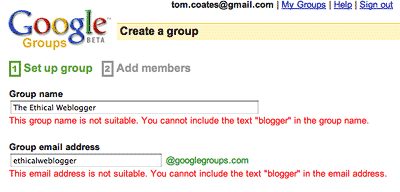
Hm. I didn’t realise that Google now had de facto ownership of the term “weblogger”. While trying to play with the new version of Google Groups this afternoon, I was confronted by this infuriating error message:
So years ago I did a journalism course and one of the early lessons in news reporting was just an exercise in trying to collectively define news. It was a pretty heavily-directed effort, and I think it had to be, because like many other things that we’re so used to in our everyday lives, it’s weirdly difficult to explain to people. Anyway, I’m cleaning up my flat and I find the definition that we came up with on a piece of notepaper, and I’m looking at it and I’m thinking: “This is actually quite interesting – and possibly quite useful for people who are setting up subject-based weblogs”. So here it is:
“New information of significance, interest or relevance which affects the lives or interests of a particular group of readers / listeners / viewers”
It’s not perfect by any means, but it gives you some places to start when you’re thinking about what to write. Know your audience, make sure you’re giving them information, and make sure that the information is actually going to matter to them. It’s not exactly revelatory information, but I figured someone out there might find it useful. And now I’ve transcribed it onto the net, it means that I can throw away the piece of paper!
My work colleague and R&D partner has a book out (with Tom Stafford)! It’s called Mind Hacks and it’s from O’Reilly in their Hacks series. So when you’ve finished fiddling with your Tivo or with Google’s API, now you can take that spare screwdriver and start mucking around with that most interesting pieces of squishyware in the world: your brain.

The book is about how your mind works and is put together, but it’s not one of those long boring books where you just have to nod sagely and stroke your beard. Instead, this is more of a things-to-make-and-do of cognitive neuroscience. It’s full of experiments, tricks and tips designed to expose how your vision, motor skills, attention, cognition and subliminally perceptual systems work. Moreover the hacks have entertaining and non-threatening names like Why people don’t work like elevator buttons (PDF) and Why can’t you tickle yourself? (PDF). The only annoying thing about the book is that it would be really ideal as a Christmas gift for Mr Webb, except he had to scupper my plans by being one of the people who wrote it. Bastard.
I think I was lucky enough to be around when the idea for the book first emerged a few years ago at a social software summit in Finland organised by Clay Shirky. At the time I think there was general agreement that it was a bloody good idea, but I don’t know how many of us actually expected to see it in print. Of course in order for it to make it to print, Mr Webb had to part-time abandon me in the bowels of the BBC to ponce off and have fun inside The British Library. He has been much missed (not that he’s coming back or anything), but I think it’s been worth it. There’s a weblog to accompany the book at mindhacks.com.
Anyway, it’s in my best interests to bask in the reflected glory of my chum, so I’m going to ask all of you to go and buy a copy immediately and recommend it to all of your friends – particularly those you think could do with some help keeping their brains ticking over. And I expect to see some pictures of you lazy bastards performing impromptu neurosurgery on each other by the end of the year!