I don’t really approve of sites that use Flash for primary navigation, but if you’re going to do it then make it as classy as this. And while you’re there you can read the article on Mobile Weblogging which isn’t total bunk.
Categories
I don’t really approve of sites that use Flash for primary navigation, but if you’re going to do it then make it as classy as this. And while you’re there you can read the article on Mobile Weblogging which isn’t total bunk.
Ok. I’ve had a response from Cory Doctorow about what I wrote earlier today and in the spirit of adequate redress (so it doesn’t look like I’m controlling the media where we’re debating), I’m just going to post it in its entirety so that people can read it and then direct everyone over to Matt’s site where you can see my reply (and any subsequent comments that Cory’s interested in making) in context and on a level playing-field…
Unfortunately, I can’t reply to you on your blog, Tom, so here’s my response: Whether we’re talking about money or effort or difficulty is irrelevant. A computational tax (hash-cache) or an effort tax both translate into an advantage for those who can lay hands on additional resources (i.e., the rich) at the expense of those who can’t. There is no scarcity here. This is an amazing and unprecedented occassion in human history: plenty. A commons that is nonzerosum. We need new tools for managing such a commons, but tariffs that create scarcity where none exists are like “fixing” the problem of high-speed travel by putting horseshoes on railroad engines.
If you enjoyed (or hated) my piece on Apple and the Pirate Everyman, then you might find Matt Haughey’s piece on Digital Rights Restrictions Management interesting:
Whatever replaces Windows XP will be forever married to this type of technology. Sure, open file formats like ogg vorbis or mp3 will stick around, but Microsoft, movie studios, and the record industry will push Windows Media Player and Liquid Media formats as hard as they can, releasing their works only in formats with DRM baked in.
Addendum: And there’s another article over at Mac Musings called: Copyright, Common Sense and Fair Use which is not entirely disconnected from my thoughts on Apple’s lack (so far) of DRM…
I don’t have comments on my site – or at least I do have comments on my site but not on my daily ramblings because I don’t want the responsibility of maintaining them. I’m not always going to have the time to read them. I’m not always going to have the time to make sure they’re working properly… Cory Doctorow wanted to reply to my post from Monday but couldn’t find a place to do it effectively. As a result he posted his response to Matt Jones’ site. I hope he doesn’t mind, but I’m going to replicate it here so that I can respond to it properly…
“Now there are a variety of reasons why (for example) you’d want to send lots (thousands or tens of thousands) of e-mails, but the main reason will probably be advertising or spam – kinds of e-mail which are generally perceived as an abuse. In fact I would hazard a guess that it becomes increasingly likely that someone is abusing the system the more e-mails they send.”
This is why every one of these proposals that I’ve seen so far net out with a system where the very wealthy and powerful can afford mass communication, and the poor cannot. The ability to send alerts out to very large groups of people is the ability to have a functional democracy. EFF, Greenpeace, ACLU, CDR, NTK… There are thousands of good and worthy advocacy and information resources that send out tens of thousands of messages at a go, using the same tools spammers use. Popular speech never needs defending. When mass communication is given back to solely the rich and powerful, the Internet’s promise of samizdata, of Journalism 3.0, of real liberation, is eroded.
Joel’s idea was that if you spent one cent per e-mail then spamming would become uncommercial. Cory in turn suggests that this would mean that only the rich could send mass e-mail and that this would effect grass-roots democractic practice online. Straightaway one has to question whether or not anyone should be able to send mass e-mail the way that spammers do – whether it be for a noble cause or not. We already have a low-budget tool that is designed for mass publishing, and that tool is the web – ultimately democratic in that people can publish on it whenever they want and given the extra advantage of being immediately an opt-in way of viewing content…
But ideal usage and practical implications are different things – clearly it is wrong that those with money should have much more power to abuse the processes of e-mail than the poor (and I think that you could make a fairly easy argument for abuse here in that there seem to be few legitimate applications for mass e-mail that couldn’t be undertaken elsewhere). But even here we have a problem, because such an issue would only be a problem with a linear curve, while I was talking about the advantages of providing systems that scale badly – and exponential curves. With these the incremental cost would be disproportionately high at higher volumes – someone with twice as much money to spend would very definitely not have twice the power…
Moreover, and I think most importantly, I was using Joel’s proposal as a jumping off point for the concept of exponential graphs of ‘difficulty of use’ – not money. Rather than thinking of incremental cost, I was thinking of incremental effort. Think of it like juggling – two balls are relatively easy, three or four within most people’s grasp, five or six is the work of masters, while twenty would be practically impossible. In terms of web usability, think about the effort involved in maintaining multiple identities on a discussion forum… Essentially there is none. You might have to post every six months in order to stop your account being deleted, but that’s about it. As a result there are lots of empty accounts used by abusive people to post anonymously or harass people, evading all attempts to ban them. If you could strengthen the link between user and user-name (without having to make it a one-on-one solid link) then you’d be a long way towards being able to have some impact on these problems. One of the ways you could do it is to find a way to make maintaining one user-name relatively easy, two slightly harder, three much harder and four or five an unmanageable feat of inhuman endurance… In effect, the effort involved in user-name maintenance would scale exponentially…
Here’s something I’ve been thinking about that that ties into Joel’s idea that an e-mail service that charged one cent per e-mail would help counteract spammers. I’ve been thinking about the scalability of user-functionality online. From the position of a user the process of sending e-mail scales reasonably well – or at least it basically scales linearly – the incremental cost in effort for each e-mail being dependent only on the elegance of the software you have to automate your e-mail sending process. Adding a financial aspect to sending e-mail doesn’t change the nature of the curve, but it does raise the incremental cost (albeit only financially).
Now there are a variety of reasons why (for example) you’d want to send lots (thousands or tens of thousands) of e-mails, but the main reason will probably be advertising or spam – kinds of e-mail which are generally perceived as an abuse. In fact I would hazard a guess that it becomes increasingly likely that someone is abusing the system the more e-mails they send. (Incidentally – what shape do we think the curve of numbers of e-mails sent vs. numbers of people sending them would be?) So we’re in fact not interested in stopping people sending spam, we’re interested in discouraging people from sending large blocks of e-mail generally…
Essentially what many systems online need – the systems that are prone to abuse that is – are graphs of ‘difficulty of use’ that are exponential – start almost flat and then escalate heavily afterwards. I think this could be true for e-mail (although I suspect it would be impossible to implement outside of a closed system) but also for related processes like posting to message boards or creating online identities… Wouldn’t it be ideal if it was tremendously simple to send up to a hundred e-mails a day, slightly harder to send the next hundred and almost impossible to send ten thousand? We’re not used to thinking in this way, because the dot-com explosion was all about scale and size and making everything work at large-volume and making everything easy for users. But there’s a difference between clarity of function and purpose and ease of use. Maybe there are processes that should be harder generally – and more specifically maybe there are processes that should become harder the more they are used…
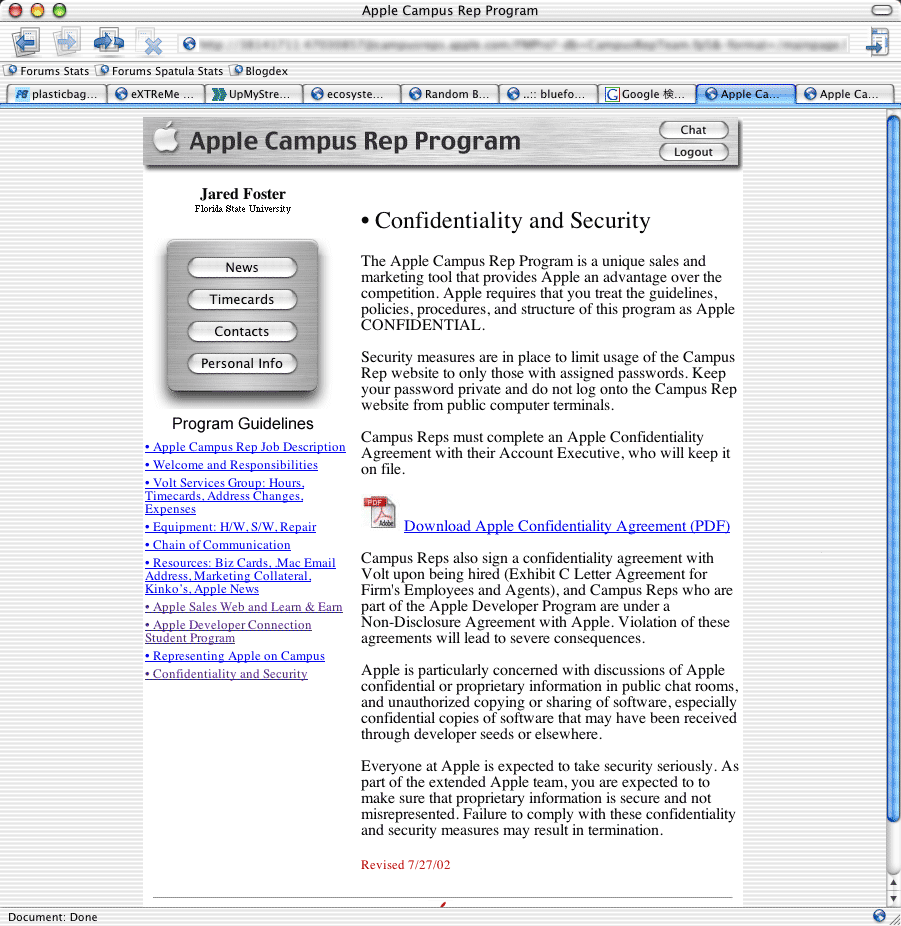
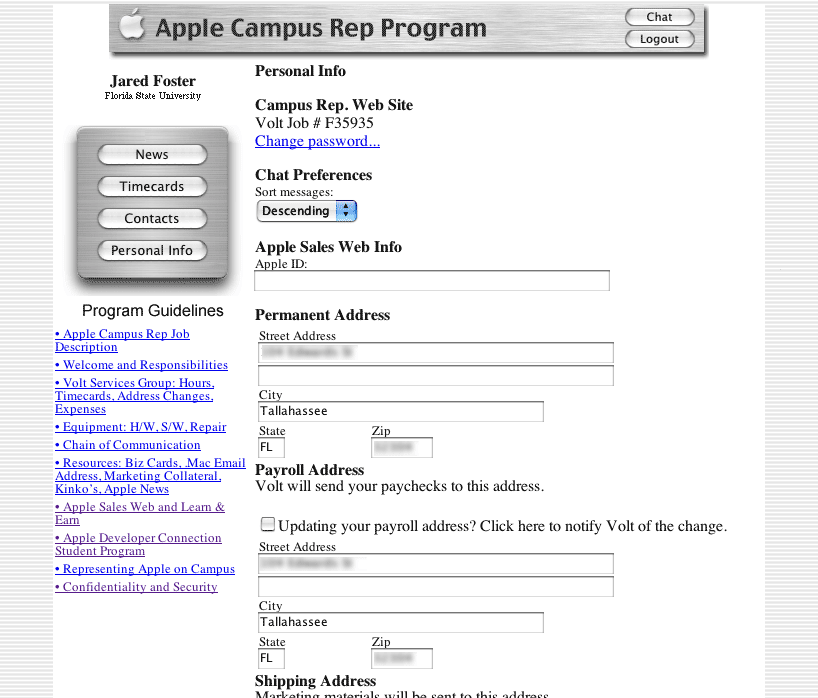
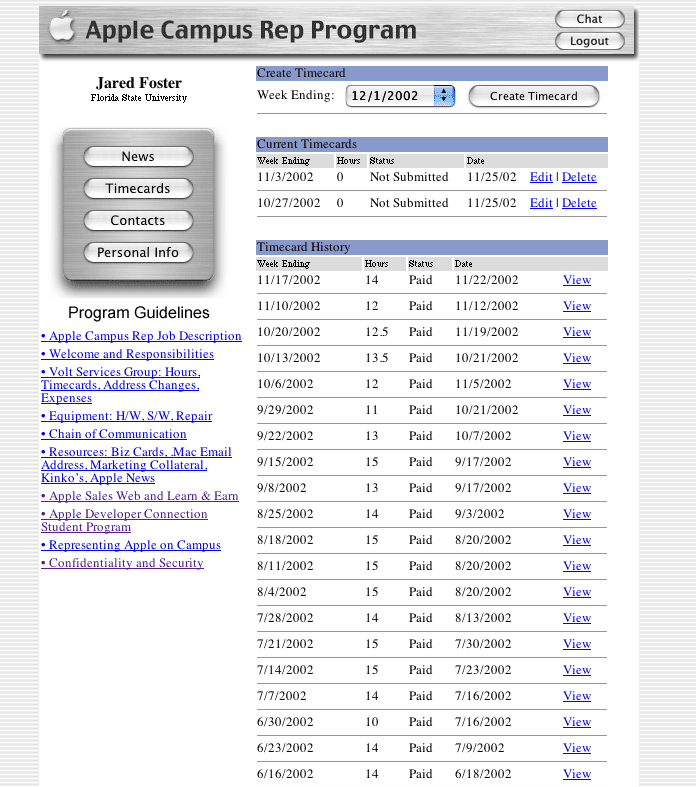
Righto. This isn’t going to do my campaign for Apple to give me an iBook gratis any good at all. Still – never mind. It has to be done. So I’m wandering cheerfully through my referrer logs and I find a weird referral from a site with Apple in the URL. I follow the link to find a little article posted about my recent Apple rant. Then I realise that not only am on an Apple site, I’m actually already logged in as a young gentleman called Jared Foster who is taking part in the Campus Rep Program at Florida University.
But how can this be? Surely Apple wouldn’t be storing crucial login information and passwords in the URL? Except they have. And it’s not like it’s a little site containing no important information. In fact by the time I realised what was going on, I’d already seen a lot of information that should be very carefully protected. Now – if I wanted to – I could have access to all of Jared’s personal information, his timecards, the contact details of loads of people at Apple and – moreover – trade secrets on the Campus Rep Program and also the confidentiality agreement that everyone who participates in the program has to sign.
Now I’m a tremendous fan of Apple’s computers and software and wish nothing but success to them. I’ve been promoting Apple’s stuff here on this site for years simply because I love it. But this is a fairly horrifically substantial security breach for a company like Apple to countenance. And I think that it should be brought to the attention of the public.
Follow-up: I’ve been talking to some people with greater knowledge of security than me, and potentially this is a problem that has been caused by a security flaw in the browser that the person used who was followed the referral link to my site rather than an Apple security issue. Clearly this would leave Apple relatively free from blame in this matter. I personally would also be relieved. More information as I have it – certainly I have no interest in lambasting Apple for a problem if it is not their responsibility…
According to slightly dumb BBC TV programme and the voting whims of a country of BBC TV watchers, Winston Churchill is the Greatest Briton ever. The case for his superiority was put by the ever charming and smart Mo Mowlam. But watching the programme, one has to wonder… Did she have a special relationship with the cigar-chewing curmudgeon? Could they be related? There is a startly resemblance…
 |
A trip from London to Cardiff and back – and just think of all the things that I could have experienced! And what did I experience? Almost bloody nothing. Train to Cardiff. Cab to BBC Cardiff. Talk for a couple of hours. Can to train station. Train to London. Tube back home. So what did I take pictures of? Bits of bloody train stations…
Firstly – a few bits of Paddington’s roof – the newer parts that is – the curves, the lights. It’s elegant and wonderful.

Other bits of the roof have this tremendously arcane quality – god knows when this part of the roof was assembled, but look at it – it’s like the membranes of a insect’s wing! A huge, crumbling, monstrous wing!

Those struts and panes – structural and elegant – lines slim and piled upon one another – half scaffolding and half greenhouse. This station – halfway towards Cardiff – really appealled to me…

The light in Cardiff in the early evening was honey-coloured and smooth. It’s all tiles and smooth banisters – architecture that was designed to weather well and last. You can tell that it’s struggled with the pressures put upon it – but it feels lived-in, homely – and weirdly British…

A pure and elegant vanishing-point – lines disappearing into the distance, segmented into blues, blacks, reds and yellows. A stunningly beautiful image from Cardiff station…

Back in London – and like an image directly out of the Industrial Revolution the monstrous carcass of Paddington stretches before you. You can almost smell my exhaustion. To home. And to bed!

Ok, I don’t want to be scathing. I really don’t. But on the site for Celebrity Big Brother you can find out the favourite films of the various contestants. Some of them aren’t particularly surprising – Anne Diamond likes Some Like It Hot and Les Dennis is a bit of a fan of It’s a Wonderful Life. They make a certain amount of sense. And it also makes a certain amount of sense that Sue Perkins (who unrelatedly and incidentally comes from Planet Lesbolia) might be a fan of All About My Mother.
On the other hand do we really believe that boy-band wash-out Mark Owen is really obsessed with Life is Beautiful? Or that the all-over cosmetically enhanced Melinda Messenger finds The Royal Tenenbaums more thrilling than boob jobs? And even if we’re being generous enough to buy them, do we for a minute think that hard-man gold-toothed Drum’N’Bass star Goldie – the man who has spent four days in comedy wigs and goggle-eyed specs – is really obsessed with watching Magnolia over and over again?
I’m being a snob. I’m going to hell. A few more celebrity factoids: Mark Owen it seems is an obsessive fan of renowned homosexualist Rufus Wainwright and Anne Diamond loves Star Trek and looks terrifyingly like my old academic supervisor. How exciting is that.
Manifestos, Disclaimers, Bills of Rights, Constitutions, Codes of Practice (voluntary or otherwise). A lot of these things are filtering through my mind at the moment. Here are some examples: