- TeeVeePad – taking the piss out of celebrities and SixApart
Highly entertaining piece of the incredulous ‘you spent how much time on this?’-type….
Categories
After talking about the awesome publicity surround the Warwick Blogs project the other day, John Dale sent me a link to the full design treatments. There’s some stunning stuff in there. As I said the other day, I think it’s the best block of publicity that I’ve ever seen around weblogs – it gets across the concept, the aspiration, the aesthetic. Very very classy. Here are a few samples to get you in the mood:


Last night I was the opening act of a sexy little conference about how people might use weblogs that Alastair Shrimpton of the UK branch of Six Apart was hosting at the Polish club near Imperial College. I was a fairly late addition to the schedule, but I don’t think I roamed too far off the point. Suw Charman wrote some insanely intense and accurate notes about the whole thing over on Strange Attractor, including this near-perfect transcript of a part of my talk:
If you want to use blogs for what they’re most naturally useful for, if you’re trying to exploit what makes them brilliant, keep the individual at the heart of it. Knowledge management, or community building, or publishing Wonkette style, keep the individual at the core, be conversational. Even Fleshbot has an editorial tone, not that I’ve ever been, and neither have you, and nor should you.
It was a very interesting evening all things considered, although I sometimes get the impression that I look like I’m having too much fun or am misbehaving when I do these things. Hopefully I didn’t say anything too out on a limb. I’ll probably stick up my notes at some point.
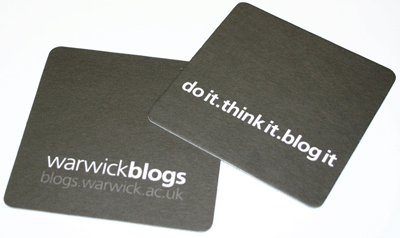
I think the best speaker of the evening was John Dale who has been putting to gether Warwick Blogs for Warwick University (which look like a pretty stunning implementation of the weblog concept inside an academic context). I think the part of his talk that surprised me most was that of everyone I’ve ever seen trying to market and publicise weblogs they seem to have done it best. They had a whole series of pretty stunning stickers and posters and fridge magnets that they distributed all over the campus. I’ve never understood why weblogging companies don’t explicitly target these venues – surely if you get them when they’re young, imaginative and have a lot of free time then they’re likely to stick with you for years. Here’s a lifted image from the Warwick blogs site to give you a sense of the way they branded the thing:

Checking out his site, I see John was at ETech too. It’s a shame we didn’t meet each other in that context too. That could have been fun.
You can download the core part of the material that follows as a PDF presentation entitled Social Software for Set-Top Boxes (4Mb).
A buddy-list for television:
Imagine a buddy-list on your television that you could bring onto your screen with the merest tap of a ‘friends’ key on your remote control. The buddy list would be the first stage of an interface that would let you add and remove friends, and see what your friends are watching in real-time – whether they be watching live television or something stored on their PVRs. Adding friends would be simple – you could enter letters on screen using your remote, or browse your existing friends’ contact lists.
Being able to see what your friends were watching on television would remind you of programmes that you also wanted to see, it would help you spot programmes that your social circle thought were interesting and it could start to give you a shared social context for conversations about the media that you and your friends had both enjoyed.

Obviously there might be some programmes that you might wish to view with a significant other, but wouldn’t necessarily want to advertise to the rest of the world that you were watching. For this reason your personalised settings would have to have all kinds of options to help you control how you were being represented to the wider world that were as simple to use and unobtrusive as possible. Primary among the tools at your disposal would be your ability to tell your set-top box not to advertise that you were watching any shows marked as for adults only and to mark certain channels as similarly private. These settings would obviously be on by default.
Presence alerts:
One of the core functions of a socially enabled set-top box would be to create the impression of watching television alongside your peer group and friends – even if you were geographically distant from one another. One key way to do this would be to create a sensation of simultaneity – to remind you that there are other people in your social circle doing things at the same time as you. This would allow you to create a mental impression of what your friends were doing.
Here are two versions of an alert that could fade up gently onto the screen when someone on your buddy list changes channel. These alerts would work in two ways – if the person was changing channel and landed on a station as a programme was just about to begin or within the first three or four minutes of a programme, then the alert would be immediate. This would give you the opportunity to change over to that channel as well without missing too much of the show. If – however – they were changing over to a channel in the middle of a show or they changed the channel again within ten seconds, then the alert would not be sent. They would have to have been watching the new channel for a few minutes before an alert would be sent. There would be nothing more intrusive and irritating than watching someone compulsively flick between channels at a distance (except perhaps being in the room with them as they did so).


The most important part of all these alerts is that they provide you with the option to join the person concerned in whichever programme they happen to now be watching…
Watch with your friends:
Now we have the concept of joining a friend to watch a show, we have to ask what should that experience be like? How should your parallel engagement manifest itself. Traditionally, net-mediated social spaces have tended towards text as a communicative medium. But this would seem like an enormously clumsy way to interact during a television programme.
Television is an audio-visual medium and there’s no reason why your engagement with your friends shouldn’t also be audio-visual. For this reason a simple high quality webcam above the television would help you see how your friends were responding to what was on screen – it would help you feel an experience of shared engagement without there being a need for overt discussion. By default your conversations with your friends would be muted, and you could – of course – minimise their images if they started to get annoying, but if you wanted to shout and scream alongside your friends, then you’d simply turn the sound back on. This would be the perfect form of engagement around certain sporting events, or for making a well-known television programme or film just the backgrounded context for a shared conversation.
In the mock-up below, you can see the cameras of three of your friends on the right. One person has wandered away from their TV…

Chatting and planning:
If your friends were in the room with you during an ad break, you might chat about the programme you’ve just been watching or bitch about the adverts in front of you. You might turn the sound down low for a few seconds and talk about something else completely. There are lots of contexts where the programme on television might not be the main focus of activity around the television. These might be times when it’s still important to have a sense of what’s happening on the screen, but where the social activity has been dragged to the foreground.
Set-top box social software would have to support such engagements. So how about a second view when you’re in one of these social situations? From having the programme in the foreground, one simple switch of the button could drag your friends into the limelight. The programme could be fully or partially muted, and your friends automatically unmuted. Then you could chat to each other about the programme you’d just watched, or wait for the adverts to end together. You could even use these opportunities to plan what to watch next. If this was handled in a similar way to group formation and parties in online gaming structures like Halo 2, then perhaps one person could even set up the next programme and stream it to everyone else, or cue forward to show their friends the best part of a particular dance sequence or the key quote from a political interview.

Choosing channels and playing games:
Having this technology in place under your television could create a tremendous platform for all kinds of other applications or games to be layered on top of your television experience. And these could be equally usable with people in the same room as yourself. If you gave everyone a personalised remote control (or installed universal remote control software in something like a mobile phone) then people could propose changing channels but be over-ruled by other people in the room. The wonderful browsing experience of flicking through music video channels could be turned into a game, with each song being rated on the fly by everyone present or telepresent and records kept of channels and songs that people tended to enjoy. The same controls could be hooked up to other forms of interactive television or to net-enabled functionality on the boxes themselves…

Sharing a social library:
And finally, to return to the idea of media discovery and regenerating a social context around television programming, how about if the shows that many of your friends had decided in advance to record were automatically recorded by your device too. How would it be if you never missed the show that everyone was talking about? And if you had – your box could ask its peers for some kind of swarmed download if anyone still had a copy and it could appear in your local library overnight.

All this of course, is just the very beginning of the kinds of things that you could create with a socially-enabled TV set-top box. It’s all basically just extensions of stuff that we’re already doing in other media. There are still technological barriers of course – bandwidth and synchronisation being core problems. But we’re gradually on the way to solving them.
To repeat – If you’d like to download this piece as a simple to read and print PDF presentation then you can do so here: Social Software for Set-Top Boxes (4Mb).
Addendum:
Here are a few related links that people have brought to my attention since posting this stuff up or since I finished work on the presentation and illustrations. I’m a little cross with myself for not posting this stuff up before, but hey…
The following post contains some of my thoughts about Social Software for Set-Top Boxes. But before I do so, I thought maybe I should write really briefly about some of the context. I’ve been thinking around this stuff for a very long time now, but I’ve been too disorganised and busy to put any of it out in public. The last thing I wrote around this area was several months ago, and was in fact entirely an attempt to set the scene a little for what I’m going to write next. It was about conceptualising how a connected media hub might operate in the home. For more background on that, you should read the three posts I wrote back then, the last of which has enough pictures to give a sense of the whole concept without the effort of ploughing through my clumsy inarticulate prose:
I started writing this post and the following post immediately after producing the pieces above, and the illustrations and design work you’ll see were well on their way before Christmas. I decided to postpone publishing it for a variety of reasons, including the fact that I felt it had a certain amount of synergy with the paper that Matt Webb and I were going to be presenting at ETCon with Paul and Matt Biddulph on “Reinventing Radio”. But with that paper now out of the way (and available here: Reinventing Radio: Enhancing One-to-Many with Many-to-Many) I think it’s probably the right time to launch into it. So with no further ado: Social Software for Set-Top Boxes.