-
Mark my words – the aspiration of humankind is to make the real world like Second Life
-
Phil Gyford puts some perspective on the beautiful things in the world…
-
“AlienBBC is a plugin for slimserver, the software platform used by the Slim Devices line of networked music players. It is designed to allow the user to listen to (mainly) BBC Radio streams.”
Month: February 2005
Links for 2005-02-20
-
I’ve been getting cross with Fetch recently. I think maybe it’s time to switch…
-
I’m quite charmed by what I’ve seen of Read Regular – there’s something about it which is slightly Comic Sans-y, but with much more restraint and class
-
“When you’re doing it for yourself, it’s like a chore, its drudgery. When you’re doing it as part of a community, in a collaborative way, it can still be a little bit of work, but the payoff is so much larger.”(categories: stewartbutterfield flickr socialsoftware folktags folksonomy tags tag ethnoclassification)
-
Talk about having a niche audience…
-
Obviously they’re doing it because of the sometimes enormous time-lag between a show being broadcast in the States and in the UK. There’s one way to fix that straightaway…
-
Which is a good thing, if only because it meant I could ask him what good webcam software there is for OSX…(categories: jasonkottke webcam)
-
Not only webcam software, but also motion sensor, permanent archiving and a nice interface
-
It’s all to do with methane emissions from subterranean caves. Very hopeful about this one. Life on another planet – however trivial and basic – would blow the world open…
-
Half the planetary systems so far discovered could harbour life, and we might be able to see if they do within fifteen years…
-
Some stuff here that’s so clearly been heavily influenced by Flash-based web design, and some other stuff that you couldn’t do in any other medium. Stunning.
-
Enormous and detailed site about Iron Man – new patron saint of O’Reilly Emerging Tech 2005
-
Typical vile quote: “All this should put the fear of God into the metropolitan elites. For years there have been widening gaps between the governing class and the governed and between the publicly funded broadcasters and the broadcasted to.”
Two books around weblogging…
Just spotted by me (remember I’ve been kind of off the radar for a year) – a couple of intriguing looking books around the whole weblogging thing. First off there’s a kids book called The Secret Blog of Raisin Rodriguez by Judy Goldschmidt, which looks like it’s supposed to be a kids book for nine year-olds. I’m kind of delighted and slightly horrified by the way that authors are picking up on the concept of weblogs and incorporating them into their narratives. Can’t quite tell if I think it’s about reflecting the reality of children or if it’s more about trying to look cool and hip for the young-folk. Who – if I recall correctly from the pre-cambrian period when I was a child – tend to think that trying to look cool for the young-folk is pretty much the lamest thing any human being on earth can do. Anyone read it?
The other book is called Blog by Hugh Hewitt. I have absolutely no idea what it’s like, but I guess if you wanted some slightly alarmist context, he’s also the author of In, But Not Of: A Guide to Christian Ambition and the incredibly subtly named If It’s Not Close, They Can’t Cheat: Crushing the Democrats in Every Election and Why Your Life Depends on It. I have this sneaking feeling that I might not agree with many of the opinions of this man on – say – pretty much anything ever. But if someone out there goes and buys it and informs me that it’s not about how you can burn gay people with your weblog, then I’ll probably still give it a shot…
ABC biscuit bundle…
A week or two ago I put out an appeal for my childhood favourite biscuits, and now I have Nico Lumma to thank for the appearance of packet upon packet of the beautiful things. Thanks dude!

Anyway, the consequence of this is – of course – that Paul and I spent a good hour writing rude words in biscuit letters and posting pictures of it all to Flickr. I would ask you to remember that even the most bright and professional of individuals occasionally suffers from loud and aggravating brain-farts and that the polite thing to do would be for you all to feign amusement and wait until the mood passes. I thank you.

There are more – I’m ashamed to say – on my Flickr photostream.
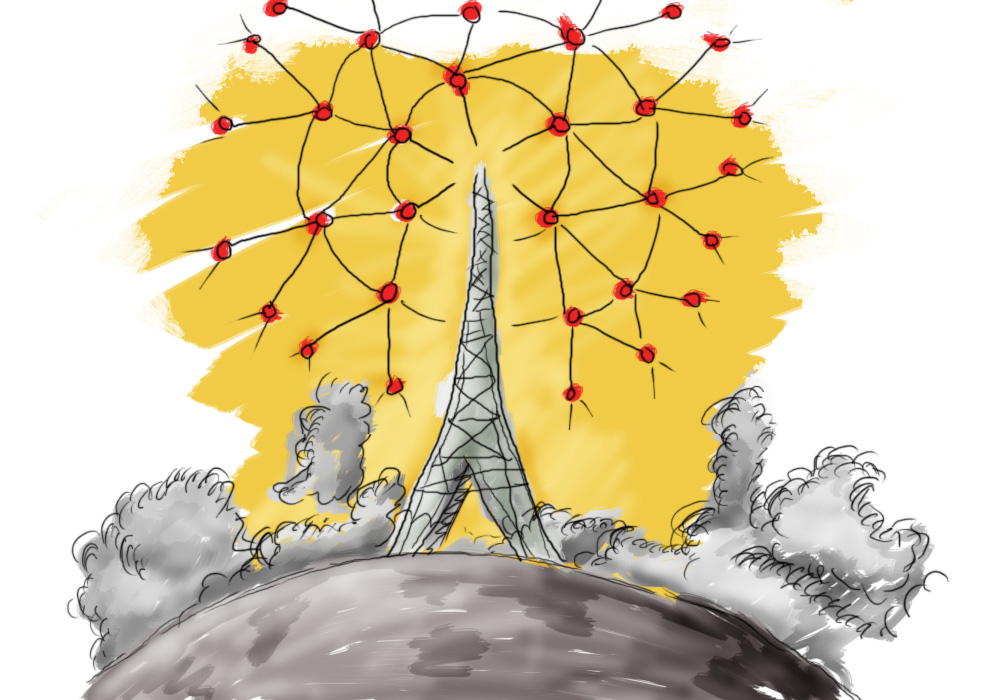
A long time ago during all the Warchalking palaver, I got interested in the idea of trying to find imagery that might convey they concept of an available wifi network to people. Warchalking obviously had its utility – it was a higher level, cultish concept designed to celebrate some kind of Ur-hacker / Urban-tech-frontiersman aesthetic. But alongside that was clearly a need for something simpler that your average punter might be able to get their head around. And when I say average punter, I do – of course – mean me, since I never actually figured out what all the little figures and abbreviations were supposed to stand for. I’m a clumsy, technologically backward Luddite. Sue me.
Of course now there are lots of little icons and logos and buttons – mostly proprietorial – that advertise the presence of wifi, so there probably isn’t the need any more. But at the time I had in my head some kind of image like the RKO pictures logo, but instead of beaming out lightning or pulses – it would instead be firing off packets into some kind of surrounding network.
Anyway, forever and a day later I find myself trying to convey an image of broadcast radio sets engaging with some kind of networked future in a useful way for a presentation and I return to the same image, and after an extraordinary amount of fiddling and arsing around come up with something fairly mediocre in execution, but interesting to me in terms of imagery…

You can download a larger version of the image here: Radio / Network hybridisation. So now I was wondering if anyone had any sense of how maybe to push it forward as an image? Or whether there was someone out there more expert in illustration than I who might be able to turn it into some kind of logo or badge or button. And – of course – I thought maybe it might be a good time to actually see if it makes any sense to people at all.
This is completely throwaway, though. Please don’t think I’m taking this terribly seriously. I just knocked it up while trying to do something else and failing and thought that it might have more value being exposed in public than just sitting on my hard-drive forever.
Links for 2005-02-17
-
In the series, he seems kind of neat. On his acting site, he looks like a tit. Reality is such a disappointment…
Hm. The O’Reilly ETech button on the right there doesn’t really look very comfortable on the page, does it? All looks a bit showy and ostentatious. It’s just the wrong width, really. Ah well. Never mind.
I’ve actually been meaning to write about talking at ETech for a while but for a variety of complex logistical reasons, I’ve been kind of leaving it until I felt reasonably confident that it was actually going to happen. I think I can tell it’s going to happen now. After all, if it wasn’t happening, then I wouldn’t have had such an overwhelming freak-out terror fit when I found out that I’d got the date for getting the paper in wrong by a full week and a half. And that I’d told all the people who were co-writing the incorrect date as well. That’s all fixed now, of course, but at least I got scared, and anything real enough to get scared about is – in my humble opinion – probably real enough to write about on my site…
So I’m really excited about the conference for a couple of reasons. And those couple of reasons are the two papers I’m involved in. Firstly there’s a paper on some of the interesting and innovative stuff that Radio and Music Interactive does at the BBC (Reinventing Radio: One-to-Many meets Many-to-Many), which is half done by Hammond/Biddulph and half done by Webb and me. Obviously twenty minutes isn’t really long enough to give thorough coverage about the stuff we’ve been working on at various points over the last 18 months, but it should give us a little time to talk about a couple of projects in a little depth. Here’s a description to whet your appetite:
How could you enhance a one-to-many national radio station by building in the many-to-many-style interactions of Flickr or the weblog community? How might lessons from social software further blur the distinction between listeners and broadcasters by pushing interactivity beyond the phone-in or the online poll?
(1) The “Ten-Hour Takeover” used SMS technology, pattern matching, and statistical analysis to give the British public control of BBC Radio 1’s musical output. For ten hours, there was no planned playlist–every track was chosen by listeners via text messages. We turned these messages into a navigable information space of artists, tracks, and listeners that the DJs could interact with directly. Moreover, the loosely coupled component-based infrastructure has allowed us to deploy new mobile-based products (SMS and MMS) quickly and easily.
(2) A component-based architecture also allows us to hook together SMS, track now-playing, and show scheduling systems with each other and with third-party services. BBC R&Mi are using this as a basis for exploring social software models of interactivity: the potential of Flickr/del.icio.us-style tagging for radio; the possibilities of combining buddy lists with media players; new applications for SMS; and concepts like “100 Composers”–DABJava applications on PDAs that can have data trickled to them over broadcast radio.
The session presents work from BBC Radio & Music Interactive’s Technical Architecture and R&D teams, including demonstrations of existing software and working prototypes of new projects.
The other thing I’m involved in – again with Mr Biddulph, but this time also with Mr Bell – is our presentation on a project called Programme Information Pages (PIPs). Now this paper has the worst name of anything ever written in the world, so I’m just going to link to the description and hope you find your way around it. It’s basically about getting ready for what might happen alongside (and potentially after), broadcast television and radio, and should fit really well with the other papers from Tivo, about television and the discussions that are really likely to appear about the Creative Archive project and the BBC’s role in open data, which really all seem to be around the same kind of areas but from really different perspectives.
That’s the paper that I’m most nervous about – certainly I’ve invested more of myself and my time into the project itself than any other piece of work I’ve done since University. I really hope that comes across in the paper itself and that people get why it’s interesting.
Anyway, so there you go. Two years since my last ETech paper and now two have come along at once! And while I can’t see the fear going anywhere for a while, I’m also really looking forward to being able to talk about all this stuff in the open and the free and clear. See you there?
For a variety of reasons I’ve been digging up some old stuff on the publishing of weblogs that I’ve written on this site of for conferences or whatever, and I thought I’d reference them again here because I was surprised by how much I still agree with them (and how much they’re still relevant) even though they’re a couple of years old:
- Some ways that mainstream web media can interact with the “revolution” in personal publishingÖ (Powerpoint – 3Mb-ish)
“Rather than treating weblogs as an object to be studied or as a territory to be claimed, mainstream publishers should be looking to build tools that increase interaction between the two types of site – making both better in the processÖ - On super-distributed and
super-localised online communities (Powerpoint – 5Mb-ish)
“The weblog world is a super-distributed community where – much like newspaper columnists – there are ongoing and involved discussions and conversations happening not on one site – but distributed across many hundreds of thousands of sites, each one radically personalised – a representation of its creator in cyberspaceÖ” - Why Content Publishers shouldn’t host weblogs (February 2003)
“There is no reason to assume that being in the position to encourage the take-up of weblogging will mean that you’ll keep the ones you want to keep using your service. In fact: 1. The longer someone has been weblogging, and the more invested they are in it, the more likely it is that they’re going to want to get a domain name of their own. 2. These same people are also likely to want to use extended functionality at some point and will probably try and move to a dedicated application or provider who can more adequately fulfil their weblogging needs. 3. A dedicated long-term weblogger may not wish to be associated with the brand of your service any more and may choose to leave.”
Links for 2005-02-14
-
I thought Hypertime was supposed to have sorted all this crap out… Oops, wrong company…
Links for 2005-02-11
-
Being possibly one of the strangest things I’ve seen on TV for a very very long time…