- OS-tan manga visualisations of what prominent Operating Systems would look like if they were cute girls There’s something glorious about this stuff. I kind of wish someone would take this as a theme and actually turn it into open source branding material – honest representations of the characters repurposed to help articulate the products to people.
- Bring on the tables – a guide to the proper use of HTML mark-up when presenting tabular data “For a table to be accessible to people using a screen reader or some other non-visual user agent, it needs to tell the user agent how the information it contains is related.”
- 1001: a desktop Flickr client “1001 allows you to step into the stream of photos passing through Flickr and to quickly see what’s new at the moment. Just run the app in the background and if triggered, 1001 pops up a small unobtrusive window to notify you of new photos.”
- A Time Lapse Lunar Eclipse A stunning visualisation of the moon as it passes through the shadow of the earth. Terribly cool. Terribly beautiful.
- Two sets of maps compare American states that were pro slavery with states that now vote Bush Obviously this is highly tendentious and aggressive and no one is suggesting that the red states are racist – but it is interesting that the two maps demonstrate a country divided against itself and that the fault-lines are pretty much identical.
- “The scramble is under way for a slice of Peel” The Independent newspaper talks about the scramble to benefit from the life and death of BBC DJ and widely-loved grump John Peel
- My attempt to capture Guy Fawkes night at Vertigo42 in London My camera wasn’t up to the job, and my narrative skills have been blunted by excessive technical project documentation, but hopefully I’ve captured something of the architecture and atmosphere of this part of London
- Buzz Anderson writes a measured response to some of the recent hysteria over Apple’s use of DRM I find many people’s positions around this stuff incomprehensibly absolutist. There are too many different perspectives to expect any eventual position to be completely free of compromise, accomodation or cost for someone involved.
- Best wishes go out to Mena who has popped out her knee. You have all my sympathies… And yet – dear God, lovely lady – that’s the most amusing way I’ve ever heard anyone injure themselves. Ever. In the world. Snigger. Snort. Chortle. Laugh. Cough. No no… Not funny. Oh no.
- For everyone who doesn’t live in the UK – here’s a brief explanation of Guy Fawkes night “Bonfire night is now just as celebrated within Britain’s Catholic communities. The once common practice of burning effigies of the Pope is now largely discontinued…”
- The Flower of Presence “This MediaLab Europe Project uses everyday natural objects to communicate a loved one’s sense of presence. Shown here is a wireless, IM-enabled flower that opesn when your friend or lover is online, and closes when she’s offline.” Bit tacky though…
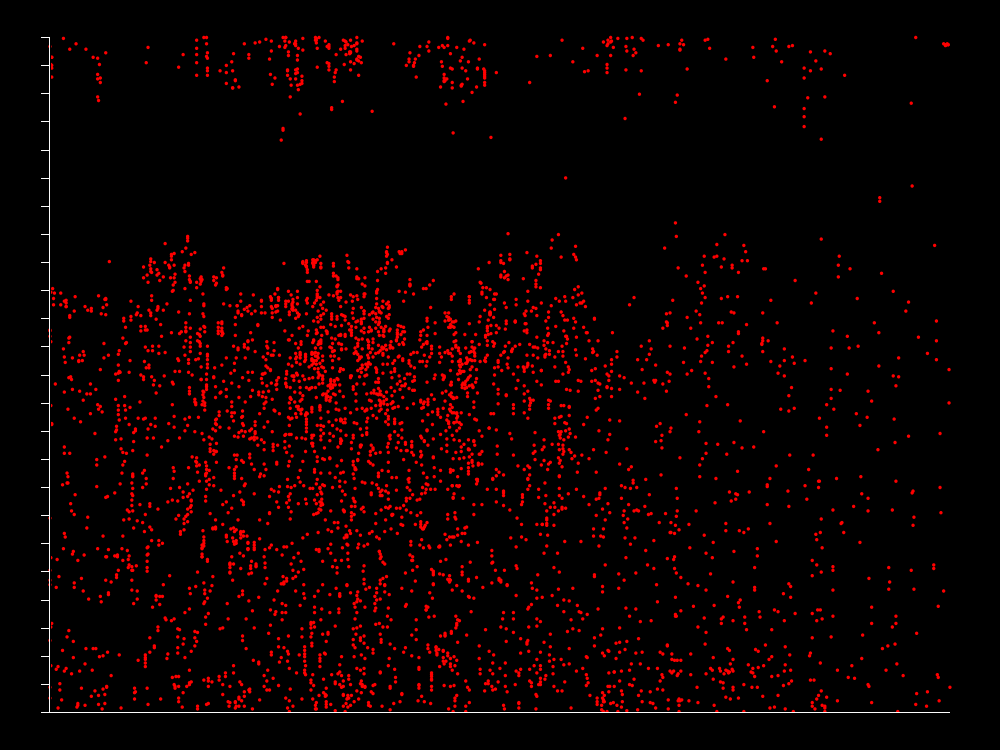
This is absolutely the last post on visualisations of plasticbag.org data unless someone sends in something else really cool – and this one is more of a clarification than anything else. Daniel Boyd created this really cool model of post time that had accurately predicted both the times I woke up and went to bed, but it had seemed to go a little pear-shaped as a visualisation at the time I switched to using MT. I’ll post the original graph below for those of you too lazy to look at it in its original context (slackers):

Anyway, the confusion emerged at the beginning of January 2003 when suddenly it looks like I was staying up all night and posting at completely random times of the day. I instinctively felt like this could not be right – and by instinctively I mean that I knew it wasn’t right because I’ve become mostly old and predictable in my early thirties. Enter Tom Carden again, who writes:
“The time of day chart is great, but I suspect that more careful analysis is needed here. For instance, I believe that the move to MT coincided with the enabling of comments. I suspect that’s why the time chart suddenly goes strange. Here’s one without the comments. It’s as you might expect – pretty much the same times, but less frequent.”

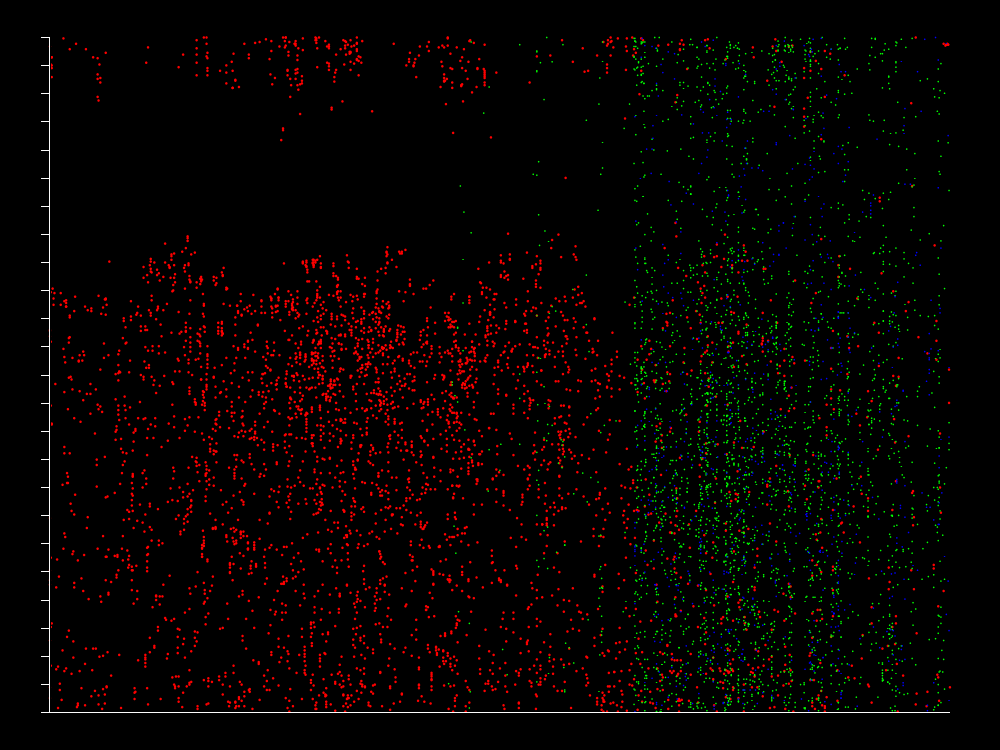
He’s also generated a visualisation that shows comments as green dots and trackbacks as blue. It’s harder to interpret these on images reduced so much, so if you’re gripped by this whole subject area you might want to check out his two larger-scaled graphs: Without Trackbacks and Comments and With Trackbacks and Comments. The smaller version looks like this:

By way of intepretation then, I think it’s clear that since moving to MT my posting has dropped enormously (there are other reasons for this of course – including my rather hardcore nine months working on Radio 3. Perhaps more interesting is that the same posting patterns during the day appear to have continued (first posts between eight and ten in the morning – last ones between 12 and 2am) but there is more deviation from this practice. Whether this just represents being at conferences in other time zones or something isn’t clear to me.
Looking at the comments and trackbacks, it seems clear that they’re much more consistent during the day and night – which probably reflects a fairly international audience (or a lot of insomniacs and filthy drunks). There does appear to be a bit of a concentration of comments at least between midday and six UK time – although that may just be a result of comments lagging after specific posts. That would also account for the fairly heavy striping in comments up and down the page – on occasion I seem to write something that a lot of people want to comment upon. The rest of the time – not so much… There are also some fairly clear stripes of total inactivity emerging – February/March-ish of this year seems a complete dead zone as does a good period around two-three months ago.
I think generally what this little project has taught me is that statistics and visualisations are are both really good fun and that they can expose to you patterns and behaviours and causalities that you may have suspected were there all along, but couldn’t be certain about. Along with projects like Audioscrobbler, I feel like I’m starting to get a strange and exotic new statistical understanding of my life. I can look at these diagrams and see myself in them. It makes me want graphs of the fibrous content of my excrement automatically generated by my loo – and a complete break down of the percentage of my floor which is covered with rubbish and books at any given moment in time. Somewhere in this stuff is self-knowledge!
Wow, so it’s nearly three in the morning, which is basically four in the morning since the clocks only changed a week ago, and I still appear to be up and awake and completely uninterested in sleep. I may as well take this opportunity to post a few more visualisations of the weblog data that I posted up a few days ago (Five Years of Weblog Data vs. The Visualisations). This batch pushes us in a few interesting new directions – some of which so interesting in fact that I have no concept whatsoever what they might signify or represent. In fact let’s start with those:


These two were undertaken by Dan Kaminski and were “run through the Phase Space Visualization process popularized by Michael Zalewski” using Phentropy. I will confess straightaway that I’ve spent a limited amount of time trying to work out what they mean, but remain as yet unsuccessful.
The second set of visualisations came in from Daniel Boyd and is a plot of when during each day I posted over the last five years:

The first three years here are astonishingly consistent and – as Daniel himself pointed out – the data would suggest that I go to bed between midnight and 2am and that I get up each morning around eight. This is stunningly accurate and highly representative of my normal behaviour. What’s less clear is what happens after the beginning of 2003 where the data starts to look remarkably less organised. I’m still not clear why this has happened – and in fact quite suspicious of how accurate that bit is. It seems to me more likely that some part of the data is corrupt around the beginning of 2004 than that my entire posting behaviour changed overnight. Except to say that yet again this phase shift seems to coincide with switching to using Movable Type.
Which brings me to the last visualisation. When I last posted these visualisations I pointed out that they seemed to suggest that the switch to Movable Type had resulted in longer posts and a drop in the rate of posting. In response Anil Dash mooted that Movable Type might be making my posts better thought out. Now of course, there’s a clear value judgement there, and one that is not necessarily correct. It’s quite conceivable that I’ve just got more wordy and long-winded and that MT has supported or even caused that shift. It’s not even clear that weblog posts should be better thought out – Matt has suggested to me in the past that another equally convincing model might be to think of MT as having broken the paradigm of incredibly fast and easy informal peer-to-peer publishing that Blogger created and was initially its USP.
So it’s just as well that we have Richard Soderberg out there. He decided to run a Flesch-Kinkaid reading analysis on each of my posts over the last five years and plot them on a graph. The solid darker line in the middle being the reading level in the US educational system that might be required to be able to read each post.

As you can see, the readability level of my site changes dramatically around the same time that I move to using MT. Over the first three years it seems to settle around eight on the Flesch-Kincaid scale. But after moving to MT, the average appears to be more around 10. More interesting still is that the extremes in both directions have started to diminish. There are few posts that plummet down to the infantile depths of the scale and few that stretch upwards towards unintelligibility. Richard’s also provided a useful CSV of some key metrics. When you investigate it, you’ll see that each post has its complexity described in as either childish, acceptable, ideal, difficult or unreadable. I wonder if the same metrics apply with writing for the web as for elsewhere (we’re normally told by usability people that sentences should be shorter and punchier and articles not as long when we write online) but if they do the site has definitely moved much more heavily towards the ‘ideal’ intelligibility rating and that does appear to coincide with a move to MT.
So there you go – three new sets of visualisations and a stunning revelation that they should put on the marketing bumph. That’s right, ladies and gentlemen, apparently MT actually makes you smarter!
Christina of Finland?
I was wandering down Oxford Street the other day when I stumbled upon this poster featuring Christina Aguilera attempting to flog Sketchers products to no doubt impressionable youth-type people. My first reaction was to think that the pose looked really familiar and after a fair amount of brain-searching, I’m thinking maybe it’s been ripped off from a piece by Tom of Finland. Now I’m really interested in finding the piece that inspired this advert – particularly because if it is Tom of Finland then there’s probably someone out there who should be writing a book on the way his bizarre sexualised gay imagery is being repurposed to sell shoes to a teen audience.

If anyone knows of the advert’s influences then please leave a comment below – and if you happen to have a URL for an ‘original’ somewhere on the web, that would be bloody awesome too.
Links for 2004-11-07
- Population boom set to stabilise at 9bn by 2300 “Fears that the human race may drive itself to extinction through over-population are challenged by new United Nations figures suggesting an eventual equilibrium as people in poorer countries come to understand the need for smaller families.”
- Mac OS X 10.3.6 Update Most importantly: “Safari no longer times out after 60 seconds when attempting to connect to a webpage or to submit form data. With this update, Safari will keep trying indefinitely (or until you cancel the attempt).”
- A guide to office productivity based on David Allen’s teachings David Allen is a bit of a guru of people who were clearly slightly dorky as children. I’m currently enjoying Getting Things Done quite a lot, and found this visual guide to an Allen-like office space similarly interesting / amusing
- Capture the map – A flash-based game based on google search results This doesn’t appear to be working consistently, but when it does it’s quite a laugh. You type in search requests and all the results are matched against geographic hoojis and stuff…
- The Hidden Door Company turns normal doors into secret doors concealed with bookcases Underneath my family’s staircase there’s a door that goes down into the cellar. Probably since I was ten I’ve thought about how it should be replaced with a secret door that looks like a bookcase. Wouldn’t that be neat!?
Links for 2004-11-06
- A two-dimensional to-do list manager that slightly misses the point This simple app allows you to plot things to do against two axes – urgency and importance. These do not appear to be orthogonal to one another. It would seem more useful to use difficulty and reward as axes instead.
- Malcolm Gladwell on “Getting Over It” This is the difference between a novel written in the middle of the last century and a novel written at the end of the century. Somehow in the intervening decades our understanding of what it means to experience a traumatic event has changed.
- Cal is a beautiful Fairy Princess Bizarrely he looks healthy and happy and more well than I’ve seen him look in ages. Also he looks really funny. Snort.
- The terrible consequences of love between heavenly bodies A cartoon about passion and loss at enormous scales
Links for 2004-11-05
- VLC media player I’ve almost certainly linked to this before, but the VLC cross-platform open source media player is so good, I’m prepared to risk it. A Quicktime Player-killer for the Mac.
- Why every good liberal should marry an American… “Give me your tired, your poor, your huddled masses yearning to breathe free, the wretched refuse of your teeming shore…”
- Kerry wins by Landslide “Since most of the President’s decisions affect people in other lands (often negatively), then it stands to reason that those people should be included in the electoral process…”
- Blast from the past: Play Web Trumps I got a referral from Web Trumps for the first time in a hundred million years. It still looks incredibly sharp and fresh and creative. It’s also still bloody good fun to play…
- Hello Kitty Online World – taking MMORPGs to an entirely fluffier level This may very well be the cutest thing I have ever seen in my entire life and may push the MMORPG squarely over the gender divide
- Taken to extremes – The Guardian Online on Extreme Programming and Scrum methodologies I’m quite keen on Scrum stuff and on any form of programming or working that minimises meetings and formal project plans. We used some of this stuff in my last project in the BBC.
- Metacritic on Halo 2 I’m getting a bit concerned by the complete absence of reviews for Halo 2. It sounds lame – I’m waiting for it with baited breath – but what if it’s a total letdown?
- John Kerry’s address isn’t entirely lovable of course – it also includes this startling quotation of lunactic patriotism “But in an American election, there are no losers, because whether or not our candidates are successful, the next morning we all wake up as Americans. And that is the greatest privilege and the most remarkable good fortune that can come to us on earth”
How can 59,054,087 people be so DUMB?
Today’s front page in the Britain’s Daily Mirror. I’m fairly sure that there’s a large number of people around the world who are asking themselves the same question. If you’re interested in this stuff, the BBC has a page which summarises UK newspapers reactions to the US election result.

Links for 2004-11-04
- Konakai.com – everything you need to know about Tiki stuff! And I mean everything. And then a bit more. And then a bit more than that. Basically a hell of a lot of stuff about Tiki stuff.
- Blue Coconut – helping you to really share your iTunes music library Apparently it doesn’t work with iTunes 4.7, but I hear a new version is on its way. Looking forward to it.
- Optimus Prime wins US election We’re safe at last – he’s vowed to end the Decepticon threat.
- Could it be? Have the real-life actors behind The OC’s Seth and Summmer actually got engaged? Sometimes I think the best thing about my site is how undiscriminating I can be. I mean, you wouldn’t have gotten this on Dive Into Mark…
- Mena relaxes in her Canada 2.0 citizenship Now this is a country that I’d bloody love to live in – a North American state that merges Old Canada with Chicago and environs, the Eastern Seaboard and some of the nicer bits of Washington and California
Links for 2004-11-03
-
Or at least it is according to a weird new advert (in Hong Kong) for a new form of cherry ginger Perrier water…