For some unknown reason I spent much of yesterday evening cooking a Cherry & Almond Cake. The finished product is a little burnt around the edges, but is extremely nice. Maybe a little too sweet…

For some unknown reason I spent much of yesterday evening cooking a Cherry & Almond Cake. The finished product is a little burnt around the edges, but is extremely nice. Maybe a little too sweet…
“The history of mankind in the last three hundred years has been punctuated by major upheavals in human thought that we call scientific revolutions – upheavals that have profoundly affected the way in which we view ourselves and our place in the cosmos. First there was the Copernican revolution – the notion that far from being the centre of the universe, our planet is a mere speck of dust revolving around the sun. Then there was the Darwinian revolution culminating in the view that we are not angels but merely hairless apes, as Huxley once pointed out in this very room. And third there was Freud’s discovery of the “unconscious” – the idea that even though we claim to be in charge of our destinies, most of our behaviour is governed by a cauldron of motives and emotions which we are barely conscious of. Your conscious life, in short, is nothing but an elaborate post-hoc rationalisation of things you really do for other reasons.”
So starts the BBC’s Reith lecture series for 2003 – broadcast a couple of months ago on BBC Radio 4. The topic of the lectures was “The Emerging Mind”, and they were delivered by Vilayanur S. Ramachandran. They make for fascinating listening and are very much recommended.
But perhaps more impressive than the lectures themselves is that every single one of them is still available for download on Radio 4’s site. And they’re of eminently listenable quality, even if they’re in RealAudio format. And it’s not only the Reith Lectures that are online – in fact, almost every radio programme played on the station in recent months remains available. And there are a hell of a lot of those programmes covering all the major subject areas – all ready to be listened to on demand. Here’s some to be going along with: News, Drama, Comedy, Science, Religion and History…
If I sound over-excited, it’s because – bluntly – I am. I’ve never been a devoted acolyte of the station, but now I can easily cherry-pick precisely what interests me it’s becoming easier to see the appeal. For example – what other station would have a weekly programme dedicated to the history of ideas? And would that programme routinely have in such figures as Steven Pinker or Adam Philips and Malcolm Bowie for round-table debates. What other station would manage to have two separate series about interesting numbers: 5 numbers and Another 5 numbers – as presented by Simon Singh.
I know I’m coming into this late. I know that everyone else in the UK is going to look at me funny and point out that I should have been paying more attention several months ago. But dammit! I’m as impressed by this as when Pathe News put all its archives online.
P.S. If anyone can remember which writer it was that first described Galileo, Darwin and Freud as thinkers who decentred man from his view first of cosmology, biology and finally from his view of his own mind, then can you let me know. It’s driving me mad…
I can very much recommend Clay’s latest piece: FCC, Weblogs and Inequality to anyone who’s even vaguely interested in either FCC regulation of the airwaves or the nature of inequalities in webloggia. I’m afraid I’m going to spoil the ending for you, because I think it’s particularly pertinent to some of the recent discussions we’ve been having:
The one incoherent view is the belief that a free and diverse media will naturally tend towards equality. The development of weblogs in their first five years demonstrates that is not always true, and gives us reason to suspect it may never be true. Equality can only be guaranteed by limiting either diversity or freedom. The best thing that could come from the lesson of weblog popularity would be an abandoning of the idea that there will ever be an unconstrained but egalitarian media utopia, a realization ideally followed by a more pragmatic discussion between the “diverse and free” and “diverse and equal” camps.
My only issue with the piece is that the concept of equality is reduced to equality of audience/readership/influence and only briefly alludes to equality of opportunity.
The main problem I have with the weblog-related positions of professional writers like Bill Thompson and professional trolls like Andrew Orlowski is that we’ve had all these debates so many times before. Debate around A-list cliques has existed for years – as have comments that weblogs are ultimately trivial. It was over three years ago now that A List Apart published Fame Fatale – and that wasn’t the first article along those lines. Some of the pieces had more justification than others. Some had little or no justification at all. Mostly, in time, people just changed their minds. We’ve walked around these particular avenues and alleyways several times now, each time accompanied by a new group of people who consider themselves slightly higher up the food chain.
It would be different if they accomplished anything. If Orlowski was working to improve weblog culture or pull it in a positive direction, then there would be value in that. If Bill’s work was trying to rectify inappropriate imbalances in the social system that has emerged, then we might actually be getting somewhere. I don’t think there’s a single weblogger who thinks that there’s absolutely no scope for improvement. But instead what happens is that legitimate concerns get pushed aside by florid rhetoric and high dudgeon, debate gets polarised, until eventually everyone gets bored and weblogging continues pretty much as it did before. Only this time with permalinks! Or comments! Or automated blog-rolling!
And the steady take-up of weblogging seems undeterred by these debates. People still continue to start weblogs faster than people stop writing them – there are now (by conservative estimates) hundreds of thousands of regularly updated sites. And with AOL and Microsoft rumoured to be getting in on the act, along with new ventures by Blogger, Movable Type, 20six (etc.) it looks like there’s going to be a hell of a lot more weblogs started in the next few years.
I think it’s now time that people started to face this fact. That whether or not they like it (whether or not any of us like it), weblogging is not something that’s going away in the next couple of years. Having an ‘anti-weblogging position’ is no longer even vaguely a ‘real-world antidote’ to unfathomable and unwarranted ‘weblog hysteria’. It’s just really unhelpful. It doesn’t accomplish anything. So you want my advice? Work to make it better or sod off. If you think there’s really a legitimate problem in the way that weblogs operate between each other then try and suggest a solution, try and suggest some things that are likely to be taken up and worked with by the extended community. Or think of something better than weblogs! That’s got to be a more creative, positive and useful way of interacting with the world than sitting on the sidelines and bitching… Surely?
This piece was grumpily forged in the comments of the iSociety‘s weblog.
A few things that I’m taking the time to place inside my mind palace – as ever mostly culled from my favourite weblogs and news sources (see the Weblogs panel on the right):
As ever when I’ve written something long and vaguely serious, I can’t think of anything to talk about for days afterwards. So to try and break me back into the writing habit, I’m going to talk a bit about the response that Discussion and Citation in the Blogosphere has received. As NSLog() has pointed out, it’s not the most revolutionary of posts, but I think sometimes it’s still important to state what we believe to be obvious – either to have it challenged or because other people don’t find it obvious. I think both types of reaction have taken place in this particular case.
(1) A few responses to comments
I’m going to start off by looking at a couple of the comments that I received about the piece. Jumping right in, these were (1) that I didn’t talk about the kind of indented hierarchical threaded-discussion boards (in which discussion can take a much more non-linear approach than my diagram suggested) and that (2) my diagram of micro-paradigm shifts was too neat and doesn’t mirror reality (Microdocs).
Firstly I’d like to say straight-away that they are – of course – both right. Real-life is always messier than abstractions, and I could never hope to have talked about all the kinds of online discussion boards that exist.
In the case of the indented-threading models – all I can say in my defence was that the piece I was trying to write wasn’t so much about the directionality or linearity of message-board discussions, but more about the filtering mechanisms implicit in the system. Another commentator) also pointed out that some message-board systems allow trackback on individual posts. Here I can only say that there’s a certain degree of bifurcation going on there – I can’t see a way in which those people within the social system of the board itself can help the filtering process for strangers, except by moving outside it and linking to it from outside (say from a weblog). And he also talks about weblog / message-board hybrids – which again I can only say that I wasn’t specifically familiar with. There are a lot of interesting models for online fora – and I hope people forgive me for concentrating for the most part on the one that the most people are familiar with… I think the most important thing that I want to say about this stuff is that I was definitely not undermining the importance of message-board technology in community-building. I’m a dyed-in-the-wool advocate of message-boards and have been playing with some new models in moderation and administration over at Barbelith Underground for several years now.
As regards my diagram being too regular and not reflecting reality (again cf. Microdoc’s diagram of this debate)- where they see difference – I see considerable similarity. Let’s call those posts that have one or less inward link “supporting” posts, and all those with more than one “structural” posts. If one does this, then even at this early stage it’s clear that only a couple of posts are driving the discussion forward. At the moment the debate has bifurcated (I specifically mention that as a possibility in the last post) – and no doubt one of those will be taken further by a subsequent structuring posts at some point. While the reality will always be messier than the abstracted diagram, I believe that (if we give the debate time enough to develop) the two diagrams will come to look more and more similar.
(2) On parallels with academic citation networks
Now I’m going to turn to another common response to the post. A few people have argued that (i) the existence of peer review mechanisms and (ii) an expertise-based barrier of entry makes academic filtering mechanisms very different from weblogging ones. I’ve seen this position articulated on a few sites – particularly 2lmc, commonplaces and a comment by Ross Mayfield on Many to Many – but I’m going to concentrate (yet again) on the response from Microdoc because it’s the most succinct and clear:
There is a substantial difference between writing an academic paper and having it published in comparison to blogging. In the academic world, I write a paper, have my peers review it, and then I submit it for publication where it may go through another review process, and eventually be published and it is from that paper that has two or three reviews that people will cite in their papers. That is, the academic paper is already “authorized” or “reviewed” and therefore has some weight already.
This is certainly true – there is a substantial barrier to entry in writing academic work. You have to be (to an extent at least) an expert in your field before your words will be seen by the rest of the community. And that means you also have to be an expert in your field before you can cite another article as well (although you don’t have to have the same level of expertise in the field of the article that you’ve cited).
But once you are inside that community of people, what then? Articles are not cited an equal number of times and nor are they given same value within the community – these mechanisms of citation and linkage appear to occur in almost exactly the same way as within weblogs. Individual scholars choose who to cite through a complex balancing act of who they wish to credit to, who directly inspires them, who they have to employ to back up their arguments and which articles have achieved such value and ubiquity that you can’t have a discussion about a given subject without citing them (this last one is more common among graduate students persuing a doctorate). Some of these citations consist of nothing more than a vote – a gesture that the article concerned is pertinent to a discussion. Often articles (or books) crystallise a discussion and are treated as a baseline from then on.
Essentially – the only difference that having barriers to entry into the community makes is that the criteria for judging whether a piece of writing is worth linking to may be different. The mechanisms, however, remain identical. Certain articles get cited, others do not. Discussion happens in a series of discontinuous leaps – sometimes collapsing back onto itself, sometimes bifurcating – with the community self-filtering the good stuff to where it’s most likely to be seen.
A few days ago a stunningly interesting article was published on Microdoc News called Dynamics of a Blogosphere Story which aimed to look at exactly how a story or discussion moved through weblog space. I’ve been thinking along similar lines for a while now – at least partly as a way of articulating my problems with the iWire Scaling Clay Shirky piece. I’ve been trying to put down on paper why I think the iWire assertions are incorrect and to develop an alternative model of how discussion can occur usefully through the ‘blogosphere’. In fact more than that – I wanted to illustrate why I believe the system works to actually generate better discussion than a simple discussion board – by (on average) helping to hide the bad content and making it easier to find the good content. I most recently wrote something that gestured in this direction (How do we find information in the blogosphere?)
The Microdoc News piece is particularly illuminating because it’s dragged some actual examples into the fray. After examining 45 “blogosphere stories” they found four kinds of posts and a relatively predictable pattern of their usage, with an initial weighty post generating an explosion of smaller fragmentary reactions, commentaries and votes (cf Casting the microcontent vote). These posts are then aggregated or collected into another weighty post, which itself might have the potential to push forward the debate. Their four example posts are:
I’ve been working in similar directions as this – in an attempt to resolve the questions, “Can you have good discussion across the blogosphere?”, “What is the nature of that discussion?” and “How does it differ from message-board conversation?”. And I think the answer lies – yet again – in going back to the beginning and looking at the way the web in general (and weblogs in particular) operate like an academic citation network.
The origins of the web are highly academic in origin. So it’s hardly a surprise that the combined use of hypertext and discreet blocks of content comes to mirror academic citation in research papers. Apart from a few wry-eyebrow-raising academics, I think most of us would agree that the idea that useful debate cannot happen in academic discourse is patently absurd. After all, the vast bulk of academic research in both the humanities and sciences is published as part of an ongoing conversation involving statements and citations.
The weblog sphere has taken on a great many of the characteristics of the distributed academic community’s citation networks – just at a much smaller, faster and more amateur level. Consensus can emerge (briefly or otherwise), reputations are made (deservedly or not), arguments occur regularly (usefully or otherwise). Nonetheless, discussions do occur, they do progress and they do reach conclusions. But it’s happening at a granularity of paragraphs rather than articles. It’s happening at a scale of hours rather than months.
The Microdoc article could easily have been written about citation networks in academic literature. And when we realise this, then lots of other things become clear too. The answers to my earlier questions are beginning to come into focus. And they remain basically simple answers too:
So here’s my suggestion of how we can usefully conceive of discussion occurring across the blogosphere (and I think it’s a model that’s practically explicit in the Microdoc article, so forgive me if it’s boring). We should think of it as a kind of micro-paradigm shift – a kind of hyperactive academia, where discussion moves forward in discontinuous chunks – with an initial weighty post articulating a position that is then commented upon, challenged and cited all over the place. But the debate doesn’t move forward until someone manages to articulate a position of sufficient weight and resonance to shift the emphasis of the discussion to their new position.
The weight of these debate-structuring posts can often be measured in terms of aggregated insight – in which case it’s a purely progressive model – an individual synthesizes all the interesting comments made by everyone else and pushes it slightly further, generating a new baseline from which the conversation can continue. On occasion, however, it would still be possible that an individual’s reputation would be weighty enough that everything they say defines the scope of the debate – that smaller dissenting voices would not be heard – and the debate would be carried behind a leader of some kind. And of course there are the times where a debate fragments or polarises, where more than one of these structuring posts occurs roughly simultaneously, or with radically different views – bifurcating any debate. Nonetheless, debate remains a series of discontinuous leaps, structured by impactful posting.
Here’s a diagram that I think illustrates how I think discussion happens between weblogs:
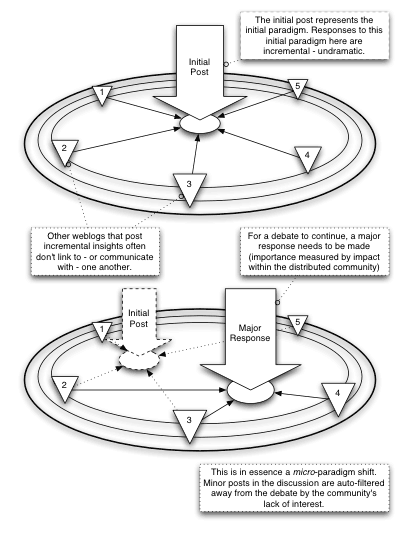
This ties in well with my previous article on finding information in the blogosphere. Because the smaller posts with negligible insight, voting or replicated insight are less likely to be linked to, then they’re also less likely to be read. And yet their value remains – they represent the arbiters (in a distributed fashion) of what should be being read. The posts that one is directed to most quickly are these structural posts – places where some kind of micro-paradigm shift has occurred.
I’m going to end now with a bit of a brief discussion about the differences between this kind of debate and the kinds of discussion that one finds on message-boards. I’m going to start off with a comparative diagram:
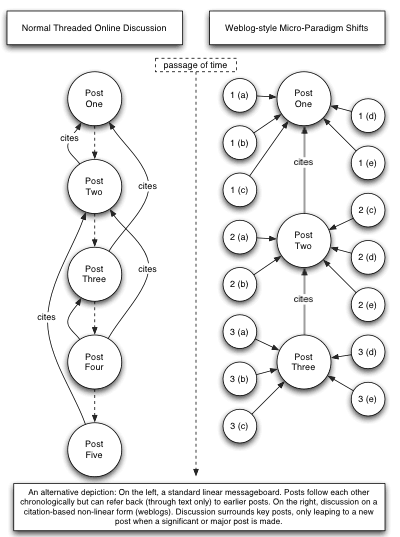 On the left, you can see a normal piece of discussion – as it would occur on a threaded message-board. In this example, the top post is the first, the second post cites the first, the third also cites the first while the fourth cites both the third and the second but not the first. In this debate there is no filtering mechanism of any kind. If the second post is entirely off-topic or contains spurious information, then it remains very clearly in the context of the thread. And if that thread is linked to from elsewhere, there can be no simple evaluation of what posts are considered more worthwhile than other1 – the thread is either good or it is not.
On the right, you can see a simplified diagram of the passage of a discussion through a citation network. If there are filtering mechanisms functioning through the community (in our case people choose who to link to based on whatever personal preference they wish to express) then the most important structural posts will self-locate towards the middle, generating a clear (almost linear) movement of discussion from first principles towards a conclusion of some kind. The conclusion itself may never be met – consensus may never be fully reached – but positions with regard to this evolving dominant narrative will be reached by everyone. Those posts which are merely “I agree” or “I disagree” will be filtered from the public consciousness, even as they have fulfilled a valuable function in directing people towards the next structural post in their debate.
So – what does this all mean? In essence I’m arguing that debate across weblogs self-organises in a pretty useful way. But I’m not going to pretend that it operates perfectly or that we can’t do anything to improve it. However, it seems to me that rather than bemoaning the things that make debate across weblogs different, we should be trying to grease the wheels of those mechanisms. It’s my personal belief (and one that I’ve expressed before) that things like trackback and Daypop work so well because they are specifically building upon – enhancing – the mechanisms that make webloggia operate effectively in the first place. If you’re looking for more specific suggestions, then I think that a balkanisation of blogdex would help different those mechanisms work more effectively within smaller communities with different and more distinct interests. After that, I have no idea. That’s where you people come in…
Footnote: (1) Obviously Slashdot has made gestural moves in this direction, but there are some interesting differences between the way the distributed community of webloggers evaluate one another and the way it is handled on Slashdot.
Jesus! What’s wrong with you people at the moment? I don’t have time to talk about all the cool things out there, let alone all the things that just tweak my interest. Damn you for making me linklog. Damn you to hell and back…
Blogs-Clogging the net?
Entertainment
Geek Stuff
Design Stuff
There are too many sources for this stuff than I can actually count – but almost all of them will be on my list of weblogs on the right. If you liked this stuff, I’d very much recommend you wander through them at later leisure…
The last week and a half or so has seen me in fairly odd headspace – I’ve been pursuing a number of work-related leads, talking to substantial numbers of intriguing people and helping out friends with projects large and small. I have a number of forms I have to fill in and a number of phone calls I should be making. I have – of course – a number of bills to pay.
All this being the case, I’ve not had a chance to post as much as I would normally like. I’ve got a piece on the boil that I want to try and get out over the weekend if possible, but in the meantime you’re going to have to make-do with scraps.
After a large number of protests from users of this site, I’m going to have to open up my comments-related problems to the floor. But first things first, I want to talk really briefly about pair.com – a hosting organisation that I honestly can’t say enough nice things about. They’re reasonably priced, helpful and have been genuinely reliable over the last few years. I’ve still got the Barbelith Underground running on a pair server, and with remarkably few problems… But there has been one thing that they haven’t been particularly ideal for: hosting Movable Type based sites.
In fact, my problems with running Movable Type on Pair kept me using Blogger for about a year longer than I’d expected. Pair have this kind of time-out running on cgi-processes that effectively means that (unless you know to run everything through cgiwrap) any decent-sized MT operation (say saving a new post) may cause the system to throw a wobbly. And you can forget importing large number of posts from other systems. I had months of trouble with that.
I want to make it clear that once I did install the site through cgiwrap, I didn’t have any trouble – so in a sense my only gripe is that Pair are different enough from other hosts in the world to require you to go through a different installation process. I can’t exactly blame them for that. And other people’s experience of their hosting may vary from mine, of course…
Anyway – back to my problem. I’ve got MT running cheerfully on Pair’s servers now. It’s all very smooth – except in one particularly difficult area. Everyone who uses my site realises quite quickly that I’ve got a problem with comments. In fact, often when someone attempts to post a comment to the site, they get returned a Server 500 error. In fact normally the comments have been saved and it’s just the weblog page that isn’t rebuilt. But people don’t tend to realise this, so there’s routine multiple-posting. It’s profoundly annoying. Does anyone have any brilliant ideas about how I could fix this problem. Is it something that I can do to make it less likely to happen? Or do I need to go and attack Pair with pinking shears?