Categories
Technology

Highly unoriginal thoughts about mobile devices…

Notes from a conversation with Dan Hill pertaining (in particular) to address books on mobile phones. I make no claim to their originality or their novelty. Almost certainly they’re on page six of a really well known influential book that I almost certainly should have read by now…

Thought one: The mobile phone address book as a web of trust. This is really trivial, but it’s also really powerful – the telephone numbers in your mobile phone all identify actual people (however you decide to encode the metadata of their names). The telephone number is like the unique id number that you give a field in a database. So what does it mean if a pair of phones have each others numbers in their address book? Doesn’t it imply a relationship? Perhaps even a similarity? Maybe it even means that you’re more likely than average to like each other? So if you pinged every phone that’s got internet access (and the phone was happy for you to do this) you could pretty easily make a social network map of pretty much everyone in the country. This is not a new idea.

Thought two Self-assembly address books. So you’ve lost your phone and with it you’ve lost all of your numbers. So you ring up two or three of your friends and they amend their record to your new number and you add their numbers to your phone. Then you trigger the ‘fix my address book’ trigger and sit back and watch. Your phone pings your friends’ phones. Their phones ping their friends’ phones. Everyone who has your old number in it is informed of your new number, and they ping your phone and build in the reciprocal links. And those people who appear most interconnected between the groups of friends you’ve mentioned are also added to your phone. An instant sense of your social network. An instant way of grabbing your local space… This is probably not a new idea.

Thought three Distributed 192. 192 was (until very recently) the telephone number for directory enquiries in the UK. You ring it, tell them the name and address of the person you’re looking for and they give you a number. Brilliant. Except if you don’t have their address of course. And it costs money and stuff. And it doesn’t work with mobiles. So what if instead of doing that, you typed in a search term, “Coates” into your phone and got it to ping everyone in your address book, aggregate the results and display them to you. Wouldn’t that be easier? I don’t know whether this is a new idea or not. I would doubt it.

Thought four Collaborative work over mobile phones. So you’ve got a web-of-trust and you have a communications medium. So basically that’s friendster then with a rather more intensive old-skool version of instant messaging (let’s call it “speech”). I wonder if there are people out there working on social software for phones. Or maybe social software that doesn’t actually have much of a human interface at all, something that’s really collaboratively sense related. Like a cyber-pet with two buttons that you can press – one if you really like a place and one if you really hate it. And then that’s geocoded and shared through your web of trust (because you’re similar to people you know). When you go into a place that everyone dislikes, your cyberpet freaks out. And if you go to a place that everyone likes, it starts to purr pleasantly in your pocket… I bet someone has thought of that as well…

Categories
Random

The End of Days…

I’ve just seen the final episode of Buffy. Here is my initial response:

I don’t really know what to say, because I’ve kind of been excited
about the whole thing but also kind of dreading it, because it would
have to be good, really – it would have to be good *enough* to be
a fitting end to all that had gone before, and I think it was. I really
think it was…

I’m delighted Angel came in and got out of it so soon. I’m delighted
that they didn’t push the Angel / Spike conflict and I’m really glad
that finally, at the end of days, they let things lighten up – to return
to the simplest elements.

Buffy’s realisation is interesting and unexpected. You get so used to
these bits of lore that you forget that someone had to think of them
eventually – be they man or god – and that things can can be remade
differently…

There were a lot of people they could have killed for cheap effect, but they
didn’t. The deaths were gruesome but valiant. Anya has never
been more glorious. Almost unmourned though, which was a bit creepy…

Andrew survived. He should and he did. He’s there to show that there’s
nothing simple about redemption. It’s not just throwing yourself in a pit.
Buffy’s always been better than that. And the little girls all around the
world… Awesome touch. Really nice.

Spike. Spike. Spike. They needed more Buffy subtext and explanation of this
stuff, but he was still pretty awesome. And I don’t know as yet whether
that means the move to Angel is a con or not. Certainly he’s never been
more glorious. It makes me wonder about the vampire with a soul
thing from Angel. Is his story over?

Willow the White, Xander and Dawn in the corridors. Shopping. Malls. School Buses and Slayers. It might not have been the ending that we dreamed of, but only because some parts (small parts maybe) weren’t dreamable about. And if you were worried about the scale of Willo’s tiny evil temple last year – then you’re not going to be let-down this year. This is pretty damn huge…

Categories
Net Culture

Is the UK falling behind?

Everywhere I look at the moment there are people working in the same areas as me going to conferences and festivals. God I’m jealous. They’re going to BlogTalk in Austria or they’re going to Digital Genres in Chicago or they’re going to Reboot in Copenhagen. But apart from my desperate overwhelming desire to go to all of these events (particularly after the world-expanding experience of ETCon) there’s only one thing I’ve really noticed about all these events. Absolutely none of them are happening in the UK.

But it’s not only conferences that we’re lacking. With a few limited exceptions, I think that the UK is beginning to fall behind (or is not moving fast enough to catch up with) the US in talking and developing the kind of thing that is being discussed at these events. Weblogs are a trivial but obvious example. The States has developed a certain amount of respect for the possibilities of the form, to the extent that acclaimed journalists feel comfortable starting weblog-style sites. And these sites seem to be gaining widespread core appeal from the rest of the country – weblogging has gone mainstream in the US so quickly and effectively so that it’s almost commonplace for writers of an equivalent standard to Julie Burchill to start their own sites.

In the UK, the only major newspaper to talk about weblogs in any ongoing or serious fashion is The Guardian. In the States (and in the international news media – ie. International Herald Tribune TV) it seems much more widespread. In the States’ tech community (ETCon for example), weblogs are also fairly central to people’s research into how information technology and the internet are affecting people – how potentially they could empower them (or – on occasion – discussing whether they’re disempowering them). Both AOL and Microsoft are working on – or rumoured to be working on – weblogging tech.

There’s a lot less of this stuff in the UK, and I think it’s a terrible shame, since we should be in a much better position than the rest of Europe to be at the head of this trend (since weblog software and weblogs themselves are often English-language). There’s a hell of a lot of potential for business around this stuff as well – so why isn’t it happening here! In fact there’s a whole exciting new raft of people thinking about, talking around and working in these areas, and none of it appears to be happening here in the UK… I think maybe that’s beginning to get me down…

Categories
Random

The Cat in the Hat…

Tom Coates

This is essentially a vague attempt to make it look like I’m not the most boring person in the world who only ever writes or thinks about weblogs, social software and work.

Categories
Personal Publishing Social Software

How do we find information in the Blogosphere?

It has become almost a truism in critical examinations of the Blogosphere to talk about how – with the explosion in weblog numbers – it becomes difficult to find the best insights on any given subject. I first came into contact with the clear expression of this idea in an article called Scaling Clay Shirky but it’s recently been pretty much everywhere…

I believe that there are some legitimate concerns in these sentiments, but I think fundamentally they miss the point – it’s my opinion that replication of content online and a massive increase in the number people posting about a specific issue does not constitute a problem for the blogosphere, but instead one of its most significant advantages. In fact I’d go further and say that where there are problems, these can be resolved by simply speeding up the self-organising mechanisms that are implicit within the blogosphere, which is, I think what sites like Daypop, Blogdex, Popdex and Technorati are currently doing, albeit in a reasonably primitive way. But I’m getting ahead of myself. Today I’m just going to talk about How do we reach 100% information saturation on any given subject in the blogosphere without reading anywhere near 100% of the weblogs in it? Or to put it another way: With everyone posting lots, does the system help me find the good stuff?

  • Before I start though – here’s a simplified, and easier to assimilate / read pdf version of what I’m about to say: scaling_clay_shirky.pdf [75k]

Let’s start off by aggregating all the possible insights about a given subject from all the weblogs that specifically refer to it. This total aggregation will represent 100% of the information available on the subject in the blogosphere at a point in time.

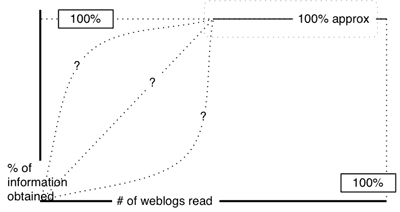
If information was distributed evenly throughout webloggery and weblogs were read randomly then take-up of information would be linear and stable – in order to get 100% of the insights, you’d have to read 100% of the weblogs.

Linear gradient

[In this first graph I’ve plotted on the left the amount of information that you’ve managed to assimilate versus (on the right) the percentage of the weblogs that you’d have to read in order to get that amount of information – in the very specific special case that information is distributed evenly and randomly. The features of this “special case” will gradually be removed over the rest of the article. Another point I should perhaps clarify is that I’ve tried to conceive of the bottom axis as also including the order in which one reads the weblogs – that should become clearer through the article…]

However, we know it to be the case that information will not be distributed evenly throughout these weblogs. Many weblogs will contain limited information of any kind. Some will contain a lot. Many will contain replicated information that could easily be found on other sites.

Graph reaches 100% earlier

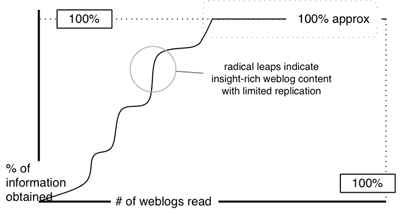
In this graph, ignore for the moment the dotted lines on the left. they represent nothing but the uncertainly fo the beginning of the curve. This diagram takes into account that weblogs have different levels of insight withint them, and that information is often replicated (either by active memetic spread or because the insights are simple and common). In the vast majority of cases then – even given that you’re still reading weblogs in a totally arbitrary order – it’s likely that you’ll get extremely close to the 100% saturation point a significant way before you’ve read 100% of the available weblogs.

In practice – again assuming that you were reading the weblogs in a random order, it would be impossible to gauge the particulars of the curve that led up to the near-as-dammit-to-100% information saturation point. A sample curve would probably be organised in a series of steps – with gradual accretion of insight being the normal, but with occasional significant massive leaps also occurring.

The line becomes a series of progressive steps

Now – all these models have been based upon the assumption that the order in which the weblogs are read will be random. In fact nothing could be further from the truth. Some weblogs are clearly more likely to be read – this is not necessarily purely based upon the value of their contributions, but it’s not completely distinct from such valuations either. It would probably be fair to say that on average well-linked-to sites are more likely (albeit perhaps only incrementally) to contain insight than sites which are not linked to at all. Secondly, if someone does produce content of value and insight on any specific subject, then it is more likely to be linked to – which in turn increases the likelihood that an individual will visit the site in question.

Both of these criteria suggest that (in our attempts to reach the 100% insight threshold) we will be more likely to be initially directed to high-insight sites than low-insight sites. This changes our graph substantially.

The graph starts strong and levels off close to 100%

It seems likely, in other words, that even if there’s a limited tendency for sites with more insight to be read first – then the information accretion would be remarkably steep initially and the level off dramatically close to the 100% saturation point.

Hypothetical conclusions: For any given body of information on weblogs, no matter the rate of replication of information or the number of people who post exactly the same comments, close to 100% of the available insight can be reviewed by reading a disproportionately small number of sites – sites that will – as a rule – be among the first that they stumble across through their normal browsing and research patterns.

Related Hypotheses perhaps worth exploring: (1) The larger the number of posts about a subject (and hence the more likely replication) the smaller the proportion of those sites that need to be read in order to have reviewed close to 100% of the available insight. (2) The size of the available insight will increase as the number of posts about a subject increases (although perhaps not in linear proportion).

Categories
Random

Remodelling…

While I have the opportunity, I’m trying to get a few things done around the site. I’ve removed the files section of the site (which is where I used to put all my longer pieces) and I’ve put those posts back into the rest of the site. And to make it easier to find them (and some other stuff from around the weblog that’s worth preserving), I’ve created a best of… section that is essentially a categorised guide to stuff that other people might actually find useful.

I still think there’s some woolliness around the edges, and please god don’t read the introductory copy on some of the category pages – it’s bloody terrible. But at least this now does mean (for example) that I can start pointing towards the social software or the personal publishing parts of the site… And no – I’ve not planned for separate RSS feeds yet, so don’t even ask…

Categories
Random

What's happening at UMS…

I’ve just been reading the Media Guardian’s piece on uSwitch buying UpMyStreet. Obviously closest to my heart is what they’re going to be doing with Conversations, which I think many of us believed was only the beginning of what we could do around geocoded community features. I’m delighted to hear that they’re still going to running it – even developing it further – although obviously it’s disappointing not to be part of that process…

The site, which has 650,000 unique users a month, recently launched a message board service called Conversations that allows neighbours to contact one another. Mr Salmon said that this area would also be developed in order to get people to return more often. “I want it to be a site that people go to every day in the same way they would the BBC or a financial news site,” he said.

Categories
Life

###Tom For Sale###

As many of you know, UpMyStreet.com – the company where I have worked for the last ten months – put itself up for sale a few weeks ago. Many of my co-workers prudently put their CVs online at that time, but for a variety of reasons, until now I’ve not done so. Yesterday a deal was finally struck which sold UpMyStreet to uSwitch, but unfortunately the other company’s offer was not for the entire organisation (cf. Stefan’s comments).

As a result – effective immediately – I now find myself looking for a new project to work on. Ideally, I’d be looking to be developing some new social software or community projects (either public-facing or within organisations) or to work around personal publishing and user-generated content. However, I’m also open to possibilities in other areas, so if there’s something you’d like to discuss with me, let me know…

If you have any questions, suggestions or are looking for clarification on anything, then please don’t hesitate to contact me directly – My e-mail address is on my CV.

Categories
Random

The pure unadulterated Joy of Linkage…

For a variety of reasons that I’ll go into later in the day, I’ve not found myself able to post for a good few days now, so I think I’m going to get myself back into the swing of things by a quick block of back-to-basics weblogging. All that follows is simple, entertaining and fun. Nothing intellectually stimulating, nothing ideologically threatening, nothing (indeed) about social software. Just good quality linkage:

Categories
Random

UkBloggers discuss…

For anyone out there who is interested in another avenue for the discussion of weblog culture – particularly in the UK – I can particularly recommend the UK Bloggers Discuss list at the moment…