Categories
Random

Links for 2005-08-30

Categories
Navigation Radio & Music Social Software

Reinventing Radio: On Phonetags…

This post concerns an experimental internal-BBC-only project designed to allow users to bookmark, tag and rate songs they hear on the radio using their mobile phone. It was developed by Matt Webb and myself (with Gavin Bell, Graham Beale and Jason Cowlam) earlier this year. Although the project is a BBC project, all the speculation and theorising around the edges is my own and does not necessarily represent the opinion of my department or the BBC in general.

We have more television stations than we have time to watch, more radio programmes than we can fit in analogue frequencies, more music and film availablethan any human could consume in their lifetimes and a huge ever-growing world of information growing every day on the internet. And this is just the beginning. The next push is the archive – decades of programming coming online, lost films recovered, libraries being digitised. But the scale of even this content is dwarfed by the third push into the world of the amateurised content-creator, where potentially billions of people are putting information and media out into the world as a matter of course.

The most substantial challenge to technology creators, media creators and distributors is – then – to find ways of making this enormous and every-growing repository navigable and sensible to real people. There are substantial rewards to be found in finding ways to help people find their way around this space – and people familiar with the challenges of the web over the last ten years are in exactly the right place to work out what these navigable mechanisms are likely to look like. But you don’t only have to create the navigation to reap the rewards – the organisations that can supply the right metadata, supplementary and structured relationships about and around their media will be the ones that will survive most easily inside this new ecology.

There’s also one more major challenge. Current media distributors and large-scale media creators are going to find themselves suddenly operating in a market of peer creators, where hundreds of people can create and interact and respond to the media around them. The network is already a challenge to broadcast – people who use the internet a lot use television less – but this is a new challenge. It’s a challenge of participation – where one-to-many broadcast-style content has to figure out how to find new ways of getting their ‘audience’ involved. This is a challenge that’s all over the place – and it’s a problem of bandwidth. How does one show or product or team respond to and respect the input of hundreds of thousands of individuals, and reflect it in what they make? If you’re last.fm it’s easy – you give everyone something different. But if you’re a popular content creator with one outward channel that’s the same for everyone, things get a little harder. How will they adapt?

This is the world that a few of us went to ETech this year to talk about. Mr Biddulph and Paul Hammond talked about BBC Radio’s current offerings and live work, particularly digital radio, on-demand streams and RadioPlayer and the famous Ten-Hour Takeover. Meanwhile Mr Webb and I talked about some more experimental work we were doing (in collboration with people like Gavin Bell) on the assumption that navigation, interaction and user-creativity were the core media issues of the next twenty years. We talked particularly about two projects: Group Listening and Phonetags. At the time, I promised to post something about the latter project at the time, but I never got around to it. After renewed interest from the FooCamp crowd, I thought I’d do it now.

Radio networks have always been interactive, but they suffer from bottlenecks. If you ask people to vote in a poll and then report the results, then you are to an extent reflecting your audience on air. But it’s a fairly homogenised and averaged-out view of their beliefs – pushed through a fine-meshed sieve. The variety is completely lost in the aggregation.

On the other hand, if you want to get some of the spice and individuality of the individuals concerned you can pick out specific individuals from your audience and put them on air (or mention them). Unfortunately, many individuals find the prospect of being on air more than a little intimidating – and of those that don’t, still only a fraction can actually be featured on air.

Both of these approaches have worked perfectly well for many years – but we’re now at a point where we can start thinking beyond them. So the question now is – what is beyond aggregation and lottery? What new patterns of interaction can we form around and within broadcast now that we have a networked world to hybridise with it?

Phonetags is an experimental project designed to try and help us get some purchase on some of these questions. The best way to describe it is to start off with some Principles for Effective Social Software that we developed as a result of working on the project. I’m not going to pretend that they cover everything, but they’ve proven very useful for us. We believe that for a piece of Social Software to be useful:

  • Every individual should derive value from their contributions
  • Every contribution should provide value to their peers as well
  • The site or organisation that hosts the service should be able to derive value from the aggregate of the data and should be able to expose that value back to individuals

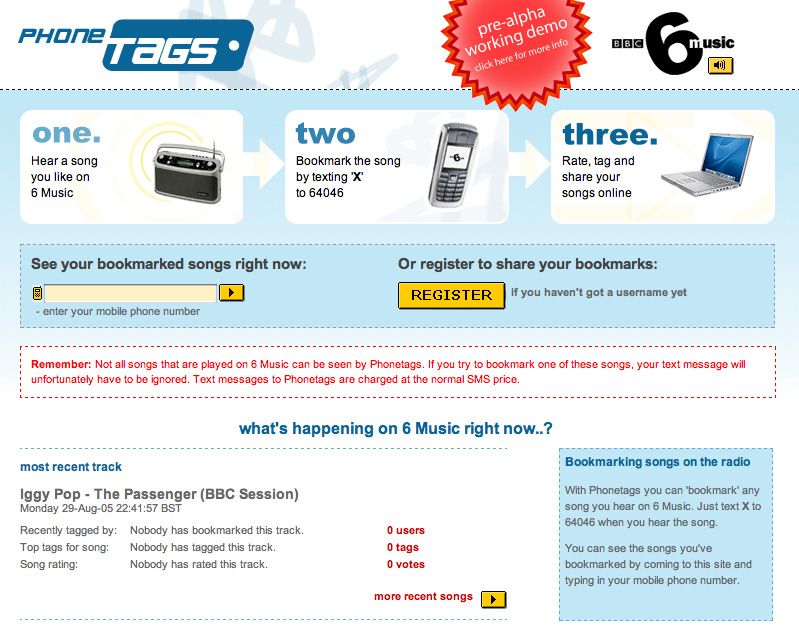
So this is how it works. Phonetags is about bookmarking songs you hear on the radio using your mobile phone. The way you use it is very simple. If you’re listening to a radio network (initially BBC 6 Music) and you hear a song you’d like to make a note of, you pull out your mobile phone, type an ‘X’ into an SMS (remember: X marks the song) and send the text to a BBC short-code. Later when you come to the site, you type in your mobile number into the search box to see a list of all the songs that you’ve bookmarked:

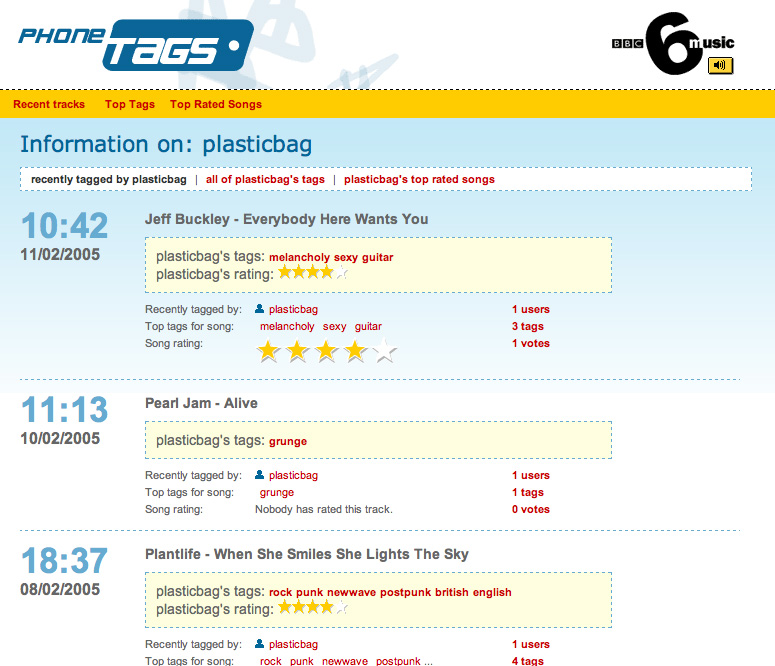
As you’ve probably already noticed, bookmarking isn’t the only thing you can do with Phonetags. You’ve typed in the ‘X’ to bookmark, but you can type in other stuff too – any words you type after the X are considered tags in the same style as Flickr and del.icio.us. You can navigate your own tags and explore other people’s tags – both in aggregate and individually as you see fit:

You can probably start to see in the latter screenshot why this stuff starts getting so valuable for us, at least. Those keywords – along with their reflected popularity – are starting to provide a pretty clear articulation of what the concept of ‘rock’ means.

Alongside the bookmarking and the tags, we added a new concept called ‘magic tags’. Basically these are special tags – like magic words – that perform some action upon the song that you’re bookmarking. At one level you could view them as nothing but compensation for a lack of UI widgets in an SMS interface, but there could be value in having tags that were both semantically interesting and also performed an action of some kind.

The tag we used in this circumstance was a simple ‘rating’ tag. If you wrote a tag of the form *one, *two, *three, *four or *five, you would mark the song as having been rated one-five stars for quality. This seemed to make a lot of sense in the music space, as it’s something people are familiar with from applications like iTunes, and you could imagine a range of circumstances where people might wish to express their opinions on songs played.

This view results in my favourite view in the entire system – that of the top-rated songs for any given ‘tag’:

A page like this exists for every tag in the system – there are pages of the top rated indie songs, pop songs, guitar songs, summer songs. You can imagine a whole range of possibilities for extending these pages to make them permanent or to atrophy with time / create weekly charts. It’s a huge mine of interesting musical information and a great way to discover new songs.

Anyway, the point of Phonetags was to try and find a different way for a user or audience member to participate in programme-making and to collaborate with one another without any of their contributions being lost, and with the value accreting over time.

In this model, a user gets value from their very first contribution – by having a song bookmarked that they can return to later. They gain extra value by being able to keep track of and comment upon the songs that they’re listening to – and when they do so, everyone else starts gaining value as well.

The peer benefit is in music discovery and navigation. There’s an incredible amount of new music being produced all the time. Our increased access to it means – in principle – that we should be able to find music that we felt more appropriately suited us, but the sheer volume makes it hard to explore. With a service like phonetags, an individual can start exploring music by axes of quality, or by keywords or by discovering people with similar tastes to themselves. And it gets updated in pretty much real-time.

Radio DJs gain a little bit of this experience too, in that they’re able now to operate as a peer in this exchange – tracking a bit more rapidly how well people are responding to songs, and using the live site as a way of mining for songs on any given theme (give me ‘happy’ songs, songs about ‘summer’, songs about ‘mum’, songs about ‘fruit’). They can also court reactions from their audience – rate all the songs in this week’s shows and we’ll play the best at the end of the week…

But it’s behind the scenes that I think the most substantial value could be created. We’re getting in incredible metadata on music that we simply didn’t have before – metadata and descriptive (emotive!) keywords that we can analyse and chop up and use as the basis for all kinds of other navigational systems. This is metadata that is often sorely lacking and could help us enormously in the future.

Anyway, I’d be delighted to hear any comments or thoughts that anyone has on Phonetags. All the images above can be clicked on if you want to see a larger version. If you want to contact me, then it’s tom {at} the name of this website (as usual). At the moment, we’re testing this particular version of the service inside the BBC (it’s available to all BBC staff to use so if you want the URL, then just let me know). The project is unlikely to be released to the public in its current form – but we’re using it as a way of testing out some of these concepts and approaches – some of which will probably manifest in upcoming products in one way or another.

And just to give you the disclaimer one more time: Phonetags was developed by Tom Coates and Matt Webb with Gavin Bell, Jason Cowlam and Graham Beale. However, all the opinions expressed in this piece should be considered as my own personal take on the developing media landscape, and not necessarily those of my employers or the department in which I work.
Categories
Random

An archaology of weblogging…

A much more exciting title than post, I’m afraid. I’ve spent most of the afternoon battling through an installation of MT 3.2 that has thrown up more unexpected pitfalls and collapses than a solo walk to the North Pole. But I’m now past the horror and what do I find? A little option revealing all the posts I have left stashed in the archives half-finished and unpublished. There are – count them – seventeen of the little buggers. Each one is pretty long, because they’re the ones that I tend to abandon half-finished. I have an evening at home to look forward to, so I’m going to try and polish off a few of them and get them out in public before I lose the drive. More later, hopefully…

Categories
Gay Politics

What lies beneath 'gay' and 'straight'?

There’s an article I’d very much like to write about in the Guardian today, except that it seems to be one of the only articles in the damn magazine not posted up online. And worse still, I wanted to take it to task by colliding it with another article that I read sometime earlier this year in New Scientist. Unfortunately, I can’t find that article online either. The web has failed me. Or more specifically, The Guardian and New Scientist have failed themselves.

The article in the Guardian concerns itself with the question “What really makes us gay or straight?” and talks about the biological research into gay genes, the shape of the brain, the influence of sex hormones in utero and childhood behaviour. I read extensively around this subject a few years ago and was relatively convinced by the argument that there is a biological rather than sociological basis to gay sexuality. This wasn’t a shock, of course. No one seems to think it’s even a legitimate question to ask whether heterosexual sexuality has a biological basis, after all. Perhaps we should start…

The Guardian’s retelling of this research is a bit suspect to me, though – and has opened up a bit of a troubling problem for me. The article – much like many others I’ve read recently – seems to be rife with stereotype, innuendo, conflation of categories and misunderstandings of the complexity and variety of people in the world. It implies a world where societal prejudice seems to govern the terms and limits of the scientific research. It suggests to me a form of science which has taken the labels and political allegiances that individuals been labelled (or have used to self-describe) and reified them to undeniable facts of nature. Imagine a western culture where all non-whites have claimed an identity of ‘black’ or ‘people of colour’, and now imagine a science organised around determining what it is that makes all these people non-white. That’s what the science that the Guardian reports feels like to me…

Which presents me with a problem. Is the science itself deformed and collapsing? Are the categories actually useful and legitimate but unsupported in the discourse of the press? Or is the press simply misunderstanding or recasting the science in clichéd, prejudicial terms it thinks that its readership can understand? It’s led me to think about all kinds of questions – from the role of the press as an intermediary, through to the number of gay people working in these fields. It’s all very troubling.

Let me give you some examples. The structuring principle of the whole article is the case of twin boys ‘Thomas’ and ‘Patrick’. They are both seven. The article states:

Patrick is social, thoughtful, attentive. He repeatedly addresses me by name. Thomas is physical, spontaneous, a bit distracted. Just minutes after meeting me outside a coffee shop, he punches me in the upper arm. It’s a hard punch. They horse around like typical brothers, but Patrick’s punches are less forceful and his voice is higher. Thomas charges at his brother, arms flexed in front of him like a mini-bodybuilder. The differences are subtle – they’re seven-year old boys, after all – but they are there.

When the twins were two, Patrick found his mother’s shoes. He liked wearing them. Thomas tried on his father’s once but didn’t see the point. When they were three, Thomas blurted out that toy guns were his favourite things. Patrick piped up that his were the Barbie dolls he discovered at nursery school.

Their mother was concerned. She wanted Patrick to be himself, but she worried that his feminine behaviour would expose him to ridicule and pain. She decided to allow him free expression at home while setting some limits in public. That worked until last year, when a school official called to say that Patrick was making his classmates uncomfortable. He kept insisting that he was a girl.

When you get to the end of this particular chunk of stuff, you’re left with a few questions. First you’re left with a sense that the little boy in question clearly exhibits some ‘feminine’ traits. After that, my immediate impression was that the child in question was exhibiting some form of transgender behaviour. He even said that he wanted to be a girl. But there’s no mention of this in the article. Instead it launched straight into a discussion of the incidence of homo- versus hetero- sexuality in children that exhibit ‘Childhood Gender Nonconformity’:

Not all homosexual men show this extremely feminine behaviour as young boys. But the research indicates that, of the boys who do exhibit CGN, about 75% of them turn out to be gay or bisexual.

Now it’s difficult to know where to start unpicking this one. Firstly we’re given no sense of what proportion of people born male who end up being gay exhibit this ‘Childhood Gender Nonconformity’, so it’s incredibly difficult to tell whether or not it’s in any way representative of the wider category or not. Secondly, ‘Childhood Gender Nonconformity’ seems rather woolly – particularly when you consider that most people don’t remember their childhood behaviour terribly well, and many parents will be probably pretty prone after the fact to try and make sense of it all with, “well he did choose that pink piece of candy once in that shop rather than the blue one”-post-hoc rationalisation. But most importantly, what if these children are transgendered? What if they’re not actually ‘homosexual’ at all – but consider themselves biologically the wrong gender? Then they could grow up as ‘straight’ in their minds and only ostensibly gay because of an accident of biology. Fundamentally, what if the behaviour of finding (say) men attractive had many disparate manfestations with different roots? Is the homosexuality of an apparently male, but self-identified female, man-fancier really the same as the homosexuality of someone who identifies as male and still fancies men – whether they be drag queen, leather queen, dom or sub, top or bottom, bear or cub, versatile or polymorphously perverse?

I’m afraid I don’t think they’re the same thing at all – I think that sexuality and gender are much more varied and complex than most of these bits of reporting and ‘science’ indicate. “Homosexuality” is a descriptive label for a whole range of behaviours, sex acts and attitudes, just as “Homosexual” is a clumsy label for a much wider variety of people – just as “Heterosexual” in turn. And the articles own statistics suggest problems with the theory. If the children did grow up to be transgendered in some way, even then it’s not completely clear that they’d be end up attracted to people of their born-gender. There are many reported cases of male-to-female transexuals, for example, who still report being attracted to women – much to the consternation of a lot of the general public who can’t seem to grasp that there are a lot of gay men who do not want to be women, just as there are a lot of transexuals who do not see a direct correlation between their gender identity and their sexual preference.

Fundamentally, the whole problem for me in the article – and perhaps in the science – is that these simple correlations are swallowed whole. Men fancy women, women fancy men. The map of divergent sexualities is presented as map of miscegenated genders. And homosexuals are all the same, created by the same processes, through simple changes or errors producing an identical class of deviations from the norm – a group of people who are the same because they share a name, whether or not there is any ontological similarity in their sexualities. It’s clumsy and – I think – a little stupid.

This is kind of where I wanted to bring in the article from New Scientist, which I just can’t find. The article basically talked about this idea of ‘male’ versus ‘female’ brains and what that entailed. I’m writing about it from memory, so you’ll have to forgive me if I get some details incorrect. Fundamentally, the argument has gone like this – men and women are fundamentally different in many ways in the brain. If you do comparative studies of men and women you can map these differences – the example that everyone knows is that men are better at spacial reasoning. So, in fact, it is possible to bluntly look at a man or a woman and say that statistically he/she’s likely to be good at some things and worse at others.

Now, the interesting thing comes when you actually look past the gender of the subject and start to categorise the responses and the brain organisational patterns. And it turns out that you can loosely categorise the brains into three categories – a brain pattern traditionally associated with the male, one with the female and one that seems ‘balanced’ between the two. But that’s not the most interesting bit. The most interesting bit is that people who are biologically male are mostly split between the ‘male’ and ‘balanced’ brain patterns, where biologically female people are split between ‘female’, ‘balanced’ and ‘male’ brain patterns.

So yeah – in aggregate you can start making bland claims about biological and profound differences between genders, but in the end it turns out that these are only aggregate changes. There aren’t two brain patterns, there are three (on this metric), and they’re not split between the genders, they’re distributed differently among them.

I want to make the same claims about sexuality – that it is quite possible to make aggregate claims about ‘heterosexual’ & ‘homosexual’ behaviours in men and women, but that until these are all shown to be consistent and to have congruent explanations, we must assume that there are deeper patterns of organisation to be uncovered. These may represent entirely different ways of categorising, exploring and unpacking concepts of gender and sexuality – generating different maps of our selves and different ways for us to gain purchase on our identity.

Unlike many other people I have met, I want to know why I am the way I am – I want to understand what it means to be gay (whatever version of gay I am). I think there are straight people in the world as well who would like to feel the edges of their preferences, to understand how things fit together and where the intersections are between their identities and what they get up to (or don’t) in bed. I want a science in the world that is prepared to explore all aspects of our lives and shine light in the darker places, but that is open-minded enough to not try to simply prove or disprove the prejudices of society but to reach some greater understanding. It’s a shame that I find myself so often disappointed.

Addendum: Thanks to MacDara for pointing out that the Guardian article in question is a reprint of a piece from The Boston Globe and is available here: What Makes People Gay?

Categories
Random

Links for 2005-08-29

Categories
Random

Links for 2005-08-28

Categories
Random

Links for 2005-08-27

Categories
Film

A review of Joss Whedon's "Serenity"…

Last night – eight hours after landing back in the UK – I went to see a very special movie. In fact I went to see a very special preview of a very special movie. I went to see Serenity. And if you like adventure films, character-driven drama, sci-fi or just have any desire to watch something intelligent, exciting and funny, then I thoroughly recommend that you watch it too. It’s as good a film as the Lord of the Rings films at their best. All the recent Star Wars movies put together aren’t fit to clean its boots. I can’t think of a sci-fi film in my recent memory that can touch it, frankly. It’s out in a month. You will go and see this movie

Now I have to be honest with you, I – like many many other people – was a fan before I got in the room – although my love for the show was far from immediate. I’d loved some of Joss Whedon’s earlier stuff on Buffy and Angel – smart shows with vivid characters that burst out of the genre fiction ghetto – but the premise of Firefly hadn’t really immediately grabbed my attention. In the end I won the DVD in some ludicrous competition and after ignoring it for a few weeks, I started to watch the show that had been cancelled before the end even of its first season.

DVD Disc One was pretty good, but it took until the end of the second disc for me to start realising that I was loving every minute of it, and from there I just started devouring episode after episode. And it started getting more and more entertaining until suddenly… Nothing. The end. Cut down in its pride. I bought the DVD for a few friends, and watched them fall in love the same way I had. And then we heard about the film…

So the story goes a bit like this – 20th Century Fox cut the show down before it was finished. No one was watching it. Who can blame them. But the DVD sales – fueled by word of mouth and an almost insane love of the show from its fans – were enormous. Based on this and the strength of the premise and characters, Universal decided to fund a film. This never happens. This is really really strange.

And what’s the film like? It’s big and its funny and it scary and it’s unafraid to talk about big stuff. I do not think that having seen the TV series is necessary to enjoying this film, but I can’t say for certain. The set-up is strong and introduces as many of the large group of character as you could possibly expect. There’s enough here to carry anyone into the universe and to care about what happens to the people in it. It’s an action-adventure but it’s not plotless or trivial, and so it’s possible that fresh audiences dealing with multiple backstories might find it a little confusing the first time through. But even if they are, I think they’ll get enough from it to want to see it again. It is a very. good. film.

And if you have watched the show – you’re in for a treat. There is nothing here for a fan to quibble about, and their added familiarity with the characters and investment in their lives will make the whole experience that much sweeter, more painful and more engaging. I totally agree with Londonist on pretty much all of that stuff. And what happens? I can’t spoil it for people – except to say that the battles are huge, the characters true and you could not expect such a battle to be fought without cost.

And you’ll get your ending if that’s all you want. You’ll be happy. Those fans who felt the show was left to die in its infancy will see it get the send-off it deserves. But I want more. After the screening, Joss Whedon himself and Summer Glau participated in a little Q&A session. Joss is funny in person. He’s personable and pleasant and a bit geeky. He’s put his heart and soul into this movie and it shows. He took a considerable amount of time to answer people’s questions and talked about an enormous range of subjects. He clearly wants to get the fans motivated and out in the world proselytising.

And for once, I don’t begrudge it. For once, I’m not suspicious. I don’t feel manipulated by marketeers. This film is worth celebrating. It’s worth shouting about. It deserves a sequel. If ever a fan favourite deserved to succeed its this one, and it deserves to succeed now, not on DVD in decades to come. So stir up the family, get your friends to watch the series and realise what they’ve been missing, and get yourself down to the cinema with about a dozen other people when this film is released. The word is out. You won’t regret it. This film is shit-hot. And if you don’t believe me, then check out its IMDB Rating of 9.1 from 1358 users. It’s a classic in the making…

Categories
Random

Links for 2005-08-25

Categories
Random

Thanks for the dinner invitation, Heather!

I just thought I’d share this with the world, because it might be the coolest dinner invitation I’ve ever received in my entire life. Thanks to Ms Champ and hopefully I’ll see you this evening!