- Awesome bizarre beautiful Java animation that you need to watch immediately (thanks Mr Webb)
The rules are simple, each time a ball reaches a branching point it divides. When the paths converge and two balls hit, they cancel each other out… - Harry says sorry for Nazi costume
Oh Jesus Christ… As if people weren’t nervous enough about ultra-rich establishment types being a bit on the right-wing side… - Awesome piece of iPod-related black surrealist British comedy by Arnando Ianucci
Excepting the new series of Monkey Dust which sucks a bit, British comedy seems to have recently taken a real turn for the better. If by better you mean awesomely weird… - Alice reposts some intriguing stats about users of Massively Multiplayer Online Role-Playing Games
Basically everyone gives up telly and hangs around online with their mates (quite right)…
So after due consideration over lunch at Benugo the other day, here is our fully worked-through and comprehensive list of our ideal celebrity / historical / fictional Big Brother:
- Germaine Greer
- Jessica Rabbit
- Gizmo
- Marcel Marceau
- Princess Peach
- Captain Nemo
- Alien
- Miss Marple
- Lara Croft
- HAL 9000
I’m particularly keen on the idea of having HAL 9000 – a disembodied omnipresent computer intelligence – in the Big Brother house. Ho hum.
Links for 2005-01-13
- So yeah the Mac Mini is nice and all, but have you seen the size of the power supply!?
I want a Mac Mini. It would make emigrating much much easier in the future… - Vote for me as Best British Poof in the whole fucking world
Because I am, you know. I’m a god. I’m a golden god. - Blogger sacked for sounding off
For God’s sake of course you get fired if you publically refer to your employer as “Bastardstones” and write rude things about your boss all the bloody time… You have to learn to sublimate your rage! Duh!
Links for 2005-01-12
- Airclick remote control for your stereo-connected iPod, via Mr Webb
“AirClick USB is a remote for Mac and PC computers. The receiver module attaches to any available USB port (including hubs) and receives signal from up to 60 feet away.” - North Korea’s equivalent of Big Brother is entitled “Let us trim our hair in accordance with Socialist lifestyle”
The BBC doesn’t really have that many equivalents any more, but the rest of the UK media really does – How Clean is Your House? Too Posh to Wash? - My first ever post to Usenet, back in June 1995
This is back when I was trying to plough my way through a doctorate in Classics, before I threw it all away and ran off to the big city to make beautiful web things - Winners of the “I Look Like My Dog” Contest
There’s not an awful lot more you can say about this. They do indeed look like their dogs. In turn I think I’m started to look more like my Powerbook. - ISAN (International Standard Audiovisual Number)
“The ISAN identifies works, not publications or broadcasts. The ISAN remains the same for an audiovisual work regardless of the various formats in which the work is distributed (e.g. DVD, video recording) or the uses to which it is put.”
Just a brief note: the iPodShuffle was one of the products released today by Steve Jobs and the Apple team. It was long-rumoured and kind of makes sense in a do people really want something that can only take that much music? kind of way. Fundamentally it’s a USB thumb-drive with a music player in it, and it’s not enormously more expensive than just the thumbdrive alone. So it’s pretty reasonable, all things considered. I won’t be buying one, but hey…
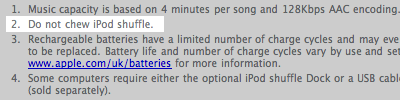
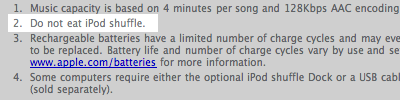
But I was talking to Gavin about it and he pointed out that Apple had been considerate enough to add a little advice to people who might have been confused by its small size if placed too close to a packet of gum. Specifically point two below:

But perhaps what’s even more peculiar is the UK version is very subtly different. I wonder what this says about our national characters:

PS. While I’ve got you here, I just want to whore you over to see what I was hoping for originally from the alleged ‘headless iMac’ and the posts I wrote about potential Apple media hubs.
Apple keynote time…
So I got the first block of my thoughts around media hubs out of the way before the Apple keynote, so that’s good. I’m happy about that. For anyone who’s interested, we’re all ‘watching’ it via IRC on irc.apple-x.net and via the low-bandwidth stealth reporter at macrumors.com. Ping me on IM as well if you want to joint the tiny UK coterie of freaky geekniks who are dribbling at the thought of yet another glorious keynote. Vive le Steve!
This part is mostly about: Illustrations of what an Apple Media Hub might look like and how it might function. If you have not done so already, you should first go and read Part One and Part Two which do not contain pictures anywhere near as pretty and are harder work to read.
What follows are illustrations of my basic concept here – a brushed metal, almost featureless box that sits underneath a television acting as wifi hub bringing internet access and local area network functionality into the home – and providing as a basic first feature set (1) the assisted capture of video from the TV or from CDs, (2) the watching of DVDs and (3) the remote-controlled play of media across multiple devices through local hubs. You can download the full diagram from here: Full Apple Media Hub Montage, or you can just peer menacingly at the details below:


This part is mostly about: How to get a device into people’s homes that opens up these markets and these possibilities and lets people do more stuff with their stuff. If you have not done so already, you should first go and read Part One.
So from now on, I’m going to talk a lot about what I think specifically Apple should do because I think they’re the best placed in the world to do this stuff right now. Their brand isn’t as geeky as Microsoft – and they’re have already demonstrated that people will buy entertainment technology from them (the iPod) even though they’ve traditionally been better known for their computers. Companies like Tivo – at least at the moment – are too narrowly focused on one form of digital media to really be able to mount that much of a challenge in this area (and I think they’re probably more than aware of that by the way that they’ve started to work more with Microsoft. Sony would also be a good condender in this area if they weren’t busy trying to develop new types of smart guns with which they can shoot themselves in the foot with startling new levels of efficiency.
One of the big questions that we’re going to come up against in thinking through the home media hub will be how do we get people to buy the devices we’re talking about. Not all new technologies gel with consumers immediately. One technique for getting new tech into people’s homes is to combine or hybridise it with existing equipment. Many people had their first DVD player as a pleasant side-effect of buying a Playstation or Xbox. The Xbox also allowed people to rip songs to its internal hard disk – functionality that I doubt many people would have gone out and directly bought at that stage. And Playstations with built-in PVRs have been mooted for a while now. Hybridisation seems to be an almost natural process when it comes to the handling of media – potentially because the web-like models and increasing mobility and granularity of media objects that we’re moving toward is turning out to be similar for video, web pages, songs, photographs… So hybridisation is likely to be an answer – but hybridisation with what?
So the obvious bits of existing technology that our future home media hub will need to be able to hook into with are:
- The internet – for the purchasing of on-demand video and music, and to have a return path for data
- TV – for video playback and rich visual interfaces for stuff
- Audio equipment / Stereos etc – for the playing of downloaded or ripped music
- Home computers etc, that may wish to manipulate or handle media artifactrs in some richer way
What hardware / functionality does this imply?
- Obviously the first piece of implied functionality that any hub has is a large amount of digital storage and some way of navigating around the material stored upon it.
- If we want this device to have mass appeal then it has to be something that you could sell – or rent as part of a service package – to people who don’t yet have internet access (or don’t even have a computer). One clear way to do this would be to disaggregate internet access from the computer, and instead place some form of cable or ADSL modem within the media hub itself. This would seem to me to be the most reasonable approach.
- In order to distribute that internet access to other devices, the simplest solution would seem to be to fit the device with a wifi hub. This immediately creates the potential for a local area network of connected devices streaming and connected to one another without the complexities of setting up dedicated routers. In principle then small Airport-Express style local hubs could be distributed next to other devices in the home that do not yet have home local area network functionality built into them. This could also distribute the internet access throughout a home in the most effective way.
- If there are going to be any cabled connections then it would make sense to have them be between the device and the equipment with which it is likely to communicate the most possible data. This may very well be a local computer or laptop for some people, but for most – with video files being so enormous, it makes most sense for the device to be attached to the home television.
- And in order to be a useful device for storing or playing digital music, then – if again we assume that we’re marketing to people who may not have a computer already – then we have to consider putting some kind of CD-playing or ripping functionality into the device itself.
- This has another advantage, because if we’re considering putting in a CD slot, then there seems little reason why the same slot should not be usable for DVDs. This would then immediately increase the value of the device for people – particularly given that we’re already assuming that it’s going to be connected to the television in some way.
- And given that we’re talking about handling large files and connecting to a television – PVR functionality seems like a natural fit.
So far then, we have a box (and not yet a desperately inexpensive one) that should be connected to a television, has a large hard-disk within it that can contain video and audio and has a slot for inserting DVDs or CDs. This is essentially then, a cut-down monitor-less iMac – for those of you who have been paying attention. Clearly you’d want to to create non-OSX-style interfaces since people are likely to want to use the device via a remote control of some kind, but if such a device has been mooted for around $500 (by Mac rumour-mongers), then it’s not inconceivable that you could bring something to market that people would be interested in buying.
In fact, if you look at devices that are already on the market, there are some that are not a million miles away from this model already. Two particular devices are already available that attach to a computer, have large hard disks, have some wired connections via the telephone or ADSL – and one of them already allows the ripping of music. On the one hand we have the dedicated PVR and on the other the dedicated gaming platform.
In order then to get this new device into people’s homes you could either:
- Further develop the entertainment features of gaming consoles, making them into full media hubs for the home.
- Further develop the connectivity and cross-media functionality of the PVR to a similar effect.
Marketing our partially mooted speculative device as an extension of a gaming console has some clear advantages – there’s already a decent amount of money to be made from gaming, the people who use them are keen consumers of new technology and much of the functionality is already in place. If I were Microsoft of Sony I would be moving in these directions. But I think I’d also be looking for a model that would appeal to a wider market than gamers. For many the gaming elements of a hybrid device could be a turn-off.
PVRs are similarly strong in some areas, but they haven’t yet set the world on fire. The consensus opinion appears to be that the main problem is that it is hard to articulate to people what a PVR does. Once people have bought one, they generally find them a delight to use. In which case a company like Apple that has little chance of being able to bring a successful gaming console to market is still in with a chance. It’s not necessarily terribly hard to evolve the concept of the PVR into a cross-media device, for watching and recording TV, watching DVDs and streaming music around a home. And once you’ve turned it into a media manager, then all Apple would have to do is make reference to their other successful piece of navigational technology:
DVD Player, iTunes at Home, PVR – it’s the iPod for everything else
At this point you should have a bit of a sense of the direction I’d be going with this stuff, so I’ll move on to putting up some illustrations of the concept and trying to articulate precisely how I think it should work…
This part is mostly about: The drive towards digital media in the home, and changes in the media creation and distribution ecology:
So I’m going to write this quickly because it’s been stuck in my head for months, and even when I’ve dedicated large chunks of my weekend to trying to get it down, it hasn’t gone terribly well. So my assumption is – find a place to start. Run at it like a mad thing. Don’t worry too much if it’s really dense or confusing, or childishly stupid in places or really badly written or wanders off the mark. Just get it out in the open with all the pretty pictures and stuff you’ve been thinking about before you go insane.
The starting point is an assumption. It’s that we’re looking for better connection between our entertainment devices and our computers, and that we’re increasingly looking towards fully digitally-distributed entertainment media in all parts of our lives. Fundamentally I’m looking at what kind of future home-entertainment-based, digital media playing and manipulating Digital Hub should we be aspiring towards?
The other assumption is that there are companies out there who are interested in working in this space. I think this is demonstrable by looking at the people already in the environment – companies like Sky, Tivo, Apple, Microsoft etc. Again – not a huge assumption to be making.
One of the reasons that companies are interested in this space is because we’re finally reaching the point where home entertainment electronics are converging with computer technologies and the internet. A whole generation of web users are circumventing traditional media distribution channels to get hold of their television programming, films and music. The people who make these things are now looking to go back on the initiative and bring greater functionality – functionality under their control – back to the people.
In the meantime, the companies that make technology and software have clearly realised that there’s money to be made in meeting these needs and so are developing technologies at a fair rate of knots. One way to think about this is to think about the number of desktop and laptop computers in the world and then to think about the number of televisions, VCRs and standalone DVD players in the world. Now imagine that you’ve cornered the market for the operating systems for all these devices. For Microsoft – that’s got to be an insanely attractive proposition. You add to that some attempts to help mediate between content producers and people who watch and view content – DRM, for example – and you start to look indispensible to the ecology. And that’s kind of a license to print money – particularly if (like Apple) you’re also trying to make your service the definitive place to buy the media products themselves…
You could take this still further. Traditional broadcasters have had it pretty easy. They had regulated but basically pretty neutral carriers that they paid cash money to. Then they got to broadcast a set of TV and radio programmes when made most sense to them, and marketed against the relatively limited number of other networks who constituted their competitors. The explosion of TV stations made that situation a bit more tenuous, but that’s nothing compared to the enormous changes that are coming up. Given that there’s value in the long tail, and that programmes are increasingly time-shifted and watched at the audience’s convenience, we can predict with some increasing accuracy that we are approaching a time of addressable and permanently online programming, downloaded or streams or distributed on-demand.
Basically this is broadcast media becoming more like the web. And when you have a web-like ecology of programming out there, then you need mechanisms for finding programming. The mediators in this environment have tremendous power – they can build collaborative filtering mechanisms or page-rank mechanisms or whatever to move you from one type of media product to another. They can sell advertising on their services to direct you to one type of media rather than another. On the web these mediators are in competition with one another – search engine versus search engine, e-commerce venture versus e-commerce venture. But if these mediation mechanisms are built into the very hardware you’re using, then you essentially have some form of lock-in. This is why – in my opinion – it’s really really good for Sky that they control the EPGs on their platform and the PVR functionality, but less good for the BBC.
In a nutshell, early adopter consumers are working around the current short-falls in entertainment technology, and that suggests that there’s a market for new and better media-handling devices. And there’s a hell of a lot of money and power to be made in this environment too – both in terms of directly making cash from licensing software and selling appliances, but also in terms of controlling and influencing the interface between consumers and the media they might want to consume.
Now read Part Two: How to get a device into people’s homes that opens up these markets and these possibilities and lets people do more stuff with their stuff.
Links for 2005-01-11
-
“It seems that every new web application now sports a “beta” tagline. Furthermore, it seems to stay that way for an indeterminable amount of time”
-
Buddy Bugs is an ambient peripheral physical interface that represents WindowsÆ Instant Messenger contact list, where people are represented by glass bugs on a leaf.
-
“From cave paintings to the quill pen — how ink, paper and pens were all were invented”
-
So one of the best things about going home for Christmas was introducing my mother – queen of makeover shows – to Pimp my Ride. I don’t know if she’ll watch it after I’ve gone, but she certainly seemed to enjoy it while I was there…
-
Apparently, “Life is Random”. The iPod in question can apparently take around 240 songs (1 Gb), has no screen and can only be played on random…
-
“The new 13-digit ISBN has been approved and plans are underway to transition to the new number industry-wide, world-wide by January 1, 2007. Find out how the expansion of the ISBN from 10-digits to 13-digits will impact your business and operations.”
-
The article seems to suggest that it’s anti-designer, but I don’t think it is. I think it’s anti pompous designer, it’s anti-artifice and I think it demonstrates enormous respect for the craft of design and the creation of simple, beautiful things…(categories: ikea observer satire elitedesigners pomposity designaesthetic aesthetic article newspaper)
-
Keeps looking at BitTorrent sites to see if they’re still there, closed down or consumed by enormous bandwidth costs…
-
I’ve already paid my $1 to read the article in question, and interested in whether or not people will actually start doing this stuff. Big names first, clearly…(categories: micropayments typekey paypal diy andretorrez torrez awesome neat weblog content publishing business money)
-
Beautiful, elegant, intelligent site that sells beautiful, elegant and intelligent T-shirts to a small coterie of beautiful, elegant… you get the picture…(categories: tshirt t-shirts tshirts clothes ecommerce site design participation participatory socialsoftware rating voting flash html)
-
I should be gripped by this, but it’s so banally broadcast-oriented that it’s stunning to think that internet people even wrote it. Doesn’t even have identifiers for episodes or shows…
-
“Moving the radio vertically changes the volume, moving the radio on the horizontal axis changes the frequency. The radio is on, when the black speaker points up in the air.”
-
Or at least her book. Nice cover! Very stylish indeed…