- A BBC analysis column explores the politics and positioning behind the Internet governance discussions “Internet professor Michael Geist explains why the arguments over who runs the internet are far from over”
- An astonishing set of images of scenes and structures constructed out of paper that sit on or with the original sheet, the negative space of which add context. It’s really difficult to describe. You have to see this, and scroll right down to the end when it starts getting astonishing and almost confusingly great…
- A video of strange things you can do with air, weird liquids and vibrations… It starts off slow, but the last thirty seconds or so are absolutely mesmerising and extraordinary. A definite must-see…
- More of the beautiful paper creations by Peter Callesen that I linked to earlier in the day Mostly larger scale items, including ladders and replicas of architectural features constructed entirely out of paper with an astonishing attention to detail
- Doc Searls writes about how to protect the internet from the hands of the carriers “We’re hearing tales of two scenarios–one pessimistic, one optimistic–for the future of the Net. If the paranoids are right, the Net’s toast. If they’re not, it will be because we fought to save it, perhaps in a new way we haven’t talked about before.”
- The 11-Year Quest to Create Disappearing Colored Bubbles Popular Science must have the most aggravating pagination scheme of all time, but the story – about the project to find a way to create multi-coloured bubbles for kids – is weirdly amazing and the picture is beautiful…
- “E-Mail Is So Five Minutes Ago” – Business Week talks about how the abuse of e-mail as broadcast has led to its redundancy and looks towards IM, wikis and blogs as replacements… It’s all pretty obvious and the tools are useful. I wouldn’t be without a decent workplace wiki now. But the aggravating thing is that internal e-mail only got so useless because of corporate insistence on broadcast messaging. Idiots.
- Wired News explore the Sony malware installation and questions why anti-virus and security companies did so little about the whole thing… I’m kind of stunned by the Sony move – installing software without the permission of your users, software that exposes their computers to viruses and worms. That’s astonishing movie-villain behaviour, surely?!
- Ruby the Rival – an investigation of whether Ruby is proving a potential replacement or rival to Java I’m increasingly finding this stuff interesting as time passes. I guess I’m getting nerdier.
Year: 2005
The early UK weblogging community was really focused around a couple of core mailing lists (UKBloggers Social and UK Bloggers Discuss) which subsequently fell apart, probably as a result of meddling in the structure by myself and Mr Morgan. The list spawned well-documented blogmeets – the earliest of which was in early 2000 – which themselves triggered the beginning of a vibrant, real-life community of people who worked, played, lived and occasionally slept with each other (as well as regularly colliding with the cult I look after at Barbelith).
Over the next couple of years, the community kind of fragmented as core people ran off back to their home countries or got involved in work or broke up acrimoniously. Some of the original people ponced off to another list called vodkajelly and plotted behind the scenes, before that too gradually evaporated under other life commitments. And alongside, parallel weblogging communities – many of which had never heard of UK Bloggers – started to emerge. Most of the people who were there at the beginning are doing pretty well for themselves, and are still friends. But we don’t see each other as much as maybe I’d like.
Anyway, a few months ago I was reminded by one of my partners in early UK weblogging crime, Ms Meg Pickard how much fun it all was, and also how ahead of the times we occasionally were. She reminded me in particular of an e-mail that I’d sent to the list suggesting a UK weblogging festival, which I’d written after many discussions and bits of trouble-making with Meg and people like Cal and Mo and Davo, and pointed out both how self-indulgent it was and how similar elements of it were to conferences that appeared years later.
So anyway, I thought I’d republish it here for the purposes of nostalgia and to reference youthful enthusiasm. It’s kind of lame and embarrassing, but it’s also kind of fun, and I don’t see any reason why we shouldn’t think again of what an event for and about webloggers might be like. Think of it as a rambling, infantile starter for ten, and feel free to shout out below any thoughts it inspires (other than the obvious ones concerning slapping or getting a life). There are minor edits for language and formatting because I was much more of a potty mouth in my late twenties.
From: Tom Coates
Date: 2 July 2002 23:20:11 BDTTO BE KEPT ON THIS LIST ONLY AND FOR SERIOUS DEBATE BECAUSE I’M SERIOUS OK BEFORE YOU ALL GET GOING, AND IF YOU’VE GOT SOME BETTER IDEAS THEN I’D LIKE TO HEAR YOU COME UP WITH THEM….
Being a day in London organised by some people – possibly us – designed to be a celebration and parody of weblog culture (such as it is) for the benefit of all oppressed webloggers and weblogging shareholders world-wide, designed to be a laugh and based around encouraging participation from every single weblogger we can lay our arsehole handmitts on – featuring:
- invited american webloggers and international weblogging stars/whores…
- DAVE FUCKING WINER (we can do this… I’m sure of it)
- warbloggers
- serious panel discussions and presentations:
- News of the people – what will the shape of weblog aggregation be in a few years time?
- Broadband blogging – what else of our lives can we possibly put online, and why the hell would we want to..?
- What have we done?! what the hell has weblogging done to the internet? is it good, is it bad – who the hell do we blame?
- Weblogging Utopia – how has weblogging helped the disenfranchised and the oppressed?
- Shape of the future – what’s the potential next step in weblog-tech – what will weblogging be like in five years time – what functionality could transform weblogging into something more X, Y or Z? What’s to come AFTER weblogging?
- panel discussions and presentations from (shorter, more funner ‘n’ shit) – examples… (imagine 70s style Open University lessons on Hydrocarbons and Calculus)…
- Writing “the most boring weblog in the world….”
- Blog love – a powerpoint presentation about two noomeejawhores brought together by puters…
- What to write when you have nothing to say… by several old-time webwhores
- Lying on your weblog – the path to daypop?
- Why nothing else in the world matters but fucking weblogs…
- Backslapping wank – a presentation on non-reproductive sexuality, by Tom Coates…
- The weblog path to successful self-promotion…
- debates… each one half hour long… Two people stand on stage and pitch opposing positions for five – ten minutes. Audience asks ten minutes of questions. Audience vote on the replies and EVERYONE HAS TO STICK WITH THEM ALL YEAR… (or at least pretend they are going to…)
- “Grouchy” vs “Happy” – What should be the mood of weblogging for 2003? – Representing ‘Grouchy” – Mr MOOOO MOOOOORGAN… Representing ‘Happy’ – MR … er … oh I don’t know, we’ll think of something…
- “Pointless” vs “Pointful” – Tom Coates vs Anyonewho’spreparedtotakemeon
- “Short posts” vs “Long Posts” – Cal Henderson vs Meg Pickard
- “Blogger” vs “Greymatter” vs “Moveable Type” vs “Mothra”
- ongoing polls through the day, with voting from the floor in an exciting fashion…
AND MY FAVOURITE FEATURE… Vote for the leaders of your weblog nation… People are forewarned that they can come representing a particularly political party who wish to rule weblogland – at the beginning of the day each one can get up on stage and declare their policies for ruling weblogland (“READ MY LIPS! No more green weblogs!”) and then can canvas and campaign throughout the day – and then the final event of the day is the voting for the party that will lead weblogland for ALL ETERNITY. We’ll get some dodgy Americans over and people like Cory Boing Boing, or Megnut or Winer and stuff – it’ll be great…
Things we need:
- a venue
- some money
- Matt Jones’ sponsored Wireless networking of some kind…
- A/V equipment, projector
- a guy covered in post-its who can be a living ‘weblog’
- – a rousing rendition of “WE ARE THE WORLD” at the end…
Who knows where the time goes?
Another quick song recommendation before I’m pulled off to bed. There’s this song by Nina Simone that I’ve been listening to a lot lately which you can get on the Anthology album. It’s called Who Knows Where The Time Goes, and to be honest it’s probably a bit mournful and wistful for most of the stroppy old sods who read my ramblings. But it’s great late night music, and more importantly I think it’s just designed to help you feel what you need to feel and then pull you out of whatever nostalgia trip or nosedive you’re on and set you back on your feet again. It’s wonderful stuff.
It also starts with a little speech that I think might be interesting to people who write weblogs. Certainly – after six years of writing this old heap of crap – it struck some chords with me. So I’ll quote Nina quoting Faye Dunaway and hopefully people won’t think I’m getting all self-important or making any form of direct comparisons. I particularly like the last line.
“We are recording tonight and if this were a recording we’d be trying to do some things but actually I’m too tired to do. But as Faye Dunaway, I think it was, she said, when Bonnie and Clyde come out, she said she tried to give people what they wanted. That’s a mistake, really, I know. You can’t do everything, you use up everything you’ve got trying to give everybody what they want. But I will learn my lesson soon, and then you will buy more records…”
Links for 2005-11-18
- Riya – photo search by face recognition This looks totally fascinating, although unfortunately since it only works on IE6 for Windows I can’t look to see how well it works.
- ‘Tom! The token gay friend!’ is best thing I’ve seen recently about our new status as happy nice desexualised and funny little pet people who don’t have anything to worry about… “As we learn from Tom, talking to friends and family about equality isn’t always easy. In fact, it can be an adventure.”
On Space Cadets…
There’s an article in the Independent newspaper today that I’m trying really hard to convince myself isn’t true. If it is true, it sounds like one of the cruelest things I’ve ever heard of. A group of people chosen for their suggestability are going to be convinced that they are going to experiencer a near-space mission, trained in a fake Russian military base, and then convinced they are orbiting the planet for four days in space where they will perform experiments.
But they’re not going into space at all. In fact, the whole thing is a hoax perpetrated at enormous expense in an institution somewhere in England. The poor suckers they’ve found to inflict this ‘prank’ upon will find out the truth live on television in front of millions of people, just as they think they’ve completed what must seem to be one of the most important and impactful and life-changing experiences of their lives.
I have a tendency to identify too heavily with people on television and in films, which is one of the reasons I find media so compelling as well as one of the reasons I can’t watch embarrassment-based comedy. But I think if I went through such an experience of stress and striving – all in the aspirant desire to do something as astonishing and meaningful an experience as a space mission – I’d be devastated by the idea that it had all been a set-up. As a friend of mine said, the experience would be like one of those sudden context shifts that’s so disorientating and fascinating when suddenly realise where you are having been lost in a strange city, except that afterwards you’d go catatonic and never trust anyone ever again.
And as if that wasn’t bad enough, they’ve specifically gone after people who are prone to suggestion – which seems to me like actively taking advantage of the good nature and innocence of people – in order to ridicule and humiliate them in front of the nation. The idea of a cynical media hack celebrity consoling a contestant devastated by the revelation by the idea that at least now they’ll be on the cover of Heat magazine… God the whole thing makes me almost physical nauseous.
Who knows. I might be wrong – the whole enterprise might be in the best possible taste and all the people involved might not be permanently emotionally crippled by the idea that they could have such an experience pulled out from underneath them by monstrous inhuman cynics out to make a quick buck from advertising revenues. I’ll probably watch an episode or two before condemning the whole enterprise out of hand. But I’ve found the concept alone profoundly disturbing and a significant and unpleasant shift from Big Brother towards something much much darker and malevolent.
You can read all about the project in the Independent article: Unreality TV: The final frontier. After that, why not explore The Google News related stories. It’s been on Boing Boing too, I see, although they didn’t seem to find it as repulsive as do. So just to remind you all of what the hell they’re doing – here’s a quote to help you get your head around how unpleasant the whole ‘enterprise’ is:
Several months ago, the channel advertised for “thrill seekers” to take part in a new reality TV show. A hundred applicants were invited to London for an interview before being put through a series of psychological tests to ascertain how suggestible they were.
Although the term space cadet is slang for someone who is distracted from reality, Shirley Jones, the show’s executive producer, insisted the contestants were “not stupid people”.
“Suggestibility is a psychological term that has no link with intelligence or gullibility. People who have a creative mind tend to be quite suggestible. All the tests we did have been done in conjunction with a psychologist,” she said.
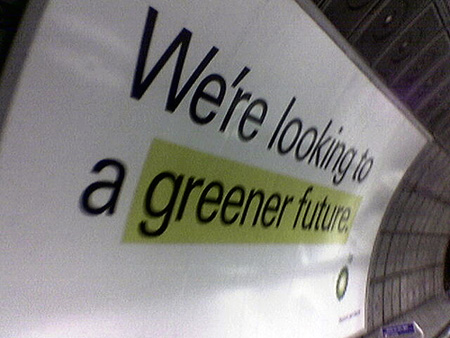
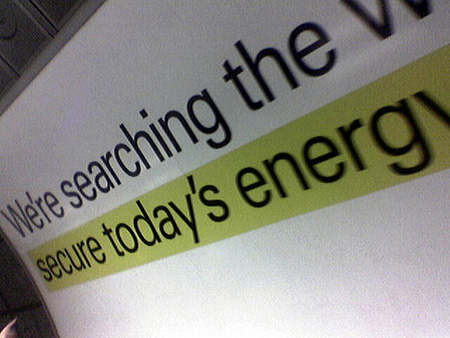
About a month ago I was watching television and an advert for BP appeared and goddam did their new advertising aesthetic look like my site. Now I’m not seriously suggesting that they ripped off the design of my site, but the synchronicity is pretty astonishing – particularly given that plasticbag.org used an exclusively yellow highlight for a few months early on. I tried to take a picture of the TV at the time, with no success (lots of banding and stuff) but last night I was on an escalator in a tube station and stumbled upon a huge block of billboards. And here are the pictures:


So it’s all quite funny and entertaining and everything. We’re clearly all meshed with the same zeitgeist or whatever, but in the spirit of accidental crossovers (particularly given the acronymic similarity between BP and PB.org) and inspired by a comment by Mr Paul Hammond, I’ve remixed their logo in return to make it fit with the various plasticbag.org colour schemes. Maybe I’ll use it as a logo for a while sometime in the future… Hopefully they’ll see the joke and won’t sue me or anything:

Links for 2005-11-17
- Wikipedia has an article on the “Two-Spirit” identity that Native Americans with unconventional sexual or gender identities have claimed for their own… “Two-Spirit is a term for third gender people (for example, woman-living-man) that are among many, if not most, Native American and Canadian First Nations tribes. It usually implies a masculine spirit and a feminine spirit living in the same body.”
- The world’s least usable lavatory – my Flickr photoset of the confusing ablution arrangements at Yahoo… Mr Willison and I decided that we had to document the whole experience. Do not mock us. This is important “Design of Everyday Things” kind of stuff…
- Russell Beattie talks about his own experiences with the world’s most user-hostile bathroom “Foreign bathrooms are hard enough to operate while dealing with Jet Lag, but man that one wins a prize.”
- Five years after Meg and Jason were featured in the New Yorker’s weblogging article, Meg has an announcement to make. “So for everyone who’s been reading for five years, I just wanted you to know: a few months ago Jason and I got engaged. We’re going to be married early next year.”
Right. Now. This is interesting. Google Base has launched and is both pretty weird and pretty interesting. The concept is fundamentally pretty simple – it’s almost like a completely open content management tool where you can post a recipe or a personal profile or a classified ad or whatever kind of thing you want. The item is then added to the internet as a standalone page – A recipe for Beef & Broccoli Over Shells for example. You can then contact the poster and navigate through similar items by tags (here called ‘labels’) or search through the complete database to find events, jobs, news, products, reference articles or whatever other type of data you want to define and submit.
From a personal perspective, I don’t quite get it – there’s no obvious reason I can think of for an individual to post a recipe to the service – but from a business perspective it’s really interesting. Basically it’s a complete circumvention of the problems with the Semantic web which abandons decentralisation and microformats completely. If your company has a database of things (whether that be products or pictures or weblog posts or news articles or whatever) that it represents on the web, then Google Base suggests that you should not wait to be spidered and nor should you expect them to do all the heavy-lifting to work out what your site is about. Instead, you just bulk upload all your data to Google directly and associate each entry with your corresponding page on the web. Google get an enormous amount of new useful data to organise and present to people, while the businesses or start-ups that use the service get new interfaces created for their content, and a greater findability and navigability for their data, products and services. And when Google creates an API for the service, suddenly every data source that uses them has an API as well. That’s pretty astonishing.
It’s not all positive for the businesses or start-ups, of course. It consolidates the idea of Google or a parallel search engine as the definitive place to find out information of any kind (rather than the local brand that you usually associate with events, restaurants or whatever). And that kind of corresponds to a larger question about whether Google is gradually and systematically eating the web. And I think there are larger problems too – the lack of any form of solid identifiers that will indicate whether you’re talking about the same film or book (in the review space at least) seems to me to be am issue. But generally it’s pretty interesting.
Which brings me to a fun challenge to my old employers. My old colleague Mr Biddulph (who has been freelancing for the BBC for a few months) and Mr Hammersley (of RSS, web services and utilikilt infamy) have been working on a representation of the BBC Archives Infax database for a few months. They’ve written about it in two pieces: The BBC’s programme catalogue (on Rails) and Hot BBC Archive Action. So why not make this content more explorable and searchable (and help define the way the web understands TV and radio programming) by bulk-submitting the entire massive database to Google Base? That would be an extraordinarily interesting move…
A couple of other interesting pieces:
Links for 2005-11-16
- The history of Power Girl is a history of enormous comic book breasts. There’s a lot of insight into the minds of teenage male comic book readers in this piece… “Seriously, she has got to be the most sexualized – dare I say, objectified? – heroine in mainstream spandex comics.”
- Bill Gates stands before a hideous and apparently meaningless slide about Windows God, does anyone have the slightest idea what Microsoft are on about?
I just got chucked a link to some video by Kevin Marks – an early pioneer of the technology that would eventually become podcasting – in which he talks about his time in broadcast as a cameraman, working at Apple and how podcasting changes everything (nostreaming.mov). It’s a fascinating few minutes of video with an interesting thesis – that subscribable media like podcasting removes the need for streaming almost completely.
My perspective is slightly different – both bigger and smaller. Because it’s not streaming that’s most affected by a combination of on demand and ‘deliver it to me’ subscribable podcast-like functionality. The main potential victim here is broadcast itself. Those of us who have Tivos or PVR functionality are already used to the idea that we don’t have to sit in front of the television when something’s being broadcast to watch our shows. And as a consequence, I very infrequently do. I watch things time-shifted by days, or hours or sometimes only by minutes – often pausing a programme at the beginning for ten or fifteen minutes so I can later skip through all the adverts. I reserve the watching of programming live for an increasingly small proportion of shows that necessaily can be watched more effectively live – live news channels or live broadcasts from events.
My sense of the future is that the role of broadcast in the delivery of television and audio programming is going to significantly diminish over the next twenty years, and a more browsable subscribable media derived from the (fairly obvious) lessons of podcasting will replace it (with an individual either subscribing through a net interface or through a truncated remote-control based lean-back experience. And I suspect the people who are going to be maintaining the intermediary platforms for this kind of experience will be the big search, navigation and media sales companies – Amazon, AOL, Apple, Google, Microsoft and Yahoo!. If they have any sense, they’ll find ways to turn their hub status into a platform for a complete democratisation of content, becoming almost neutral intermediaries for large & small companies and creative individuals to put up and distribute their programming as they see fit.
But the most interesting thing is what happens to broadcast in the absence of conventional programming. My hypothesis is that television becomes more like radio. People use radio to time-keep, to feel connected to the outside world around them, to feel like they have company. They have it backgrounded. Along with coverage of live news and live events – where broadcast is clearly the easiest distributor of the coverage – I expect TV to increasingly start fulfilling that kind of topical wallpaper and companionship role. The huge explosion of music channels and news channels in the UK over the last few years seems to bear out the desire for that kind of activity, but I suspect many more ambient, easy to digest, backgroundable media will start appearing over the next decade. In effect all programming becomes a bit like much current daytime programming – topical, conversational, relaxed – a perpetual stream of context-driven and easy-to-digest media. And when people want a challenge, they’ll just try out a new show on demand.
The death of broadcast, of course, has some other really interesting aspects. It’s pretty clear that the content creators – the people with the rights – are going to be the people able to exploit this world more effectively. And they may not need television companies or broadcasters at all to get their content out to the masses – which is likely to put the cat among the pigeons in a few parts of the industry. And then there’s all kinds of other weirdnesses – how do you get people to try your show without just broadcasting it for free? Is there a way you can open up the pilot-making process to more accurately reflect the market? I can imagine a situation whereby companies hold programmes for ransom at the pilot stage – where they wait for ten thousand people to agree to pay to subscribe to the series before they even consider making episode two. And there’s a significant question about where public sector programme-making fits into that space, and whether any of the platforms will be designed for the distribution of media free to people in a particular territory.
Anyway, I’m going to leave it there and open up the subject for further discussion. What do you think the role of broadcast is in the 21st Century? Is it on the way out? How would the market work? And what scope is there for broadcast after on-demand takes over? Anyone got any thoughts?