Categories
Conference Notes

On doing two papers at ETech 2005

Hm. The O’Reilly ETech button on the right there doesn’t really look very comfortable on the page, does it? All looks a bit showy and ostentatious. It’s just the wrong width, really. Ah well. Never mind.

I’ve actually been meaning to write about talking at ETech for a while but for a variety of complex logistical reasons, I’ve been kind of leaving it until I felt reasonably confident that it was actually going to happen. I think I can tell it’s going to happen now. After all, if it wasn’t happening, then I wouldn’t have had such an overwhelming freak-out terror fit when I found out that I’d got the date for getting the paper in wrong by a full week and a half. And that I’d told all the people who were co-writing the incorrect date as well. That’s all fixed now, of course, but at least I got scared, and anything real enough to get scared about is – in my humble opinion – probably real enough to write about on my site…

So I’m really excited about the conference for a couple of reasons. And those couple of reasons are the two papers I’m involved in. Firstly there’s a paper on some of the interesting and innovative stuff that Radio and Music Interactive does at the BBC (Reinventing Radio: One-to-Many meets Many-to-Many), which is half done by Hammond/Biddulph and half done by Webb and me. Obviously twenty minutes isn’t really long enough to give thorough coverage about the stuff we’ve been working on at various points over the last 18 months, but it should give us a little time to talk about a couple of projects in a little depth. Here’s a description to whet your appetite:

How could you enhance a one-to-many national radio station by building in the many-to-many-style interactions of Flickr or the weblog community? How might lessons from social software further blur the distinction between listeners and broadcasters by pushing interactivity beyond the phone-in or the online poll?

(1) The “Ten-Hour Takeover” used SMS technology, pattern matching, and statistical analysis to give the British public control of BBC Radio 1’s musical output. For ten hours, there was no planned playlist–every track was chosen by listeners via text messages. We turned these messages into a navigable information space of artists, tracks, and listeners that the DJs could interact with directly. Moreover, the loosely coupled component-based infrastructure has allowed us to deploy new mobile-based products (SMS and MMS) quickly and easily.

(2) A component-based architecture also allows us to hook together SMS, track now-playing, and show scheduling systems with each other and with third-party services. BBC R&Mi are using this as a basis for exploring social software models of interactivity: the potential of Flickr/del.icio.us-style tagging for radio; the possibilities of combining buddy lists with media players; new applications for SMS; and concepts like “100 Composers”–DABJava applications on PDAs that can have data trickled to them over broadcast radio.

The session presents work from BBC Radio & Music Interactive’s Technical Architecture and R&D teams, including demonstrations of existing software and working prototypes of new projects.

The other thing I’m involved in – again with Mr Biddulph, but this time also with Mr Bell – is our presentation on a project called Programme Information Pages (PIPs). Now this paper has the worst name of anything ever written in the world, so I’m just going to link to the description and hope you find your way around it. It’s basically about getting ready for what might happen alongside (and potentially after), broadcast television and radio, and should fit really well with the other papers from Tivo, about television and the discussions that are really likely to appear about the Creative Archive project and the BBC’s role in open data, which really all seem to be around the same kind of areas but from really different perspectives.

That’s the paper that I’m most nervous about – certainly I’ve invested more of myself and my time into the project itself than any other piece of work I’ve done since University. I really hope that comes across in the paper itself and that people get why it’s interesting.

Anyway, so there you go. Two years since my last ETech paper and now two have come along at once! And while I can’t see the fear going anywhere for a while, I’m also really looking forward to being able to talk about all this stuff in the open and the free and clear. See you there?
Categories
Personal Publishing

Three things I wrote ages ago on weblogs, publishing and community…

For a variety of reasons I’ve been digging up some old stuff on the publishing of weblogs that I’ve written on this site of for conferences or whatever, and I thought I’d reference them again here because I was surprised by how much I still agree with them (and how much they’re still relevant) even though they’re a couple of years old:

  • Some ways that mainstream web media can interact with the “revolution” in personal publishing… (Powerpoint – 3Mb-ish)
    “Rather than treating weblogs as an object to be studied or as a territory to be claimed, mainstream publishers should be looking to build tools that increase interaction between the two types of site – making both better in the process…

  • On super-distributed and super-localised online communities (Powerpoint – 5Mb-ish)
    “The weblog world is a super-distributed community where – much like newspaper columnists – there are ongoing and involved discussions and conversations happening not on one site – but distributed across many hundreds of thousands of sites, each one radically personalised – a representation of its creator in cyberspace…”
  • Why Content Publishers shouldn’t host weblogs (February 2003)
    “There is no reason to assume that being in the position to encourage the take-up of weblogging will mean that you’ll keep the ones you want to keep using your service. In fact: 1. The longer someone has been weblogging, and the more invested they are in it, the more likely it is that they’re going to want to get a domain name of their own. 2. These same people are also likely to want to use extended functionality at some point and will probably try and move to a dedicated application or provider who can more adequately fulfil their weblogging needs. 3. A dedicated long-term weblogger may not wish to be associated with the brand of your service any more and may choose to leave.”
Categories
Random

Links for 2005-02-14

Categories
Random

Links for 2005-02-11

Categories
Random

Vivid creepy dreams of alien technology…

I had a dream last night about a beautiful tower that no one could see on a suburban street, and the strange alien called Coypew that lived there. He could see the future so he told parents to euthanise children who were about to suffer terrible deaths by putting them in cars and pushing the cars out into the ocean. It seemed like the best thing to do, and everyone liked him because what he said seemed so right, but that he knew about this stuff made him somehow sickening and vile. Perhaps because he seemed so plausible but there was always the suspicion that he made stuff up but that you had no choice but to believe that what he was saying for the best.

He was a strange stylised round creature about a foot and a half tall with markings like black and white cows – only less symmetrical. He had a pillar-like appliance that sat in the middle of the sitting room. The device seemed to unsheath itself, and the inside looked solid like a rock covered in sea-shells, but I determined that these were just inscrutable objects tightly packed to appear like some kind of solid mass. When Coypew went away he seemed really creepy and disturbing in a way he didn’t when he was close by. Once when he went out, his appliance unravelled its doors and the dog took a bite out of the mechanics inside. The technology came away like a mixture of muscle and cake. And though Coypew didn’t notice, I secretly knew that the pillar would get septic and corrupted and gradually start making mistakes, and become immoral and finally inevitably die. But for some reason I didn’t say anything… I think I wanted them both to go away…

Odd dream, all things considering. But stunningly visual and I could draw most of the things that were in it right now if I could only find a pen and some paper that didn’t have hastily scribbled superheroes on it. Ah, the mind of an over-caffeinated geek.

Categories
Random

Links for 2005-02-08

Categories
Random

Links for 2005-02-07

Categories
Random

A desperate plea for biscuits…

What follows is pretty much the archetypical weblog post. I mean it doesn’t have cats in it or anything, but it’s the next best thing. It’s like practically award-winningly archetypical. You want to give someone a lifetime achievement award for weblogging or something, then it would be for quality posts like this one, right? Right?

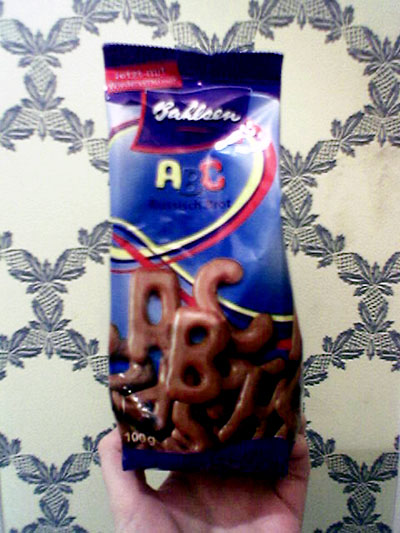
When I was a kid – and I mean something like seven or eight years old – I lived in a house in Norwich on a road called Sunningdale. My mother used to do a lot of her local shopping in a tiny little shop on Unthank road. I cannot remember its name. Anyway, my mother used to get me these biscuits – they were made by Bahlsen and were called ABC biscuits – and I used to love them. They were absolutely, undoubtedly my total favourite biscuits. It was my special treat to get a packet of these biscuits.

Anyway, one day they weren’t there any more. Just like that, they were gone. And after a few brief weeks of hoping they’d turn up again, my tiny child-brain got used to the idea that they weren’t coming back and somehow I managed to get on with my life. Every so often I’ve found myself in a shop with Bahlsen biscuits and I’ve had a bit of a scout around to see if they had them. But they didn’t. But hey – no biggie, right?

Recently, however, my family went on holiday and what should they find in some obscure shop is southern Spain, but packets upon packets of my favourite biscuits. And so they bought them. Six packets of them. And I tried them, and they were really nice. And now I’ve only got one packet left (pictured below). So here’s where you guys come in. I don’t want to sound like an addict, but does anyone know where I can get more of these gorgeous beautiful biscuits? I’ll send you cash money for them. If you know a shop in London where I can get them, I’ll be overwhelmed with good-will towards you.

picture of Bahlson ABC biscuits

So there you are – a long post about biscuits in the tradition of English weblogging. But yet also somehow with a touch of self-aware poignancy, because these aren’t just biscuits. They’re also a part of my personal narrative – a piece of my living history rediscovered! Crunchy history! Chocolaty history! Mmm… History..!

Categories
Design

Amazon's Top 10 Secrets of a Successful Website…

You’ll like this. Small post. Don’t really do so many of those any more, but this one has three links in it so I can’t stick it into del.icio.us. Oops. Four links. It starts with a little tiny post at Signal vs. Noise, the awesome 37signals weblog (dammit, five links):

“Is there any doubt that BIG is in? The signup button for Amazon Prime puts that question to rest.” (Big is in)

And when you click on the link you do indeed get a really really really big button. And the button has a bevel! And the bevel is big!

And I’m here to explain to the 37signals guys why this is the case, because although they’re all special clever-clever ‘we think we’re the shiznit’ usability people and all, they appear not to have read the seminal work on the subject – Jason Kottke’s classic 10 secrets of a successful website. It’s just as well that not everyone is so far behind the times though – I can say without question that Amazon have read this work because how else would they have known to implement Rule #10 of a successful website:

the bigger the bevel, the more important the button

Now people think Jason’s just a pretty face (jeez – six links… nngh) which is just so not true. For a start, it would be fairer to say that he was a pretty face, and not – I might add – that much prettier than me (it’s not the years, it’s the mileage). But more importantly, when he was a pretty face, he was a pretty face that also knew all about the web ‘n’ shit.

So look and learn people, and watch as Jason leads you through the future step by step – believe in him now or watch stupified as one by one his principles come to be employed in future Amazon.com designs:

From rule #4: 3D logos: “With today’s high end power mac 7200s and 486 pcs, one can create beautifully rendered animated 3D art that rivals the likes of that produced by pixar and industrial light and magic. why have a two dimensional logo when three dimensions are available? the extra dimension will make your logo stand out from those of your competition.”

From rule #6: CDRom on the web: “in the three years the web has existed, the web design community as a whole has discovered the one great truth: developing for the web is just like developing for a cdrom. you’ve probably heard different, but that’s just propaganda from all the techies that are mad because people no longer develop text-only pages.”

You know, come to think of it, you should write to Jason right now and get him to do an Amazon redesign that’ll really push them into the 21st Century! With his help maybe they can stop all this concentrating on business and so-called ‘classic design’ and really make something that sells their brand values instead!

Categories
Random

Links for 2005-02-05