- Really enjoying playing with ffffound. It’s sort of like del.icio.us divided by Flickr only with no tags and more designers. Fascinating.
Year: 2007
- A Petition to require polling organisations to abide by the preferences of citizens who have opted out of cold-calling via the Telephone Preference Service… Feel free to promote and link to as you see fit.
This is one of those grumpy old curmudgeonly men blog posts that I kept reading on the web and never really understood until very recently. I’m just warning you so you can get out now.
I have a long-standing grudge against direct marketers, which basically comes down to my desire to live uninterrupted in my own home without having people ringing me up, coming around my house or stuff crap through my doors twenty-four hours a day. I forgive people dropping off pizza vouchers as that’s more public service, but otherwise I bloody hate the bastards. I don’t know if it’s an intolerance that has come from the world of spam, but given that I get around seven or eight hundred pieces of spam in any twenty-four hour period and given that only about five hundred bits get caught by my filters, perhaps my tolerance has been rather exhausted. I could make a joke about how my spam filters have such problems with them because they’re mosly indistinguishable from all of my daily correspondence with friends and colleagues about the size of my penis, but I’m not sure that would be funny and anyone my mum reads my blog occasionally now, and she’d probably roll her eyes.
Going back to Direct Marketers, there is hope! There is a process you can undertake which will stop these bloody people harrassing you and it mostly works! By law, direct marketers from the UK have to check your address and phone number against ‘Do Not Call’ lists. So if you don’t want to receive this stuff, you just go to this page and sign off from all the various lists. While you’re there, you’ll notice a couple of creepy things about these lists, including that there’s a list called the Baby MPS which is a list that you and sign up to if you suffer a miscarriage or baby-related bereavement. It’s the list that stops them bombarding you with advertising crap for the child you’ve lost. It’s not up to them to find out this stuff, it’s up to you to let them know that your child has died. Better still–I would think–would be if they couldn’t send it to you in the first place without your express permission. But there you go.
I say it only mostly works because actually you still end up with stuff from abroad and some people just ignore it. So I went ex-directory and also signed up for BT’s Privacy Service. I think at the time I had to pay to get control over who was able to phone me, but that’s no longer the case, it seems. Together you can mostly fight to regain your peace and quiet, and if you’re prepared to shout loudly at anyone proselytising at your front door then you’ve pretty much got the whole kit covered.
Anyway, so I’m at home, and first the phone rings and it’s a bloody automated phone call from the Labour party asking me how I’d vote in any upcoming election. Interesting. Suggestive. Also really aggravating. My disgust for this kind of home invasion is such that I briefly consider voting Conservative to spite them. Or for Boris Johnson. I’d vote to bring Thatcher back from the dead (she’s dead right? in all the ways that count?) if she’d kick direct marketers back into the pit of hell from whence they’ve scrabbled their filthy little way up into the world. You can read about these people on the Direct Marketing Association website. They’re interested in ‘inspiring consumer confidence and trust’ in people who pump shit through your phone line and front door. They use that form of language that PR people are trained in, which is so drained of meaning as to be linguistic equivalent of one of those sandwiches that only the British sell, in pharmacies for God’s sake. Places where you go to get Thrush cream or treat your corns. Sandwiches and language alike are cold, damp, inoffensive, lack all substance and make you want to heave.
Ranting aside about value-neutral, intellectually empty advertising pap, I tell them how I’ll vote and then hang up. I’m sort of vaguely aware that–of course–the Telephone Preference Service doesn’t extend to political parties. Probably this is reasonable, although it makes me angry.
Twenty minutes later though, another phone call. This time from Ipsos MORI. Ipsos MORI are a polling company, and they make money by being paid by people to do polls on their behalf. Since they are not explicitly selling or marketing things to you, they don’t have to pay any attention to the TPS. Instead, they randomly dial numbers and then ask people questions about themselves and whatever service they’ve been paid to harrass you about.
I don’t realise that they’re within the law, so I cause a big stink on the phone. I know it’s not the fault of the people at the call centres, but they’ve been put there to insulate the people who really are responsible and there’s no way to get to those people, so if you’re going to punish the company in some way, if you’re going to get them to stop doing it, then you have to complain. They explain to me that they are a ‘bona fide market research company’ concerned with public affairs, media, marketing, ‘loyalty’ and advertising (I got the latter stuff off their website). This doesn’t endear me to them enormously.
Now, these people clearly get complaints. They have a section called Called by Us? which has four sections: “Where did you get my telephone number from?” which is a pretty decent question to get started with. Then my favourite, “My telephone number is registered with the Telephone Preference Service (TPS) and/or BT Privacy to stop cold calls so why are you calling me?”. Then one about the safety of supplying information and another about making complaints. That’s the lot. It’s clearly a pretty big deal. Their answer to the TPS question includes these lines:
There are no legal or regulatory requirements to filter unsolicited calls made for research purposes against the TPS. To exclude individuals with TPS registered telephone numbers could bias the results. It would also deny you the opportunity of participating in this research, the results of which may impact policies or services you use!
So the reason they inflict this stuff on people who specifically ask not to receive such unsolicited calls is because it would deny us the ability to participate! They even use an exclamation mark! To make it clear that this would clearly be ridiculous! But what if we don’t want to participate? Do we get the option to make that clear with the TPS? Nope. They’ll put you on a do not call list if you ask specifically, but it’ll be just for that one company, not any other. There’s basically very little you can do.
I know this is sort of a weird little petty vendetta by now, and I’m really sorry about that. I’m still getting in hundreds of press releases after writing a pretty strongly worded post on that subject that got a fair amount of correspondence. I’m still irritated by the way the Cillit Bang crew were prepared to plumb new lows to hawk some old cleaning drivel. This isn’t the same. It’s not the same scale, but it’s still really annoying. It’s another branch of sanctioned spam that you have no way of opting out of. PR spam. Comment spam. Life spam. Phone spam. It’s people actively costing you a little of your time or calm or space or patience to make themselves a tiny amount of money. And it would be all right if it was infrequent, but there’s a flood of it, everywhere, all the time, in every channel.
In this particular case, I went to Downing Street’s petitions website and tried to start a nice, simple little petition about this subject. Something nice and clean. It read like this:
We the undersigned petition the Prime Minister to: ‘require polling organisations like Ipsos MORI to abide by the preferences of citizens who have opted out of cold-calling via the Telephone Preference Service.’
All organisations that want to cold-call to sell or market products in the UK have to check that the person they’re contacting has not declared they do not want to receive such calls via the Telephone Preference Service. At present, polling and research organisations are not required to abide by this law, and Ipsos MORI chooses not to do so.
They declare that not calling people would ‘deny [people who have said they do not want to be called] the opportunity of participating in [Ipsos MORI’s money-making] research’. The organisations concerned allow you to opt out of further contact from them, but does not stop other polling organisations undertaking exactly the same processes.
This petition contends that it is not up to Ipsos MORI or any other polling organisation to decide whether or not people would like to be cold-called, it is up to the people they make their money from.
The British public should be able to refuse cold-calling by polling organisations at the Telephone Preference Service, and the Government should hold these organisations to account if they violate this agreement.
Unfortunately, the Downing Street site rejected the petition because (and I quote) it contained, “Potentially libellous, false, or defamatory statements”. I’m still trying to work out what on earth they were referring to, but if I come up with anything I’ll let you know.
-
Really clear and they work.
- GigaOm’s fascinating diagram of industry share of smartphones fascinates me for a few reasons It’s easy if you’re in the UK to assume that all the early adopters are using Nokia phones. Obviously that’s challenged by the iPhone, but the different in take-up between Europe and the US is extraordinary.
- Moo now has everything you need in place to make cards, stickers and notecards with photos from Facebook Lovely people, the Moo crew. It seems like a no brainer that they’d do a distribution Facebook app to get people’s mindshare around this though. Gah. Spending too much time in the US.
- Beautiful pictures of Jodrell Bank Talking a bunch about Jodrell Bank at the moment, and looking at the lovely, lovely pictures.
- Motion Blur interrogates my belief that PR is an intrinsically more cynical and fake process than human self-representation and expression on blogs (or elsewhere) This is another articulation of the idea that since all human beings attempt to make themselves look okay, that they’re engaging in public relations, which in turn acts as a de facto license for any kind of marketing, advertising or pr strategy…
- Actually semi-decent Mexican food in London? Whatever next! I can quite seriously recommend Wahaca. It doesn’t make me happy like Pancho Villa in San Francisco makes me happy (Prawn Tacos, drool), but it’s way better than most other Mexican food I’ve had in the UK
- According to Zagat (as reported widely in The Guardian, Independent and BBC) London’s restaurants are now the most expensive in the world… I can believe this. I’m not as convinced that the food is as poorly rated as people see to think it is. Perhaps you have to know it well enough to get the best out of it.
- I’m seriously considering getting myself some plasticbag.org branded M&Ms They’re just so totally awesome that I find it astonishing that I don’t have them already. God knows what I’d do with them except give them to people at conferences…
I’ve been having enormous fun playing with Lastgraph over the last week or so. You tell it your last.fm username and it runs off and plots you a nice colourful graph that visualises your listening behaviour.
I’ve been with last.fm for a very long time (since 2003, when it was still really audioscrobbler) and have scrobbled a good 50,000 tracks. As a result, my graphs are pretty nice. You can get them visualised in various ways, but I would recommend using the ‘rainbow’ style and allowing it even to plot artists that you’ve only played once. That gives you the greatest detail and most beautiful results.
The most important thing about any visualisation is that it should give you another perspective on a dataset you already knew, and these graphs certainly do that. You really can get a sense of what kind of listener you’re dealing with. When you look at mine you’ll see a hell of a lot of thin lines. I listen to a lot of different artists, normally as part of ‘Most-played Five Star’ playlists and stuff like that. But alongside those classics there’s a decent and consistent injection of new albums and artists that are played more consistently. If you compared it with one of Cal’s graphs (download / pdf) at similar levels of detail then you’d see a very different picture. He listens to albums–only albums–and he listens to them over and over again until he gets bored of them. Then he sticks another album on. This is because he is from the past and hasn’t worked out that it’s all about disaggregation and stuff like that. Foolish boy.
The graphs that lastgraph generates are pretty enormous and full of detail, and because they’ve been generated as vectors, you could quite easily get one printed out onto canvas and put it up in your sitting room. I’m thinking about doing that now. I quite like the idea of decorating my home with beautiful infographics about my behaviour. When people visited they’d get all this extra easy-to-parse information about me, just as if I were a variety-sized packet of Fruit’n’Fibre. I’m a little concerned that it might seem self-involved, but not quite concerned enough not to do it. Perhaps we should make it obligatory for people to put up information on their electricity usage in their sitting rooms and see what impact that had on global warming.
If you want to see my whole graph then I’ve put up a decent-sized jpg of it that you can download and move around. It’s pretty beautiful and interesting, although I have no doubt your graph would be more interesting to you.
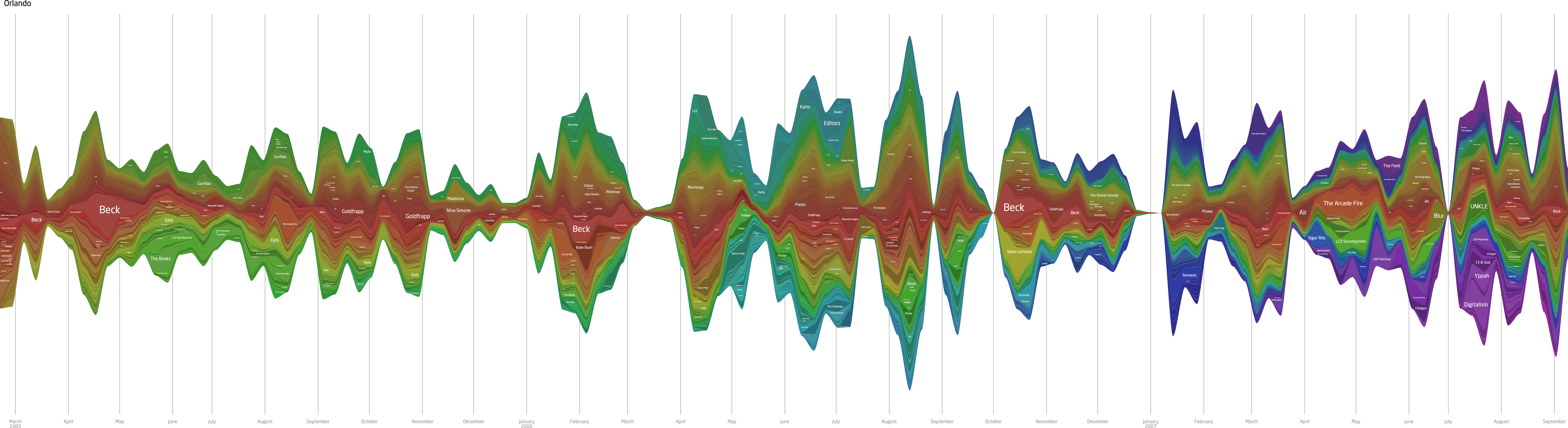
And if you’re interested in knowing more about the music that I’ve listened to over the last few years then my Overall charts on artists will reveal my love of Beck, Goldfrapp, The Arcade Fire, Nina Simone and Pixies. Meanwhile my most played tracks would reveal Goldfrapp’s Number 1 and Utopia, The MFA’s The Difference It Makes, Orbital’s Halcyon + On + On, Nouvelle Vague’s Friday Night, Saturday Morning among many others. It’s nice to be able to see the soundtrack of the last four years. I wonder what it’ll be like four years from now.
A few people have asked me to put up my slides for the dconstruct talk. However, I’m going to be doing a variant on the talk at Web 2.0 Expo Berlin in a few weeks so I thought I’d let it relax a bit in my head and see if there’s anything I’d like to adjust before I put it out into the world as it stands. If you need a version to persuade your boss of something in the meantime, let me know and I’ll send you a copy. Otherwise I’ll post one up in early November.
A week after dconstruct and I find myself jet-lagged to hell, awake and mostly alert at 5.30am PST in a Marriott hotel in Redmond. I’m here in Microsoft heartland for a Social Computing Symposium where I’m going to be talking a bit more about Fire Eagle and then I’m heading down to San Francisco for a bunch of meetings and stuff. I quite like travelling. I like the change of context. I like meeting people and the almost total solitude that you get in alternating chunks.
One of the things I like most about travelling is when you travel east-to-west and the jet-lag kicks in. The evenings sort of suck–I pass out around nine or ten for the first couple of evenings–but the mornings are pretty great. You find yourself glancing a the clock when you wake up and it’s 4am. You lie in bed getting a lie-in and when you’re bored it’s still not light. With nothing else to do, these first few hours are wonderfully relaxing and a great time to catch up on things that have rather got on top of you. I’m spending my pre-dawn hours today catching up on e-mail, posting to plasticbag.org and generally catching up with stuff. Makes me feel so productive.
I don’t always feel so terribly productive. A little over a week ago I was also waking up pretty early and working, but that was mostly because of my talk at dconstruct. And while finally delivering the talk was tremendously enjoyable and invigorating, writing it was anything but. It was instead a bloody horrible experience. And sitting here in bed–it still dark outside–it occurs to me that maybe it’s an experience I should bring out into the open, both to get it out of my head and to give other people some perspective on what it’s like to try and drag a talk together when you’re not actually a terribly extraverted person. Maybe it’ll help someone. Who knows.

Let me take you back to the middle of August – a full three weeks before dconstruct. At that point, I’d already been having real trouble getting my talk together and it had started to stress me out. I’d been thinking around the subject for a month or so, trying to scrabble my thoughts together, but it hadn’t got very far. So I came up with a solution – I’d take off three days to bring it all together. The three days bled into the weekend, and the weekend into a bank holiday. Six days to work on a talk! What bliss! What ecstacy! That’s going to be fine! What could go wrong?
It was a disaster. I woke up in the morning, stared at a screen for a while, wandered around my flat, wrote things on post-it notes and stuck them to every surface in my house. I stared at myself in the mirror. I bought lots of dental floss and had a really good go at my back teeth. I paced a lot. I did occasional spats of press-ups to try and get the frustration out of my system and ended up just feeling a bit sore. My brain refused to focus on doing the talk itself, just on worrying about writing it.
I found myself doing absolutely anything I could possibly do that would be in any way useful in my life instead as a way to legitimate my lack of progress. I bought light-bulbs. I sorted out all my old VHS videos and got rid of them via freecycle. I did inordinate amounts of washing. I went through all my books and took the ones I didn’t want to a charity shop. I emptied a cupboard. I even considered hoovering, which should give you a sense of my state of mind. Day Three came and went and nothing was flowing.
I’d managed to phrase my talk as a follow-on to Native to a Web of Data, which is probably the talk of which I’m most proud. I felt that the pressure was on to match it with a sequel. Also about forty of the people I respect most in the industry had decided that they were going to come down to Brighton for the day and I was going to be performing in front of all of them. Worse still, somehow I had landed the responsibility of being the last on stage for the day in front of six hundred people or so. To put it mildly, I was terrified. Another three days passed and I’d got nowhere substantial. My break now over and back in work, I started trying to get it together in the evenings after finishing my normal day’s workload. On a couple of occasions, I worked in the office from 10am until 1 or 2am the following day to try and get something out. Mostly this was unsuccessful.
If any of you guys out there think that this just happened to me for the first time with this talk–by the way–I need to disabuse you of it. Most of my talks are this much pain, as most of my friends can attest. I get enormous stage-fright. Standing up in front of people to give talks of this scale (several hundred people) scares the living crap out of me and always has done. In the end though, normally it’s worth it. I battle with talks to such an extent that they’re normally always pretty decent, they force me to think through and systematise things that have been in my head for a while, and the reception is normally pretty good. But god, they’re a nightmare to write.
And speaking of my friends, there are a few of them I need to thank explicitly because they normally end up being the catalyst that helps me pull the bloody things off. In particular I should thank Matt Webb, Cal Henderson, Simon Willison, Natalie Downe and Denise Wilton who have all calmed me down (and sometimes just told me off) when I’ve been freaking out about a talk.
Anyway, so the talk for dconstruct didn’t actually start really firming itself up in my head–didn’t really start coming together properly and making sense to me–until probably two days before the event itself. The day before the event I finally had a structure and all the points but still absolutely no slides. The day before the event I started knocking out some slides but found myself rapidly running out of time. At one point Cal sat down with me and just went, “Okay, what’s your next point? Write it down. Leave it. Now what? What do you want to say next? Write it down. Next.” He was–frankly–amazing. If he hadn’t have been there, I’m not sure I’d have won the battle this time.

That evening, we were supposed to go out for a dinner and a drink with the other speakers, but that was completely impossible for me. My heart had been pounding in my ears for about three days solidly, and so instead of going and drinking and socialising I found myself barrelling along, fighting and wrestling with this aggravating thing that I’d decided to create, sitting in Simon Willison and Natalie Downe’s flat scratching out slides. At around eleven I gave up for the evening. My brain felt like it had been hit dozens of times, as if it had been tenderized. Nothing I did to it could get it working again. Five hours after going to sleep at my hotel room though, I was up again – writing slides, bashing points around. It’s worth saying that at this point I’m still fiddling with the character spacing on some of the slides, that they look right being still as terrifyingly important as what they actually said. Such is the depths of my lunacy. By 10 am I was not with the rest of the speakers upstairs watching the talks, I was downstairs hidden in the Green Room blocking through the thing section by section. And with occasional breaks to go and buy fizzy drinks and things with sugar in them, that’s where I stayed for the rest of the day. No doubt I made my fellow speakers nervous with my frantic energy and buzzing adrenal frenzy. Everything tasted of metal.
And then finally, suddenly, around midday – after weeks of fighting it just started flowing naturally.
I finally finished the talk at 3.30pm, having seen not a single other speaker on stage all day, hiding in one of the chorus rooms in the basement. I had to get my laptop onto the stage by 4.30pm when Matt Webb’s talk started (my talk was directly after his), so I had nearly an hour to do my one and only rehearsal. Reassured and comfortable that it was going to be okay, I read it out loud to myself. And it stank. It really really stank. I’d been trying to just get a sense of the time, but I started to realise the gaps and absences in the argument, where it was running long, where I sounded like a hippy and where I sounded like a corporate drone. Quickly squeezing in a few extra bridging comments in my notes, and adding in a couple of extra slides, I turned around and had to call it finished.
I always find at conferences that the forty-five minutes or so before I’m actually talking are among the easiest of the whole time, and this was no exception. It’s like my brain accepts that there’s nothing more that it can do, that there’s no longer any point in worrying, and it just gets out of the way. It’s great. My brain-state was also helped substantially by Matt Webb’s talk on The Experience Stack. I found it beautiful and fascinating, and as elliptical as ever. You have to work with Matt’s talks–he makes these extraordinary leaps–but if you do you’re normally rewarded. There’s always something that makes me raise an eyebrow in suspicion or disbelief, and always something else that makes me see something old in a new way. I’m a systematiser, on the whole. He makes inspirational leaps. In many ways we’re completely different from one another, but those differences often got us to good places when we worked together. In this case, he got my brain moving again and engaged with what he was saying, and it got me nicely focused for my turn.

Which by all accounts, after all this stress and pain, seemed to go fairly well. I’ve heard lovely comments from a bunch of people and despite all the misery it took to get there, I genuinely enjoyed presenting it. I don’t think it’s as good a talk in the end as Native to a Web of Data or Greater than the Sum of its Parts, but I think there’s substance in it and some challenges to our current ways of building and thinking about the web. That makes me pretty happy. I’d love to know what you guys thought of it – and whether you had any points or suggestions about it. It’s probably going to get another airing at Web 2.0 Expo Berlin in about six weeks, so any thoughts that you had would be very very much appreciated. As I’m doing the talk again though, I’m still undecided about whether or not I should post the slides. If you’re keen to see them, can I ask you to wait a month? Or if you’re really desperate and need them to make a case to your manager or boss, then let me know via e-mail and I’ll send you a version of them.
With dconstruct over, the rest of the weekend became about letting my hair down, but it wasn’t going to start immediately. I stuck around for some of the main after-party, but by eleven in the evening, I was basically unconscious with exhaustion. I ducked back to my hotel room to dump my bag and passed out almost immediately and woke up still fried the day afterwards. Only after a lovely breakfast with fellow dconstruct nerds and a good chunk of BarCamp did I start to feel human again. And only a couple of hours at the pier on Sunday afternoon could really shake all the cobwebs out of my head. You can see all my post-dconstruct pictures on my Flickr stream: After dconstruct, but here’s one to capture the mood:

I suppose in retrospect I’d call the whole thing a difficult but worthwhile experience for me. I need to find a better way to deal with my stage-fright and to get these talks out without so much pain, but at the moment it’s survivable. The most important thing is that they’re enjoyable and interesting to the people who watch them. So if you were there, I hope you enjoyed the talk as much as I (finally) enjoyed delivering it. And if you have problems speaking in public, then maybe this post will have given you some perspective. You’re not alone!