Categories
Social Software

While cleaning out my virtual closet I found…

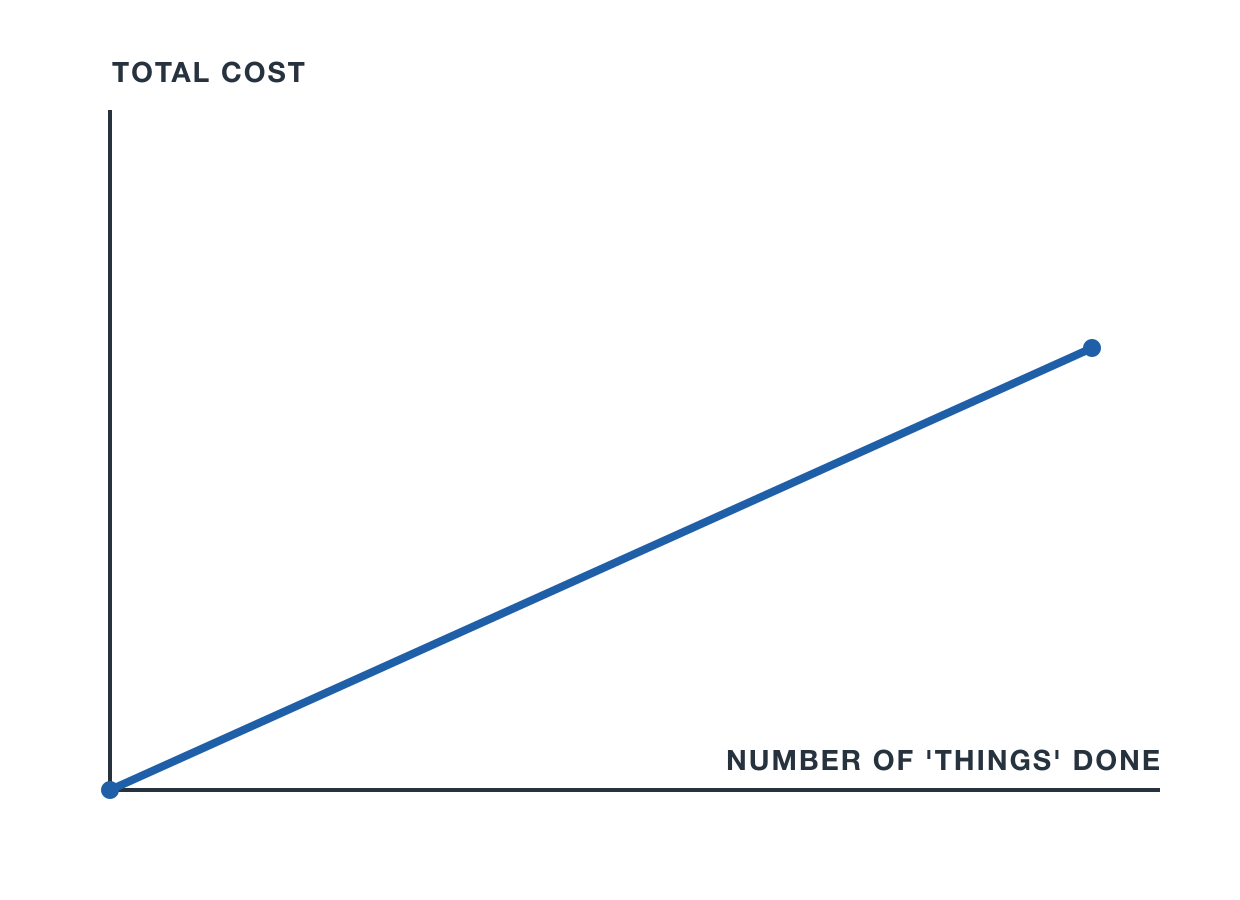
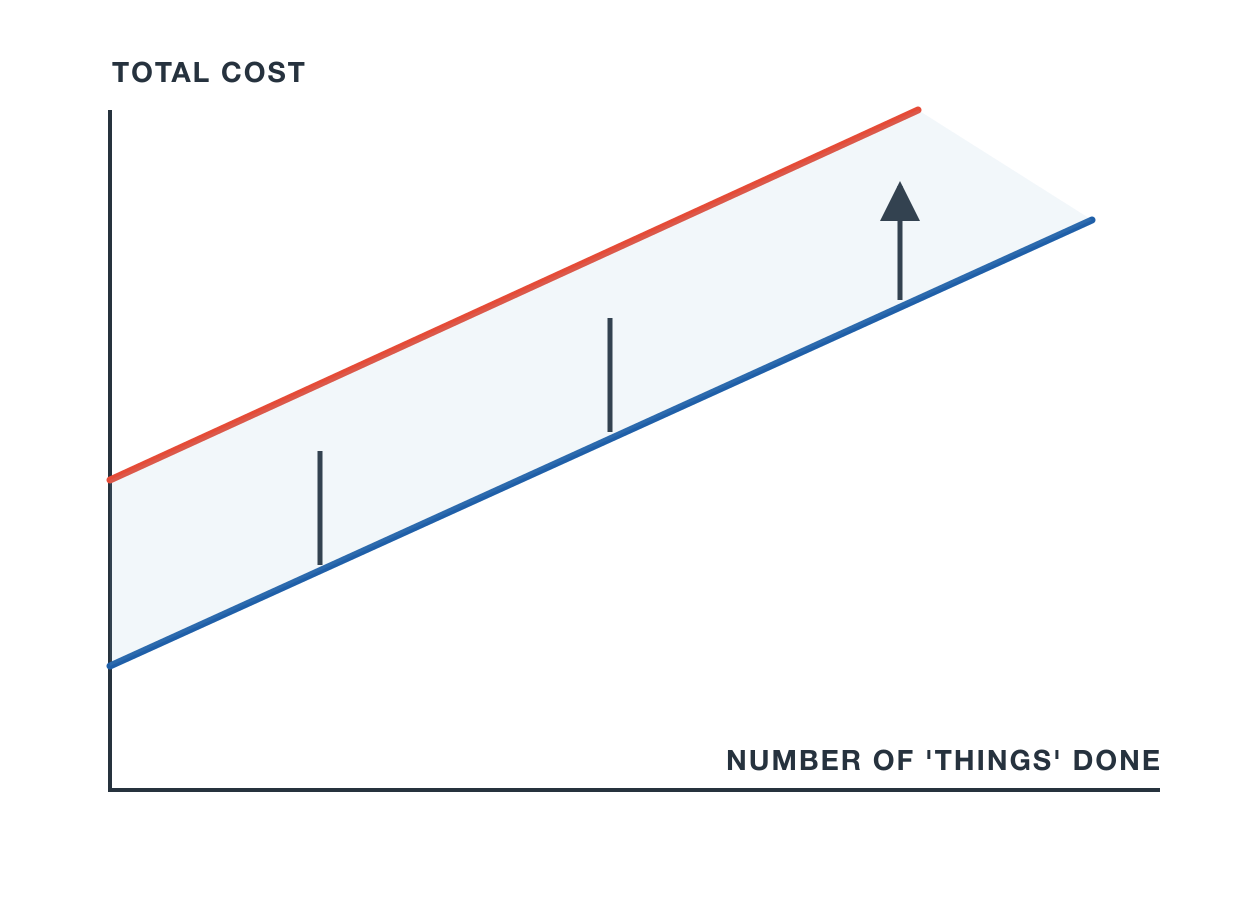
While doing a routine purge of my computer I stumbled upon three graphs made to illustrate the difference between an increased marginal ‘effort’ cost and an exponential one. This is a flashback to a now old argument about whether or not usable systems should scale badly in order to counteract large volume-abuses of a system.

If this graph shows the effort needed to accomplish a certain number of things on a normal website…

Then this one would show what would happen if the accomplishment of each ‘thing’ required extra effort – say if it required a small additional amount of financial cost…

The problem with that system would be that your ability to abuse through volume is directly proportional to how much money you have. The rich (effort or financial) get to flood the system however they want. But a system that self-consciously scales badly in terms of user effort would look more like:

I don’t really want to comment on it any further, but I thought it might illustrate the concept I was talking about a few weeks ago.

The images were replaced on 5 August 2026 for clarity. The originals are available here and here.

Categories
Random

An introductory guide to Keynesian Economics…

A link without an origin, I found this explanation and background to Keynesian economic analysis a few days ago, but couldn’t think of enough commentary on it to make it worthwhile. In the end I retreat to the anecdotal. I did Economics A-level at school. I was quite bad at it, and the teacher told my mother than I was bone-idle. I don’t think I’ll ever forgive him for that. I have a picture somewhere of Ben and Julian standing by the window with teenage hair and school-uniforms. And even if I lost the photo, the image would stick in my head regardless.

Categories
Random

The dream I had a couple of nights ago…

So in the dream, my mother is putting powder-blue mascara onto my eye-lashes. But it’s all clumpy and grotesque – like water thickly mixed with blue flour. She’s convinced it’s a really good idea. I’m not horrified by the concept, but I’m also relatively unconvinced it’s going to work.

Categories
Random

Only a few Secret Santa hours left…

With only a few hours to go, this is just a last minute reminder that Secret Santa 2002 closes in a couple of hours. Get there quickly before the Elves get irritable…

Categories
Design

On Dan Hill's "Adaptive Design" Piece…

I still haven’t completely formed my opinions on the recent IA seminar on “Adaptive Design” I attended (Dan Hill from cityofsound speaking). He’s put up the presentation along with some notes which should make the whole process rather easier. The one thing that I know stuck in my head throughout the whole thing was that there was a regular appeal towards building adaptive sites with an architecture that allowed experiementation and adaptability. There were a few more people talking about component-level systems like Lego as well. They too kept talking about the simple rules of the system that governed the use of these blocks. Everyone seemed to think that the job of the designer was the development of rules and components within self-contained sites. I kept thinking of Operating Systems and the Internet – universal computing machines lying behind the scenes forming an architecture. And then I started thinking of Applications and Sites as the components within these machines. In a sense we’re already designing components within a larger open system – allowing individuals to assemble their own ‘machines’ (which amount to their interactions with computers). Maybe we’re getting this all wrong – maybe we shouldn’t be looking at the products we make and trying to componentise them still further. Maybe we should just look to simplify what each function does and have them hang off one another by using standard formats and useful proceedures for interoperability…

I’ll give you a quick example. Blogger is a way of storing content in a particular format. It can feed that information out as e-mail, html and rss. The e-mails can be sent to me to be viewed on my e-mail client, or they can be sent to Yahoogroups where they can be displayed out of context or repurposed to be sent out to large groups of people or in a digest format. The HTML can be viewed by a web browser (of which there are several different types including speech browsers, braile browsers etc) or pulled into databases (a al Blogdex and can also be printed out to be carried around with me, or put into a palm pilot, or screen-capped and adjusted. RSS feeds can be read by applications like NetNewsWire or by IM programs like Trillian or they can be aggregated (as on Haddock Blogs) or they can be put into databases and reused. Each one of these is a component. Each one of which is something that a user decides (or decides not to) use in assembling the magic “machine that makes things happen” (ie. their person computing space). So maybe that’s what we should be concentrating on – single use (or simple use) applications or sites that do something very well, can be removed or replaced from the processing chain of information. Maybe that’s adaptive design. Maybe it’s got nothing to do with us making the architecture at all. It’s already there.

Categories
Social Software

First thoughts on Wiki

A few thoughts on Wikis:

  • There aren’t enough simple sets of instructions for people who are completely unfamiliar with Wikis. It’s quite hard to make the mental leaps necessary to get past that very initial stage of frustrated apathy. But once you do it’s tremendously easy to use and has essentially no further technical learning-curve. Suggestion – someone writes a guide to starting a wiki in non-wiki format for a change.
  • The most significant aspect for me is this sense of pottering, of idle investment – that it’s not important to achieve perfection, consensus or conclusion and so any small piece of work you do feels like a valuable contribution – a step in the right direction. They’re even faster to use than weblogs, and more flexible (with all the benefits and problems that involves).
  • The next stage in development would seem to me to be an aesthetic one and a usability one – there’s clearly work that needs to be done before they go fully mainstream, and if publishers are going to approach this kind of stuff then they’re going to want some reassurement that the content won’t simply be lost – so some kind of collaborative moderation system will probably have to emerge there (at least for commercial applications).
Categories
Social Software

In which Tom mentions that he's just started his first Wiki…

Little to say except that I’ve spent some of this evening working to install my first ever Wiki using UseMod. I’ve got a very specific project in mind – getting a group of less-than-totally-tech-savvy community members to get together and assemble their own FAQs, site history and help files. Adrian Hon’s recently got something similar going with the Metafilter Wiki which I’m very impressed with. This feels extremely interesting and experimental – very much like weblogging did three years ago – but as far as I can tell Wikis already have a weight of history building behind them. I’ll keep writing about how the project appears to be going (but I’m not planning to link to it from plasticbag.org just yet).

Categories
Random

The Unwedding of Ultrasparky…

Of course the most important news in blogdom at the moment is the upcoming big gay wedding of Sparky and the Rooster (thanks to Google Images for those photos). I can’t say congratulations enough! I’m stormingly jealous as well – Dan is a wonderful sweet man who I’ve met once or twice now, and Rooster is… well… really hot. [proper pictures of the lovely couple (you’re looking at number one and two on that page)]

Categories
Random

On the Social Software Summit in New York…

It continually upsets me that things like the Social Software Summit in New York happen and that I don’t get to go to them all. Hearing Clay speak on areas very close to my heart in London recently was tremendously useful and interesting, and I find it intensely frustrating that there are debates ongoing around the world that really matter to me that I can’t attend. Hence my need to buy an iBook, hide in Norfolk and finally assemble some of my thoughts into a publishable form…

P.S. That’s Matt Jones on the left there. And aren’t there are a lot of Apple laptops in concept-forming-land…

Categories
Social Software Technology

Towards a way of measuring a stale paradigm… (ps. needs an edit which I'll come to later)

Let’s start by positing the idea that Thomas Kuhn is right when he talks of paradigm shift – that ideas don’t simply change slowly over time, but instead occasionally move with seismic speed, size and repercussions. That the progression from Newton to Einstein could never be accomplished piecemeal, but had to happen by an instantaneous leap.

Let’s split this concept in two directions which will interact with it differently – that it’s not only theories that can operate in this way, but also products. Let’s think for a moment why a theory reaches the point where one can tell a paradigm shift is about to take place… Normally it’s because a large-scale incongruity of data appears that seems to contradict the theory. Small scale contradictions emerge all the time – and they can be treated as exceptions (or more precisely circumstances where the theory is unlikely to fall down, but where it seems likely that there is more going on than we are able to perceive initially). But the more minor contradictions that emerge, the more special circumstances that appear, the more likely it is that someone will try to resolve them with a higher level theory that will encompass more of them…

What’s the equivalent for products? I would argue that the mark of a stale paradigm – one in which there is significant need for a paradigm shift – would be one in which one (or both) of two things happens. Firstly branding could emerge as the most important aspect of the product itself – with a complete absence of reasons to distinguish between two products (since both accomplish precisely the same function) then the arms race moves into pure marketing. This is a significant difference between products and theories, in that there can be two products that are essentially identical (or functionally competing for the same mindshare in the same area) in which neither can in and of itself ever be dismissed on any grounds other than taste.

The second (and more interesting) aspect might be that the product would experience non-essential feature-creep – the complementary opposite (mirror-image) of the flaws in the theoretical paradigm – minor issues with the way they are used or interacted with that are resolved by the partial dilution – or working around – of the initial paradigm. Thus a product might evolve hundreds of secondary features, none of which are crucial to its use, and which are mostly used by very niche audiences or by all audiences on very rare occasions. A side effect of this might be a market saturated with apparently radically different solutions to the same marginal problems, none of which achieve any apparent dominance simply because none of them have enough of an edge over any other.

Classic examples of stale paradigms? Shoes (evidence is branding and redundant feature-creep), Word Processors (evidence is redundant feature-creep) and Community websites (evidence is massive feature-creep [cf. Infopop‘s Ultimate Bulletin Board] and a recent proliferation of subtly different community applications, none of which have achieved paradigmatic dominance).