-
My personal opinion is that you need to get your product up to a point where its purpose is well communicated and simple and then get it out in public as quickly as possible so that you can rapidly iterate on top of it…
Categories

This post concerns an experimental internal-BBC-only project designed to allow users to collectively describe, segment and annotate audio in a Wikipedia-style fashion. It was developed by the BBC Radio & Music Interactive R&D team – for this project consisting of myself, Tristan Ferne, Chris Bowley, Helen Crowe, Paul Clifford and Bronwyn Van Der Merwe. Although the project is a BBC project, all the speculation and theorising around the edges is my own and does not necessarily represent the opinion of my department or the BBC in general.
It’s officially my last day at the BBC today, but with the permission of my outgoing boss Mr Daniel Hill I’m going to make the very best use of it by talking about a project that we’ve been working on for the last few weeks. I consider it one of the most exciting projects I’ve ever worked on, and BBC Radio & Music Interactive one of the only places in the world where I would have been able to have done so.
If you’re impatient, you should probably skip straight to the clumsy screencasts I’ve done to illustrate the project – playing an annotated programme (4 Mb) and editing / annotating a programme (4Mb).
But for everyone else, maybe a little context. The media landscape is changing incredibly quickly – ten or twenty years ago in the UK you might have had a choice of a dozen or so radio and television stations broadcasting at any given time. Over the last decade that’s grown to hundreds of stations, plus a variety of on-demand services like Sky Box Office. Over the next few decades, it’s pretty clear that the massive archives of content (that every broadcaster in the world has accrued over the last seventy or eighty years) will start to appear on-demand and on the internet. You can already see the evidence of consumer interest in the sheer number of conventional stations that broadcast repeats, and on the international sales of DVDs across the world. An on-demand archive is going to make the number of choices available to a given individual at any point almost completely unmanageable. And then there’s the user-generated content – the amateur and semi-professional creations, podcasts and the like that are proliferating across the internet. In the longer term there are potentially billions of these media creators in the world.
All of this choice, however, creates some significant problems – how on earth are people expected to navigate all of this content? How are they supposed to find the specific bit of audio or video that they’re looking for? And how are they supposed to discover new programmes or podcasts? And it gets more complicated than that – what if what you’re not looking for is a complete coherent half-hour programme, but a selection of pertinent clips – features on breaking news stories, elements in magazine programmes, particular performances from music shows?
In the end, the first stage in making any of these processes possible is based on the availability of information about the audio or video asset in question – metadata – at as granular a level as possible. And not only about that asset, but also about its relationship to other assets and services and other information streams that give individuals the ability to explore and investigate and assess the media they’ve uncovered.
The project we undertook was focused on Annotatable Audio (specifically, but not exclusively, of BBC radio programming) – and we decided to look in an unorthodox direction – towards the possibilities of user-created annotation and metadata. We decided that we wanted to develop an interface that might allow the collective articulation of what a programme or speech or piece of music was about and how it could be divided up and described. Our first ideas looked for approaches similar to del.icio.us, Flickr or our own Phonetags – which create collective value by accreting the numerous annotations that individuals make for their own purposes. But after a fascinating discussion with Jimmy Wales, we decided to think about this in a different way – in which (just like Wikipedia) individuals would overtly cooperate to create something greater and more authoritative.
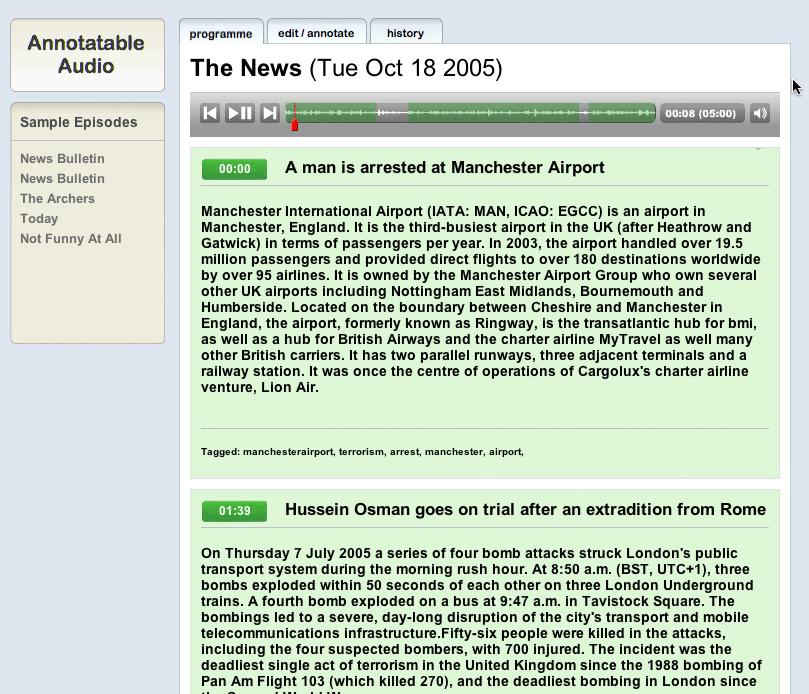
So here’s what we’ve come up with. First off, imagine yourself as a normal user coming to a page about a particular programme or speech. What you see is a simple interface for playing and scrubbing through the audio at the top of the page with marked ‘segments’ highlighted. If you hover over those segments they brighten up and display the title of that section. If you click on them, it starts the audio playing from that point. This correlates to the sections below which could be filled with any amount of wiki-style content – whether that be links or transcripts or background information or corrections or whatever. Beneath that are tags that users have added to describe the programme concerned. If you click on any of the segment permalinks to the left it starts the audio at that point and changes the URL to an internal anchor so you can throw around links to chunks of a programme or a speech. So basically you get a much richer and fuller experience of the audio that you’d get by just listening to it in a media player. Here’s a screen cap:
But it gets much more exciting when you actually delve a bit deeper. If you want to edit the information around a piece of audio, then just like on a wiki you just click on the ‘edit / annotate’ tab. This brings you up a screen like this:
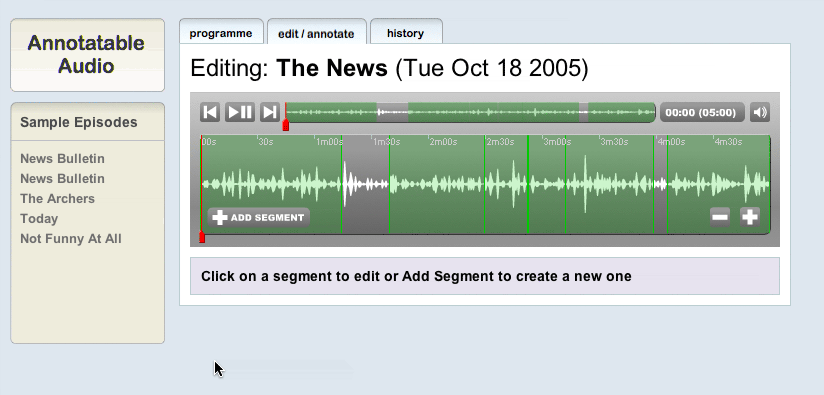
Here you can zoom into the wave form, scrub around it, and decide either to edit a segment or create a new segment. Once you’ve decided (in this walkthrough I decided to edit a pre-existing segment) you simply click on it, at which point the editing interface appears:
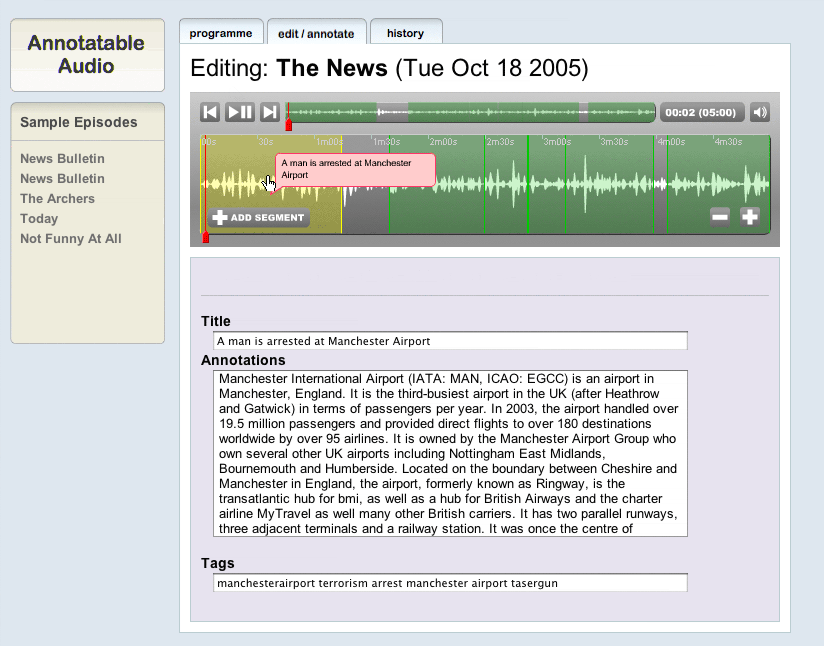
And on this screen you can change the beginning and end points of the audio by simply clicking and dragging, you can change the title to something more accurate, add any wiki-style content you wish to in the main text area and add or delete the existing fauxonomic metadata. If you want to delete a segment you can. If you need to keep digging around to explore the audio, you can do so. It’s all amazingly cool, and I’m incredibly proud of the team that made it.
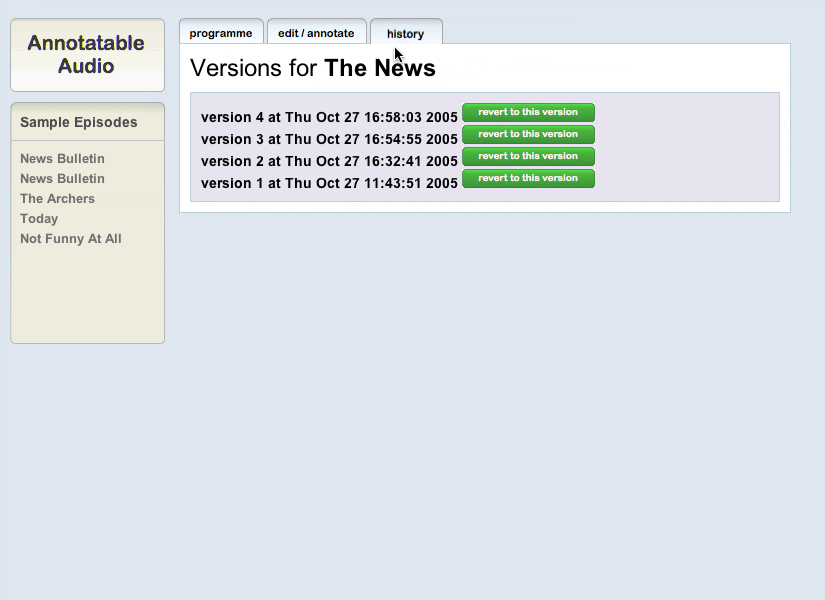
This final screen represents that last core aspect of wiki-like functionality – a history page that allows you to revert back to previous versions of the annotations if someone has defaced the current version:
So that’s the core parts of the project – a demonstration of a functional working interface for the annotation of audio that’s designed to allow the collective creation of useful metadata and wikipedia-like content around radio programmes or speeches or podcasts or pieces of music. If you’ve worked through the rest of this piece and managed to not watch the screencasts now, here are the links again – although be warned, they are a few Mb in size each. The first one shows the functionality of the playback page(8 Mb) and how people might use the information to navigate through audio. The second shows someone editing the page, editing a segment and adding a new segment (4 Mb), and it really shows off Chris Bowley‘s astonishing work on the Flash components and how it connects to Helen Crowe’s Ajaxy HTML.
As always with projects from the R&D team, the Annotatable Audio project is unlikely to be released to the public in its current form. We’re using it as a way of testing out some of these concepts and approaches – some of which will probably manifest in upcoming products in one way or another. In the meantime if you want to know more about the project or you’re inside the BBC and would like a play, then either leave a comment below or contact the awesome Tristan.Ferne {at the domain} bbc.co.uk who’s going to be running the project now I’ve left.
Anyway, I’d just like to take this final opportunity again to say thank you to the BBC and to all the people I’ve worked with to make cool stuff. It’s been a blast and I genuinely couldn’t be happier with the final project we worked on together. You guys rock. But now… Something new!
And just to give you the disclaimer one more time. The Annotatable Audio project was developed by Tom Coates, Tristan Ferne, Chris Bowley, Helen Crowe, Paul Clifford and Bronwyn Van Der Merwe. Although the project is a BBC project, all the speculation and theorising around the edges is my own and does not necessarily represent the opinion of my department or the BBC in general.
Yesterday I was awake for about nine hours of the twenty-four normally available to mortal men. Clearly I was catching up from something – I just wish I knew what it was. And today I’ve been cleaning and fiddling and getting my head together for my last four days at the BBC. With any luck I’ll be at a good zero point of ‘things to do’ by the time I leave, and I can spend the next week actually relaxing. That would be so wonderful.
In the meantime, the project my little team at the BBC is working on at the moment is so cool I could just burst with enthusiasm about it. It’s tiny but it’s awesome and I’m so into it right now. If anyone who was at Foo is out there who remembers the little project I talked about then, then we’ve got it working and it rocks. I hope we get it finished before I leave…

There’s a highly entertaining little story that’s getting everyone’s backs up in London at the moment that I suspect hasn’t really crossed the Atlantic yet, and might amuse a few people. But before I can tell you about it, I’ll have to fill in a little background. The Congestion Charge is a levy or toll imposed on anyone who drives a car in Central London. Cameras track every license plate that enters the middle of the city, checks them against a database of people who have paid (by text message, online or wherever), and if finds any absentee freeloaders joyriding around the city’s many traffic jams, it automatically dispatches a polite letter (and complementary fine) to the car owners / social reprobates in question.
The fascinating thing about the Congestion Charge is that there only seem to be two types of people who complain about it. The first group is the unfortunate shop-owner on the periphery of the zone. These are the people who would actually probably lose business through the changes. They have my sympathy. The other group are the – frankly – grotesquely rich, who insist on driving their cars through the centre because they’re too important and significant to use any form of public transport. Often Conservative politicians seem to fall into this camp, always somehow claiming that the common man of London is appalled by the charge, even though pretty much everyone in the Capital either uses buses, cabs or tubes – all of which benefit from the charge. No one I know in London has ever complained to me about it.
Now let’s get back to your scheduled programming. The latest group of people to have complained about the charge are no longer the super-rich or the political elite of London, but are instead the staff at the American embassy in London’s Grosvenor Square. Except they’ve gone one stage further. They’ve refused to pay it and are now operating as if it simply did not exist. It’s causing a bit of a diplomatic incident, as well as making quite a lot of British people grumble quietly to themselves, shift slightly in their Hush Puppies and gently waggle their hands at the television in vague dismay.
The contention of the US Embassy (and – to be fair – a selection of other equally uncivilised foreign powers, like the Germans) is that they cannot be legally required to pay the tax under the Vienna Convention on Diplomatic Relations and Optional Protocols which basically gives Diplomats such an extensive range of local law exemptions that from a distance they look like superheroes. The parts of the document you’re looking for, by the way, are articles 23, 28, 34, 36 and 37. My personal opinion is that they’re rather scuppered by the ‘services rendered’ bit of Article 36, but what do I know.
Anyway, the consequence of all this is that they’ve run up bills that could amount to £150,000 worth of fines, which they are – of course – refusing to pay. London’s local government agencies (and its Mayor – Ken Livingstone) are not terribly impressed…
The BBC News story on the fiasco quotes a US embassy spokesman who said, “We consider it a tax, and it is the view of the United States government that all direct taxes on diplomats and diplomatic operations, including this one, are prohibited by the Vienna Convention”. In response, the Mayor’s office has stated, “The congestion charge is not a tax. It is a charge for a service. All staff at the American embassy should pay the congestion charge, in the same way as British officials pay road tolls in the United States.”
Anyway, the whole thing is getting more and more entertaining. The Americans seem to be totally miscalculating the mood of Londoners on this one, who don’t seem at all inspired by their attempt to stick it to the man. And this was not helped by a leaked memo that they just read on Channel 4 News in which an embassy official said, “It is with significant personal pride that I can advise all mission staff that… all accredited US mission personnel are to cease paying the congestion charge as well as any subsequent fines or penalties”. Can I first say – wow! – someone leaked a memo for a story about the American Embassy and the Congestion Charge!? And secondly, I think I should probably also report that I don’t think the British news teams are taking this story particularly seriously – the memo was read in the worst American accent I’ve ever heard, and at times I could have sworn that the newsreader was about to burst into a fit of giggles.
So there we have it – war on the streets of London. And there’s nothing the British like more than a nice bureaucratic pot-boiler combined with a bit of culture clashing and grumpiness about uncouth people not pulling their weight. It’s the best news story I’ve followed in ages.
But what do you guys think? Should the visiting Americans pay their bills, or are they being held subject to a whole new set of taxations without representation? Bring it on, people – let’s get the whole thing right out in the open!
So changing the subject away from how great I am for just one minute because frankly it’s all a bit embarrassing, I’m watching the Daily Show on More 4 and suddenly – after a week – it’s gone all Global Edition and I’m crying ‘nooo’ at the screen – even more so when it starts with fragments of the previous week’s programming. WTF! And then three minutes in, pop, Phil Gyford appears dismayed in an IM window: “You watching the Daily Show? I’ve travelled back in time to last Monday…” Ooooh, More 4. You’re in trouble now… The European metropolitan liberal elite are angry!
Anyway, we can all relax, because apparently – with no flagging or whatsover on the TV – it’s only the Monday episode that’s the Global Edition recap of the previous week. The rest of the week it’s the proper one-day-delayed quality Jon Stewart goodness that we’ve come to love, with none of the partially-digested-for-non-Americans baby brain food that the Monday edition consists of. The online explanation:
“Recorded on weekday evenings before a New York audience, the show will be screened the following night in the UK. Monday’s UK show will feature a round up of the highlights from the previous week, while on Tuesday to Friday nights, the US show from the previous night will be broadcast.”
Quick tip for More 4 controllers – it’s less expensive to tell us first than to deal with all the complaints and queries and confused people ringing up and e-mailing and hanging outside your house burning effigies.
This is so not a proper post. I’m really sorry about the whole thing.