Categories
Random

Belaugh from the sky…

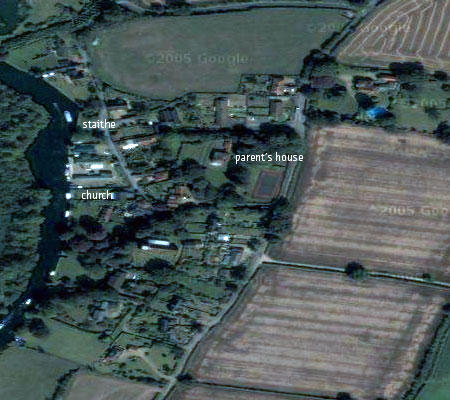
This may seem many months too late for other people to be interested, but I was roaming around Google Maps the other day and decided to try out their satellite imagery for the UK. Until a few days ago there had only been risable quality, super-long-distance photos of Britain – and if you zoomed in you got the standard grey squares that are more traditionally associated with sensitive parts of the US. Anyway, I typed in my parent’s postal code and came back with this startling image:

I’ve had to shrink it down a bit to get the full image to fit. You can see the original picture here though: Belaugh on Google Maps. Frankly, it’s stunning. I always knew that my parents’ village was situated in a little bend in the river. I’ve written about the village a couple of times in the past: Factfile: Belaugh, Norfolk is the best summary I’ve got. But I’ve never really been able to visualise it, and maps of the area are incredibly spotty and ill-focused. But suddenly I get to see the whole village from an entirely unexpected angle – I can see the farm nestled in the bend itself. I can see the ‘Unsuitable for Motors’ road and how secluded the village is – no one ever needs to drive through it on the way anywhere… And when I zoom in still further, I can see my parents house, and the river where I used to go canoeing and the church with the hidden passage. Yay, Google. Nostalgia, information, context and perspective – showing me things I never could have seen alone. Wow.

Categories
Conference Notes

Supernova '05: A round-up of Tuesday afternoon…

The talks that this post refers to occurred at Supernova 2005 on Tuesday 21st of June between midday and 4.30pm.

In the first post I wrote about my experiences at Supernova I expressed this opinion about the conference as a whole:

“I think by necessity this creates a kind of weirdly diverse conference that attracts radically different types of people whose relationship to each other isn’t always easy. So you’ve got the business people, the alpha geeks, the legislators, the military, the policy people and the academics talking about things from very different angles. Which means that any individual part of the audience is likely to be frustrated at some points, bored at other points and insanely fascinated for the rest of the time.”

I came to that conclusion during the first day of the conference proper and I think specifically because of the mixed experience I had of the event. The first interview had been pretty interesting, the panel that followed was good, but right in the middle of my area, so perhaps not ground-breaking. After that had come again the overly familiar: Chris Anderson on the Long Tail and then Jeff Weiner talking about Yahoo, which by that point in the conference had been by far the most interesting talk I’d heard. But around lunchtime, a very different group of people took to the stage for a few hours and for the most part I derived very little of value from their pieces. I want to repeat that I don’t think this is a consequence of poor public-speaking skills and I wouldn’t for one minute suggest that the subjects themselves were empircally uninteresting. But I will stand up and say that there were times when it felt to me like there were two concurrent conferences running at the same time – one which I enjoyed and occasionally loved and a completely different parallel one for a completely different class of human.

The talks, then, that I am going to skim through immensely quickly are pieces from Udi Manber representing A9, Hossein Eslambolchi representing AT&T, a panel on Voice over IP that featured Bill Schlough from the SF Giants, Peter Sisson from Teleo and Stuart Henshall from the Skype Journal. I’ll also touch on Kris Lichter’s piece on the Genographic Project – not because I didn’t derive value from it, but because I can’t think of anything particularly intelligent to say about it.

My notes from the A9 talk are extraordinarily brief. They read, “Search is hard. Why?”. I don’t know who I was addressing that question to specifically – perhaps myself, perhaps it was a transcription of a section of the presentation or perhaps I wanted to corner the guy concerned and ask him directly. But I think my major problem with the talk wasn’t with the talk at all, but with the product he was talking about. A9 is a profoundly puzzling venture that seems up front to be a patently ingenious way of helping people navigate for stuff, but which somehow falls down every time when I actually try and sit in front of it. I have the same problem with Yahoo – I just find it difficult and mind-threatening to deal with the busy pages. In Yahoo’s case that’s the homepage – a mire of complexity and horror that distracts me from whatever I’m trying to accomplish. In A9’s case, it’s the multi-columnar format. And when I see people proposing ways of adding to the numbers of columns you concurrently search – frankly, I tune out…

Hossein Eslambolchi, I’m afraid, probably wins my wooden spoon for worst presentation at a conference ever. And I’m prepared to stand up right now in front of the world and say that I know that I’m being unfair. Like several other papers delivered at ETech this year, it was absolutely clear that there was substantial value lurking somewhere under the surface, but the speed of communication, the language, the unspoken assumptions and the complexity of the slides made the whole thing entirely unfollowable. As a communications exercise it completely failed. And that means – unfortunately – that it became impossible to determine whether what he was saying made sense or was exciting or not.

The panel was substantially better in quality than either of its two preceeding talks. But from my perspective, conceptually at least, VoIP is a solved problem. What I’m waiting for is effective implementations – little more than that. Once that’s been done, then I guess the applications of incorporating speech into other areas (TV’s / software etc) make it worth reinvestigating, but I cannot articulate how uninteresting I find some of the core questions about regulation and hardware vs. software.

To be fair to the panel, however, two panellists did engage my attention. Bill Schlough talked about ubiquitous wireless internet access in the SF Giants ground – which I still don’t really understand the point of at this moment in time (but still fascinated me with possibilities). But it was Stewart Henshall who made the most substantial personal impression. He gestured at a couple of core issues which seemed to me to be about culture changes brought in by technology changes:

“I ask people two questions – ‘what’s your skype strategy?’ and ‘what’s your presence strategy?’ – Skype moves your use of voice from telephony to a kind of intercom where rather than closing a line down you just temporarily mute it. The social net reflects a revolution in the way that we use our tools. There’s always been a tension to use a communications technology to get things done, but now communications technologies are being used to connect, to create communities…”

The final talk I’m going to heavily abbreviate in this section was by Kris Lichter from IBM about the Genographic Project, a bold attempt to study migration patterns and movements of our distant ancestors, the first humans. There’s very little I can say about this, except that it was engaging and I would recommend that people explore it in more depth. The very brief notes from this part of the afternoon are captured here: supernova_tuesday.txt.

Categories
Random

Links for 2005-06-29

Categories
Conference Notes

Supernova '05: Jeff Weiner from Yahoo!

The talk that this piece refers to took place at Supernova 2005 on Tuesday 21st of June around 11.30am.

Now I think I can say with relative certainty that the Chris Anderson talk did not go down terribly well with the assembled backchannellers, who were for the most part regular conference-goers desperately looking for intellectual novelty beyond the stuff that they can read up about in weblogs. The whole weblogging culture has – in my opinion – pretty dramatically changed the conference dynamic. Now it’s not good enough for someone to stand up and talk about the same thing that they’ve been thinking about or doing for the last six months. Many of the audience will be more than familiar with the subject already. They’re going to be looking for novelty. I think this affected the reaction to Google at this year’s ETech a fair amount as well. Everyone had already seen Google Maps. Everyone had cooed over it and celebrated it and got all excited about it weeks before the conference itself. And so when it was presented as the big novelty in the auditorium, accusations of shark-jumping or just being dull flew around the place.

As I said in the previous post, just because people have been over-exposed to things or crave novelty doesn’t really mean that the talk is any less good or pertinent. It doesn’t mean that no progress has been made either (only that people are too flighty and unfocused and impatient to wait until the end of a presentation to find out what’s new).

Nonetheless, there is something specially gratifying about being presented with a talk that you didn’t expect and which actually makes you think in different directions. For me, the first talk that really did that at Supernova was by Jeff Weiner from Yahoo!

He presented an exercise in sizing the amount of knowledge in the world. He didn’t take it too seriously – it was just an attempt to articulate some scale. But it goes a bit like this. If you imagine a typical person and all the things they know about, they probably know a little something about an enormous range of things. There’s a lot of information stuck in their heads, one way or another, whether that be about the best places to eat or the best ways to clean a sink or the best bands of the 1990s or particle physics. If you include all the stuff they know about their family and their neighbourhood and their job then you could probably get someone to write a few sides of A4 paper about a few thousand topics. He postulated maybe 10 pages per subject on average with about 5000 subjects per person.

Now, ignoring overlap for the sake of convenience (and probably because we don’t really seem to generally worry about duplication online anyway), if you multiplied those 50,000 pages by the seven billion people in the world, you’d end up with hundreds of trillians of potential documents full of information. And how many do current search engines think are on the internet? Only eight billion. As a proportion of the total knowledge that we might be able to capture out of people’s heads, that’s a trivial number. Significantly less than one percent. This, says Jeff, is no larger than a rounding error…

This is where it got interesting for me – if there’s all that information in the world, then it’s the responsibility of an organisation like Yahoo! to get that information to the people who might want or need it. And to do that, they need to get people to actively participate. And here’s where he puts up the ‘vision statement’ and it’s even nicer than Google’s. It goes like this:

Enable people to find, use, share and expand all human knowledge

That emphasis on the creative aspect of knowledge – the fact that people make it and that an organisation could be there to help them and to make it easier for them to share it and even to employ it – really appealed to me. The only thing that subsequently spoiled it was when he revealed that you could make the acronym F.U.S.E. out of all the core parts of the enterprise. That was a lurch too far for me…

In terms of demo’s – the bit that stuck in my head but seems to be pretty invisible to most of the people around me was the My Web search interface. Fundamentally, this is no more or less than a tagless version of del.icio.us with one major difference – you can search through your bookmarked pages in full rather than just your tags and descriptions of them – and there’s the full expertise of Yahoo’s search engine to make that searching accurate. I wonder if if it’s too small a conceptual difference from the other bookmarking services to really gain conceptual currency, but it’s certainly more useful than many of them. It may get lost under folksonomies…

A couple of other minor notes from the backchannel around this particular talk – there was general derision for the F.U.S.E. acronym of course, but also considerable irritation about the use of an older woman (normally mother) as the stereotypical naive or relatively naive user. Moreover, there was a bit of a query about the tone of the piece which seemed really aggressive and a certain nervousness expressed for our much-loved colleagues at Flickr when Weiner mentioned their acquisition. Some form of collective intake of breath and tensing happened in that moment. I’ll be interested to know what it means…

As ever, there are more comprehensive notes about this session available, should you be interested: supernova_weiner.txt.

Categories
Conference Notes Radio & Music Television

Supernova '05: Chris Anderson on the Long Tail…

Quick apologies – my notes and write up of Supernova have been thrown out of whack by various unforeseeable pressures. I’m going to try and get through them very quickly now. This session was held last Tuesday at 11am.

It’s getting like it wouldn’t be a conference without a long tail somewhere in evidence and Supernova didn’t disappoint. The third main act of the first day of the conference proper finds us watching Chris Anderson working through his thesis in public again. He clearly knows his schtick pretty well by now, and that he knows how to present it. But this shouldn’t really be a shock – it’s been nine months since his first article on the subject appeared in Wired (The Long Tail) and he’s taken his core ideas and extended them across a number of conference appearances since then. I myself have had the pleasure to read the article and see him talk around it at least twice.

Of course, familiarity breeds contempt, and while it’s clear that he’s not standing still and that the thoughts are developing, the conference backchannel was not positive about the whole enterprise. The idea already seems dangerously close to over-exposure in the geek community – perhaps because of the weblog of the same name and the planned book on the subject that’s supposed to emerge from it. Apparently it’s now also become a fairly standard piece of rhetoric for people working their way around venture capitalists. No presentation, it seems, would be complete without it.

None of which is Anderson’s fault of course. For the few of you who aren’t familiar with the idea (and I suppose I have to believe that there are a few of you left) in a nutshell it is that – under certain new democratised and superfluid economic circumstances – there can be as much value (normally financial) in the enormous amount of unpopular, niche products as there is in the big ‘hits’. If you can:

  • Democratise the tools of production
  • Minimise the transaction costs of consumption
  • (and) Connect consumers to amplify word of mouth

… then you can turn a market where it’s only economically viable to sell things you know are going to be popular into one where costs are so low and consumers are so connected that the true revenue comes in the millions of people buying products that almost no one else is interested in. If you’re engaged but still confused at this stage, I suggest you read the article itself. The link again is: The Long Tail.

I’m not going to go into much more detail about the whole talk, but there was one particular area (or set of observations) that he made about TV and radio distribution that I should cover. He observed that television was the industry that was going to be most strongly affected by move to a long-tail philosophy because it was the industry with the highest ratio of produced content versus available content. That is to say – an enormous amount of television programming has been produced over the last sixty years or so, but at any given time an almost trivial percentage of that is available for people to consume. The desire of individuals to open up that back catalogue – he argued – was inevitably going to be completely industry transformative. This all seems perfectly reasonable to me.

In a previous session the day before (which unfortunately I’d missed) he talked in much more detail about the implications for radio along with Dave Goldberg (VP Music at Yahoo!), Jeremy Allaire (CEO of Brightcove) and David Hornik (August Capital). I got a by-the-blows account of the whole thing as it was happening from Nat Torkington which he subsequently wrote up for on the O’Reilly Radar weblog: Supernova 2005: Long Tail Panel. There was a particularly interesting summary of some of David Goldberg’s comments which I’ve quoted below:

Goldberg: They’re closing one rock radio station per week. Audiences for rock couldn’t get what they wanted from rock radio, now getting it from other places. Yahoo has a thesis: music will disappear from terrestrial radio within ten years. Don’t know implications for preferences, but will change way artists get invested in and marketed. Major record labels and movie studios have controlled distribution. When you take away that distribution, they have to be good at either marketing or investing. Right now they’re good at neither. All these things will change at the same time.

I can really recommend that anyone interested in the future of music and programming in general reads the rest of that summary. It’s extraordinarily interesting. But Beyond that, there’s very little for me to explore here in particular depth that my full rough notes won’t articulate more effectively. So I’ll move on…

Categories
Radio & Music

iTunes 4.9 is full of podcasts…

So iTunes 4.9 is out and includes all kinds of exciting support for podcasts. And with that support comes another way for you to get your greasy mitts on some of the stuff that the BBC has put out there so far for download – including interviews from Radio 4’s Today programme, Fighting Talk and In Business. At the moment – at least if you’re in the UK – the easiest way to find them is via the top podcasts box as featured in this image in Matt Jones photostream. US people will have to do a search, I’m afraid. But it’s worth it – if only for a regular dose of extraordinarily geek-friendly In Our Time.

Categories
Random

Links for 2005-06-28

Categories
Family

The letter from Traceline…

I’m back in London and after several hours of pottering around, I finally get the nerve to open the letter on my doorstep. I already knew the content of the letter, but nonetheless I’ve been circling it since lunch-time. Most important notes: they’re not sure this guy is my father, and I may have to wait months before I get any more information. On the other hand, assuming the guy is my father, that means he’s findable. One way or another, he’s findable and he’s out there. At which point, screw his personal preferences, I guess I move to a different kind of searching. I’m not going to give up at this stage…

Dear Mr Coates,

In response to your recent application, details have been traced which would appear to relate to the above-named person and we are prepared to write to him asking for permission to forward a letter from yourself.

Would you please now submit an open letter, together with a further non-refundable remittance of £25.00. Cheques should be made payable to ONS (please quote the reference number above with all correspondence). Please note, sealed letters will be opened for inspection.

Please do not include photographs or any personal items.

Given permission to do so, your letter will be passed on.

If however a negative response is received or, if at the end of three months there has been no response, your letter will be returned to you.

Yours sincerely, etc.

Categories
Random

Totally exhausted in San Francisco…

So I fly back from San Francisco today at the end of the weirdest holiday I’ve ever had in my life. I keep forgetting how many people I know out here. So enormous thanks to Leslie, Ben and Mena for housing me for a few days. Thanks to Nat Torkington, Cal Henderson, Ryan Carson, Kevin Werbach and Trevor F Smith for hooking me up with the nerds. Thanks to Heather, Lance for wandering around with me. And general waves to Jesse James Garrett, Jeff Veen, Dave Sifry, Ev Williams, Derek Powazek, Stewart Butterfield, John Poisson, Molly Wright Steenson, Ross Mayfield, Suw Charman, Kevin Marks, Leonard Lin, Anil Dash, Brad Fitzpatrick and all the other bloody millions of neat people I got to hang out with while I was out there. Mostly, I feel like I didn’t get anywhere near enough time to chat to you all – I’m particularly regretting the end of conversations with Jesse, Derek and Dave.

Anyway, on the flight back I’m hoping to catch up with the note-taking and the synthesis of all the stuff I’ve been up to, but probably the defining memory of the trip for me was getting to go to PARC. It’s a place I’ve read about so much and so many times and it was extraordinary to see it – however briefly – in person. So here’s my representative picture of the whole experience (you can see more on my Flickr photostream).

Categories
Random

Links for 2005-06-26