Categories
Random

A camera-phone retrospective…

Down the side of the sofa is the blue widget that connects my iBook to my phone. Since Vodafone or Sony Erickson or London’s weather or radioactive space emissions interfere so regularly with my ability to send picture messages, this blue widget is the only way I seem to be able to photos off my camera phone. Finding it down the side of the sofa, therefore, has suddenly unlocked my portable image stash.

For my thirty-first birthday, we hired a little chug boat from a place near my parent’s village. Rounding a corner we found ourselves looking directly at a wherry:

While I’m wandering around London, I often find myself taking snapshots of interesting bits of signage – bits of typography and design that trigger completely different reactions. It’s almost hard to believe that the stark and sombre marks on the Cenotaph were produced by the same frivolous elegant species that produced Art Nouveau. Here are five fragments of London signage:

And then there’s the pictures of people – oddly truncated, strangely cameo-shaped – like grunge passport photographs:

Categories
Random

I am not a tuber…

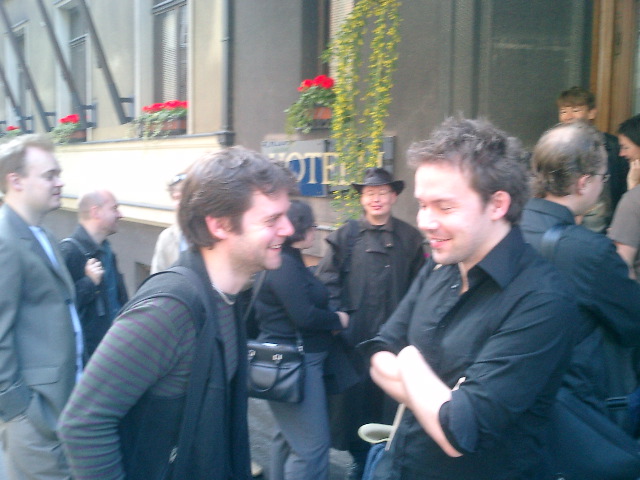
The only other thing that I really really feel is important to say about the Guardian article is that the photo they have decided to use alongside it makes me look – at best – like a total drooling inbred. It’s like they popped out into their country garden, got the largest, sweatiest tuber they could find, cut a few random shapes into it, poked it a few times with a ball-point pen and slapped my byline next to it! To compensate (and understanding of course that this in no way undermines my image of being a consumate professional) here are some happy pictures of me looking less gross:

Categories
Random

On Guardian "Second Sight"…

So there’s an article in today’s Guardian Online supplement that I wrote about weblog culture. I’m pretty happy with it – I think I managed to say most of what I wanted to say. I’m not sure it’ll convince anyone who isn’t already convinced, but it might start pushing the debate in a slightly different direction – away from “dumb vs. not dumb” and more towards “well we’re stuck with them, what do we do now“. I had to edit it down by a couple of hundred words to get in under the word limit, so if I get time I’ll stick up a full version at some point in the next few days. In the meantime, here’s a quick quote from Second Sight:

A future weblogging culture should be able to find counterpoints to arguments, to identify experts quickly and easily, and it should help good commentary bubble up effectively from new or low-trafficked sites. Mechanisms that help us know who to read, who to trust and who to ignore should be permeating the entire community invisibly and pervasively.

Categories
Random

Dumb links for a Thursday morning…

Safari is close to mental collapse. I have far too many “must write about this” links hovering perpetually in my multi-tabbed browser. Safari is not perfect. It will throw a strop if I don’t take some of the strain away. So you’ll have to guess for yourself what kinds of penetrating commentary I would have otherwise given these following (less than fresh) links:

  1. How to use hypnosis to bring out the best in your sex life
  2. Blog is a perfectly cromulent word
  3. On controlling your sleep (I do this too)
  4. Aggregators attack info overload
  5. Doctor slang is a dying art (cf. “Normal for Norfolk”)
  6. Eigenradio
Categories
Design Navigation Personal Publishing Social Software

On the 'one big site'-ness of weblogs…

Here’s a weird quote about weblogging: “I believe in my heart that people should come up with their own publishing methods. Frankly, it’s boring to surf the blogosphere and see so many sites using the same, tired weblogging tools. The same basic templates, the same ‘post a comment’ form, the same URL schemes! It’s almost as if they’re all small parts of one huge site.” (Adrian Holovaty).

So my immediate reaction is that the fact that there are a limited set of really popular weblogging systems has probably been a good thing, because it means there’s an active and widespread community large enough to be able to self-support, fully explore the boundaries of the software available and push for new functionality. But more importantly, there’s an element in which all weblogs are part of one huge site. And that’s only partly the sense in which all the web is basically one big hypertext entity in which all boundaries between sites are essentially arbitrarily – or culturally – enforced.

More specifically I mean that at that point where a weblog is pretty much balanced between personal publishing (micro-broadcasting or ‘one-to-some’ communication) and social software (something like a distributed discussion board) there are aspects of ‘one huge siteness’ in play – and that that’s precisely why they’re mostly working. We have a roughly common vocabulary about what an entry consists of, a set of structures about how a site works, and systems of trackback, permalinking and commenting that are pretty much interoperable (in one form or another).

I suppose if I wanted push an old comparison (that I never thought really worked) in a slightly different direction, then I’d say that weblogs needed to be ‘like one huge site’ to the same extent that a peer-to-peer network needs to consist of mostly coherent and standardised applications in order to do what it does. Maybe some of the newer responses to writing and interactions between people are demonstrating that ‘siteness’ (heimlich) and ‘unsiteness’ (unheimlich / other) aren’t categories with as much utility as we once thought – or at least that breaching or straddling them provides opportunities for new, powerful kinds of applications.

Categories
Personal Publishing

On "plogging"…

There seems to be a current obsession with the language of weblogging coursing through print. First things first we got Technobabble in The Times being all random, and now we have “ploggers” (from the Guardian’s Backbencher e-mail):

Readers who have yet to succumb to the blogging craze sweeping Westminster (© all leftwing thinktanks) should pay heed to the experience of Richard Allan (Lib Dem, Sheffield Hallam), a blogger – or “plogger”, as the political variety now seem to be known. Richard, who has announced his intention to stand down at the next election, was asked how it felt to be a “blogging elected representative”.

“My answer, based on my experience to date, is that a blog is like a dog,” Richard mused. “It needs a certain amount of care every day. This is time consuming and can feel like a bit of a drag when you are busy. But you know that without the regular walks and feeding then the dog/blog will become unhealthy. And for all that you occasionally moan about the demands of your faithful friend, you become so attached that you would not enjoy life without half so much without it.”

I can’t quite figure the whole thing out. I mean firstly, no one seems to like the word ‘blog’ anyway except the press. Everyone else seems to find it really ugly or vaguely stupid. Movable Type no longer use it at all, and various long-term luminaries have publically regretted ever hearing or using the word in the first place. And as to all these other neologisms… I just don’t get why the press gets all excited about all those little bits of shorthand – they’re (at best) only tongue-in-cheek. Very few people take them in any way seriously. I’m finding it increasingly difficult to tell whether these journalists are in on the joke or whether they’re just looking for something easy to take pot-shots at…

Categories
Net Culture Politics

Tories would close BBC website…

I’m going to just report this without much in the way of comment while I try and work out what my professional relationship with the BBC means about my ability to give my personal opinion about things like this: Tories would close BBC website.

The Conservative party would switch off a swath of the BBC’s digital services, including its website and the youth channel BBC3, if it won the next general election.

The party’s culture spokesman, John Whittingdale, told Guardian Unlimited Politics he was “not persuaded” of the case for a public service website and that he was “not convinced the BBC needs to do all the things it is doing at the present”, including providing “more and more channels”.

“As a free-market Conservative, I will only support a nationalised industry if I’m persuaded that that is the only way to do it and if it were not nationalised it would not happen.”

Mr Whittingdale’s comments will be seen within the BBC as a glimpse of what it can expect from the Tories’ review of the corporation. The party launched the review, chaired by the outspoken former chief executive of Channel Five, David Elstein, earlier this year.

[He continued] “…I am not persuaded that there is necessarily a case for a public service website. I’m not persuaded that anything on the BBC site could not be provided elsewhere, [for instance] the newspapers are mostly providing sites, which provide news and comment.

“They [the newspaper sites] are essentially trying to provide for the same market and therefore you can argue why does the licence fee payers need to be financing the BBC to do it when there are other commercial organisations who are doing the same thing.”

I’m just going to leave this one open to general opinion, I think. If you’ve got any thoughts or comments, then leave them below…

Categories
Random

The OED's draft definition of a weblog…

The Oxford English Dictionary’s draft definition of ‘weblog’ from March 2003: “A frequently updated web site consisting of personal observations, excerpts from other sources, etc., typically run by a single person, and usually with hyperlinks to other sites; an online journal or diary.”

Categories
Random

Hal Hartley on Quality…

Here are a couple of good (brief) quotes from Hal Hartley – who is one of my favourite directors. These quotes were found on Way Down Here:

There’s a right way and a wrong way to do things. If you make a chair, you want to make a nice chair. You want people to admire it. I think doing something well is a form of respect for humanity in general.

Depending on what’s happening in my life at a given time, I aspire towards solitude. Your stupidity quotient is obviously lower when you’re by yourself.

Categories
Design Social Software

The Ugly Wiki (Part Two)

A few months ago a conversation emerged across the net about whether or not wikis were ugly (see also Many to Many) (and moreover whether the fact that they was ugly affected how useful they were). Obviously, the whole issue was rife with debate about whether the simple design of wikis was simply nasty or whether it was actually just more useful and appropriate to have something stripped down to the bone.

Anyway, over the last few weeks the team that Matt and I work with has been trying to put together a wiki for our intranet. I think they’ve demonstrated that maybe there are ways of keeping both camps content – simple, adaptable Wiki designs can be made that are also elegant and attractive. First things first – here’s a quick thumbnail of Kate Rogers’ design for the page (apologies for the blue border – it’s a standard plasticbag.org thing).

I’m not sure that having the image reduced to that size necessarily does the design justice, so here are two screen-shots of the site at different screen-widths. The whole thing’s been recoded in (mostl) compliant HTML and CSS, so it’s also quite flexible:

Matt and I haven’t had that much to do with the getting the Wiki together – it was a project that existed before we got here – but we’ve had a couple of minor opportunities to help out and the whole process has been really interesting. I think most of all we’ve learned a lot about how Wikis should be rolled out to groups of people who aren’t really familiar with them – in particular the importance of transmitting the culture and the ethos. It’s still a bit of a work in progress, but it’s looking increasingly like it’s actually going to work…

But before I say any more about rolling out Wikis, major kudos to Paul Clifford and Joss Burnett – when we arrived in the department they were experimenting with Zope as a substrate for the intranet, and had put Zwiki in place for the wiki. But when we actually came to working through Zwiki’s rules for text-formatting, we were all a bit startled – they were extraordinarily arcane and complex. So we researched the problem a bit and looked at various kinds of wiki mark-up and discovered that there was not only a massive variety of them, but also that many of them operated on completely different principles from one another.

After considerable examination, we decided that MoinMoin‘s parsing was probably the most effective and useful for our purposes, because – even though I don’t think they’re as simple as Usemod – it’s powerful and has a relatively shallow learning curve. At which point Paul and Joss spent considerable time and effort building a highly effective MoinMoin parser for Zwiki – giving us all the benefits of Zope with a Wiki that is actually simple enough for non-technical members of the department to use. General consensus here is – that if we are able – we’re going to throw all this stuff (design and code) straight back out into the public sphere for people to work with and play with… More news on that as we have it…

Coming soon… The Ugly Wiki (Part Three)