Categories
Random

Apple keynote time…

So I got the first block of my thoughts around media hubs out of the way before the Apple keynote, so that’s good. I’m happy about that. For anyone who’s interested, we’re all ‘watching’ it via IRC on irc.apple-x.net and via the low-bandwidth stealth reporter at macrumors.com. Ping me on IM as well if you want to joint the tiny UK coterie of freaky geekniks who are dribbling at the thought of yet another glorious keynote. Vive le Steve!

Categories
Technology Television

A really rough proposal for an Apple Media Hub (Illustrations)

This part is mostly about: Illustrations of what an Apple Media Hub might look like and how it might function. If you have not done so already, you should first go and read Part One and Part Two which do not contain pictures anywhere near as pretty and are harder work to read.

What follows are illustrations of my basic concept here – a brushed metal, almost featureless box that sits underneath a television acting as wifi hub bringing internet access and local area network functionality into the home – and providing as a basic first feature set (1) the assisted capture of video from the TV or from CDs, (2) the watching of DVDs and (3) the remote-controlled play of media across multiple devices through local hubs. You can download the full diagram from here: Full Apple Media Hub Montage, or you can just peer menacingly at the details below:

Categories
Technology Television

A really rough proposal for an Apple Media Hub (Part Two)

This part is mostly about: How to get a device into people’s homes that opens up these markets and these possibilities and lets people do more stuff with their stuff. If you have not done so already, you should first go and read Part One.

So from now on, I’m going to talk a lot about what I think specifically Apple should do because I think they’re the best placed in the world to do this stuff right now. Their brand isn’t as geeky as Microsoft – and they’re have already demonstrated that people will buy entertainment technology from them (the iPod) even though they’ve traditionally been better known for their computers. Companies like Tivo – at least at the moment – are too narrowly focused on one form of digital media to really be able to mount that much of a challenge in this area (and I think they’re probably more than aware of that by the way that they’ve started to work more with Microsoft. Sony would also be a good condender in this area if they weren’t busy trying to develop new types of smart guns with which they can shoot themselves in the foot with startling new levels of efficiency.

One of the big questions that we’re going to come up against in thinking through the home media hub will be how do we get people to buy the devices we’re talking about. Not all new technologies gel with consumers immediately. One technique for getting new tech into people’s homes is to combine or hybridise it with existing equipment. Many people had their first DVD player as a pleasant side-effect of buying a Playstation or Xbox. The Xbox also allowed people to rip songs to its internal hard disk – functionality that I doubt many people would have gone out and directly bought at that stage. And Playstations with built-in PVRs have been mooted for a while now. Hybridisation seems to be an almost natural process when it comes to the handling of media – potentially because the web-like models and increasing mobility and granularity of media objects that we’re moving toward is turning out to be similar for video, web pages, songs, photographs… So hybridisation is likely to be an answer – but hybridisation with what?

So the obvious bits of existing technology that our future home media hub will need to be able to hook into with are:

  • The internet – for the purchasing of on-demand video and music, and to have a return path for data
  • TV – for video playback and rich visual interfaces for stuff
  • Audio equipment / Stereos etc – for the playing of downloaded or ripped music
  • Home computers etc, that may wish to manipulate or handle media artifactrs in some richer way

What hardware / functionality does this imply?

  • Obviously the first piece of implied functionality that any hub has is a large amount of digital storage and some way of navigating around the material stored upon it.
  • If we want this device to have mass appeal then it has to be something that you could sell – or rent as part of a service package – to people who don’t yet have internet access (or don’t even have a computer). One clear way to do this would be to disaggregate internet access from the computer, and instead place some form of cable or ADSL modem within the media hub itself. This would seem to me to be the most reasonable approach.
  • In order to distribute that internet access to other devices, the simplest solution would seem to be to fit the device with a wifi hub. This immediately creates the potential for a local area network of connected devices streaming and connected to one another without the complexities of setting up dedicated routers. In principle then small Airport-Express style local hubs could be distributed next to other devices in the home that do not yet have home local area network functionality built into them. This could also distribute the internet access throughout a home in the most effective way.
  • If there are going to be any cabled connections then it would make sense to have them be between the device and the equipment with which it is likely to communicate the most possible data. This may very well be a local computer or laptop for some people, but for most – with video files being so enormous, it makes most sense for the device to be attached to the home television.
  • And in order to be a useful device for storing or playing digital music, then – if again we assume that we’re marketing to people who may not have a computer already – then we have to consider putting some kind of CD-playing or ripping functionality into the device itself.
  • This has another advantage, because if we’re considering putting in a CD slot, then there seems little reason why the same slot should not be usable for DVDs. This would then immediately increase the value of the device for people – particularly given that we’re already assuming that it’s going to be connected to the television in some way.
  • And given that we’re talking about handling large files and connecting to a television – PVR functionality seems like a natural fit.

So far then, we have a box (and not yet a desperately inexpensive one) that should be connected to a television, has a large hard-disk within it that can contain video and audio and has a slot for inserting DVDs or CDs. This is essentially then, a cut-down monitor-less iMac – for those of you who have been paying attention. Clearly you’d want to to create non-OSX-style interfaces since people are likely to want to use the device via a remote control of some kind, but if such a device has been mooted for around $500 (by Mac rumour-mongers), then it’s not inconceivable that you could bring something to market that people would be interested in buying.

In fact, if you look at devices that are already on the market, there are some that are not a million miles away from this model already. Two particular devices are already available that attach to a computer, have large hard disks, have some wired connections via the telephone or ADSL – and one of them already allows the ripping of music. On the one hand we have the dedicated PVR and on the other the dedicated gaming platform.

In order then to get this new device into people’s homes you could either:

  1. Further develop the entertainment features of gaming consoles, making them into full media hubs for the home.
  2. Further develop the connectivity and cross-media functionality of the PVR to a similar effect.

Marketing our partially mooted speculative device as an extension of a gaming console has some clear advantages – there’s already a decent amount of money to be made from gaming, the people who use them are keen consumers of new technology and much of the functionality is already in place. If I were Microsoft of Sony I would be moving in these directions. But I think I’d also be looking for a model that would appeal to a wider market than gamers. For many the gaming elements of a hybrid device could be a turn-off.

PVRs are similarly strong in some areas, but they haven’t yet set the world on fire. The consensus opinion appears to be that the main problem is that it is hard to articulate to people what a PVR does. Once people have bought one, they generally find them a delight to use. In which case a company like Apple that has little chance of being able to bring a successful gaming console to market is still in with a chance. It’s not necessarily terribly hard to evolve the concept of the PVR into a cross-media device, for watching and recording TV, watching DVDs and streaming music around a home. And once you’ve turned it into a media manager, then all Apple would have to do is make reference to their other successful piece of navigational technology:

DVD Player, iTunes at Home, PVR – it’s the iPod for everything else

At this point you should have a bit of a sense of the direction I’d be going with this stuff, so I’ll move on to putting up some illustrations of the concept and trying to articulate precisely how I think it should work…

Categories
Technology Television

A really rough proposal for an Apple Media Hub (Part One)

This part is mostly about: The drive towards digital media in the home, and changes in the media creation and distribution ecology:

So I’m going to write this quickly because it’s been stuck in my head for months, and even when I’ve dedicated large chunks of my weekend to trying to get it down, it hasn’t gone terribly well. So my assumption is – find a place to start. Run at it like a mad thing. Don’t worry too much if it’s really dense or confusing, or childishly stupid in places or really badly written or wanders off the mark. Just get it out in the open with all the pretty pictures and stuff you’ve been thinking about before you go insane.

The starting point is an assumption. It’s that we’re looking for better connection between our entertainment devices and our computers, and that we’re increasingly looking towards fully digitally-distributed entertainment media in all parts of our lives. Fundamentally I’m looking at what kind of future home-entertainment-based, digital media playing and manipulating Digital Hub should we be aspiring towards?

The other assumption is that there are companies out there who are interested in working in this space. I think this is demonstrable by looking at the people already in the environment – companies like Sky, Tivo, Apple, Microsoft etc. Again – not a huge assumption to be making.

One of the reasons that companies are interested in this space is because we’re finally reaching the point where home entertainment electronics are converging with computer technologies and the internet. A whole generation of web users are circumventing traditional media distribution channels to get hold of their television programming, films and music. The people who make these things are now looking to go back on the initiative and bring greater functionality – functionality under their control – back to the people.

In the meantime, the companies that make technology and software have clearly realised that there’s money to be made in meeting these needs and so are developing technologies at a fair rate of knots. One way to think about this is to think about the number of desktop and laptop computers in the world and then to think about the number of televisions, VCRs and standalone DVD players in the world. Now imagine that you’ve cornered the market for the operating systems for all these devices. For Microsoft – that’s got to be an insanely attractive proposition. You add to that some attempts to help mediate between content producers and people who watch and view content – DRM, for example – and you start to look indispensible to the ecology. And that’s kind of a license to print money – particularly if (like Apple) you’re also trying to make your service the definitive place to buy the media products themselves…

You could take this still further. Traditional broadcasters have had it pretty easy. They had regulated but basically pretty neutral carriers that they paid cash money to. Then they got to broadcast a set of TV and radio programmes when made most sense to them, and marketed against the relatively limited number of other networks who constituted their competitors. The explosion of TV stations made that situation a bit more tenuous, but that’s nothing compared to the enormous changes that are coming up. Given that there’s value in the long tail, and that programmes are increasingly time-shifted and watched at the audience’s convenience, we can predict with some increasing accuracy that we are approaching a time of addressable and permanently online programming, downloaded or streams or distributed on-demand.

Basically this is broadcast media becoming more like the web. And when you have a web-like ecology of programming out there, then you need mechanisms for finding programming. The mediators in this environment have tremendous power – they can build collaborative filtering mechanisms or page-rank mechanisms or whatever to move you from one type of media product to another. They can sell advertising on their services to direct you to one type of media rather than another. On the web these mediators are in competition with one another – search engine versus search engine, e-commerce venture versus e-commerce venture. But if these mediation mechanisms are built into the very hardware you’re using, then you essentially have some form of lock-in. This is why – in my opinion – it’s really really good for Sky that they control the EPGs on their platform and the PVR functionality, but less good for the BBC.

In a nutshell, early adopter consumers are working around the current short-falls in entertainment technology, and that suggests that there’s a market for new and better media-handling devices. And there’s a hell of a lot of money and power to be made in this environment too – both in terms of directly making cash from licensing software and selling appliances, but also in terms of controlling and influencing the interface between consumers and the media they might want to consume.

Now read Part Two: How to get a device into people’s homes that opens up these markets and these possibilities and lets people do more stuff with their stuff.

Categories
Random

Links for 2005-01-11

Categories
Random

On forcing oneself to do stuff…

So I’ve been thinking about the term to ‘force yourself to do something’ and kind of reeling at the absurdity of it all. I mean how can you force yourself to do something? Somewhere in your head you have one version of yourself pushing another version of yourself to do something they don’t want to do? Presumably kicking and screaming? But they’re both you, right? Not just the one that’s doing the forcing, but also the one being forced. So you might as well say that you were, “trying to resist forcing yourself to do something”. That would be equally bunk, right? I mean it would make as much sense, and realistically is a feeling I’m more familiar with.

So both the forced and the forcer ‘you’ are component parts of you. You can’t just identify with one of them. Which makes me think a bit about free will and which parts of the mind are genetically encoded and whether the part of the brain that needs to be forced is somehow being characterised as base matter – like we used to think of the body as being – with the forcer being our animating spark of divine will trying to get the corpse-like flesh of the body moving in a useful direction – the lightning to our Frankenstein’s monster of lethargy? Wow, that was a long sentence.

So basically saying that you had to force yourself to do something is a bit like saying that a rock is in constant battle with itself about whether to sit there or whether to get up and go for a walk. I mean, realistically it just stays where it’s put because that’s what it does. Whether you do things or not isn’t about internal conflict, it’s surely just about following your dictates – either dictates to animate yourself or dictates not to do so.

So why does it sometimes seem such a bloody enormous battle to convince oneself to even start doing a piece of work? What kind of stupid fucking evolutionary process ends up with procrastination, paralysis and apparent indolence? I mean, what kind of creature does well in the world by sitting at home in front of a computer for three hours in the early evening trying to motivate itself to write something about set-top boxes?! Where’s the reproductive advantage there?!

Stupid bloody world that should make me be this way and then make me neurotic about it.

Categories
Random

Links for 2005-01-10

Categories
Random

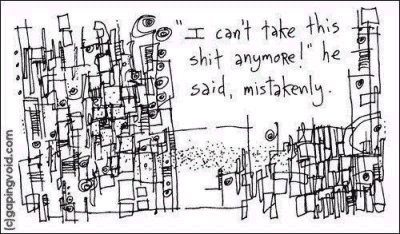
A quick cartoon from Hugh MacLeod…

Given my Zen-like state of calm today, this is potentially not the kind of thing I should be posting on my site in full view of my boss (hey dude). But it’s funny and it reminds me of a couple of weird working times in my life and the middle of one particularly appalling break-up and anyway, I’m still trying to procrastinate around writing up the Apple piece. Again. Sigh.

This is all inspired and illustrated by the book outline of How to be Creative by Hugh MacLeod, that I’ve just been reading about (again) over at his site. Early 30s people sure are a grouchy, disillusioned, stroppy, self-important and cynical bunch of bastards, aren’t they!

PS. Be warned, the linklog today is bloody enormous. It’s going to arrive around midnight with the force of a small atomic device. If you actually read any of the links I post, set aside a good hour tomorrow to work your way through them. Or just mark the damn thing as read in your RSS reader and skip on to something more useful.

Categories
Family

On writing to my father?

I’m still trying to get the Apple piece together into some kind of useful form which of course means that my mind keeps wandering and I keep writing other stuff instead. In a way, I’m quite enjoying it. Somehow it feels easier to write right now than at any time for the last several months. It’s really cathartic.

Well anyway, all of this preamble is kind of just here to stick some kind of frivolous emotional padding around one of the bigger things that is going on in my head at the moment. I hadn’t really decided whether or not I was going to talk about it online – indeed, I’ve only really mentioned it to about three people in the real world so far. And that includes no members of my family. But somehow the time is right and I want to make it slightly more real, so here we go.

Those of you who have been reading this site for a while might be vaguely familiar with the whole biological father narrative that I touch on very very infrequently, but the story in a nutshell is that I haven’t seen him or communicated with him since I was four or five. I’ve written about it more here:

So there’s the context… Now, a couple of days ago I was going through some old e-mail and came across a note from someone who mentioned a service you could use to search through the electoral roll. So on the spur of the moment I did a search on the site for my biological father’s name. I came up with about 18 candidates either called “Tom Coates”, or “Thomas J Coates”. And clearly because I was high on Getting Things Done or getting impatient with work or something, I just decided to write all of these potential fathers a letter straight away and send it out. So I wrote a letter that read very bluntly and strangely – like something that an a totally emotionally stunted person might write when his cat died or something. I guess it was pretty matter of fact. It just basically said that I was looking for some kind of limited contact with my father – just to know really whether he was alive or dead and to know some small amount about him – but that I wasn’t sure that I was looking for any kind of emotional committment or ongoing relationship or anything. I asked the recipient of the letter to pass on any information they might have, and – if they were my father – to please send some form of limited response. A few lines in a letter explaining what he was up to now and a photo would do very nicely.

So the thing about sending all these letters out is that I did it on the spur of the moment after almost thirty years and to be honest, each day I go into work I completely forget that I’ve done it. My brain’s always a complete blank – it’s thinking about Amazon or weblogs or home entertainment appliances or what happened on Alias last night. At least it is until someone around me gets some post. Then I start thinking about whether I’ll have got a reply of some kind and what kind of reply it might be. But the rest of the time, the whole thing seems like something someone else did. That’s why I thought I might write about it online. I thought maybe it would make it stick in my head better, make it more real. Maybe it won’t. Who knows.

Since I’ve started the whole palaver, I may as well carry it forward. If anyone out there knows a man called Tom Coates who worked for Honeywell computers in the 1970s who is in his early sixties – or indeed if you are this person – if you could send me even the most limited amount of information you might have that would be really good. I guess at this moment in time, I just want to know for sure whether or not my father is alive. No more than that. That’s about it. Hm.

This whole thing is all very strange and I don’t really know what I think about it. I’m certainly not looking for sympathy and I’m not trying to make a big drama about anything. This isn’t about some epic voyage of personal discovery, it’s about the pragmatics of the future. I’m 32 now. My father is likely to be 63. If I wanted to know something about him in ten years time, then it’s quite conceivable that it would be too late. It might be too late now. And while I don’t really know that the whole issue preys on my mind too much now, maybe it will later.

PS. You always write these things thinking they’re going to be so simple and easy and clean and then you get to the end and what you’ve got is a bloody disorganised mess of words slapped onto a page. I’m keeping the comments closed on this post because on previous occasions in the past I’ve had people gaming them – writing supposed comments from my father that I can’t substantiate. This does nothing but make me feel worse about the whole thing. If you want to contact me directly, the e-mail address remains the same – tom [at] plasticbag [dot] org. If you want to forward the post to anyone who might have worked at Honeywell or ICL, then that would be great. But please – don’t take the piss.

Categories
Random

A brief aside on Jerry Springer the Opera…

So I watched Jerry Springer The Opera last night on BBC2. It was pretty rude, pretty funny and had an interesting and surprisingly sophisticated philosophical outlook. I’m delighted that we live in a country where such things are broadcastable and I can’t really see why anyone would have had such a problem with it that they would have try and have it banned – particularly given the almost grotesque amounts of warnings that were placed around the show to try and avoid offending people. This was much less bizarre or troubling television than – say – the live Autopsy that was on Channel 4 a while back, or Derren Brown playing Russian Roulette.

The response around the net has been interesting and varied. Here’s a brief selection of some of the most interesting comments I’ve read on the subject:

Martin also mentions the BBC’s Points of View Messageboard where there’s been a lot of debate about the show – most of the comments that I’ve read at least have been highly supportive:

I should point out again that I’m also delighted that we live in a country where people are free to protest against things like Jerry Springer as well, and I understand that there is a complexity here about what is appropriate or innappropriate to broadcast. Certainly I’ve complained in the past to the BBC about things I think are unfair or dangerous or damaging. Sometimes I think the complexities of BBC policy on this stuff aren’t known to people outside the organisation. If you’re interested in knowing what the BBC thinks is appropriate or innapropriate (and what it judges itself against), then I can heartily recommend reading The Producer Guidelines which are well-polished and thorough.